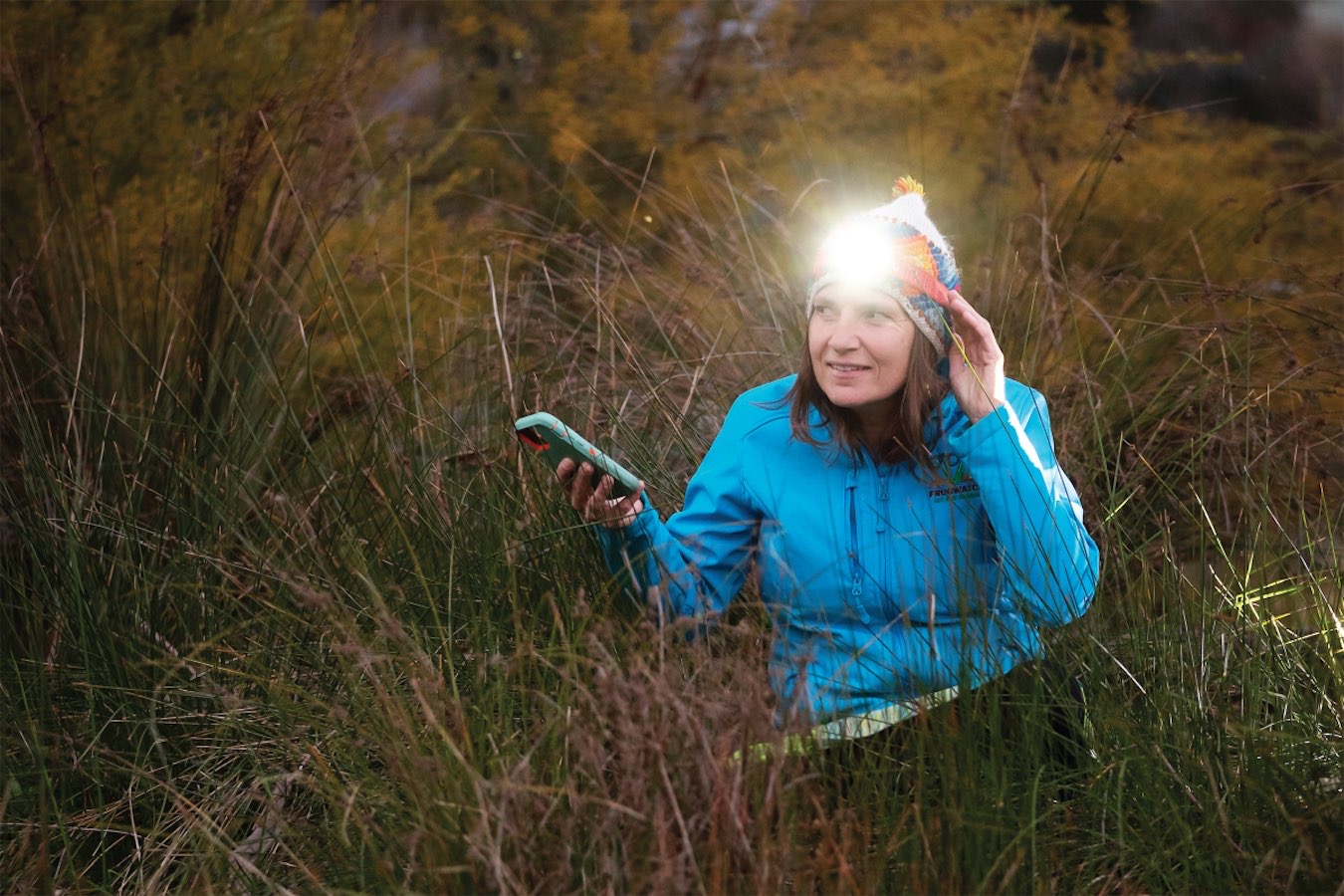
Canberra’s frog saviour Anke Maria Hoefer has picked up a national Landcare award for her work bringing the green and golden bell frog back from extinction, reports DHWANI PATHAK.
A community-led project using saunas and salty spas to bring the green and golden bell frog back from local extinction has just won the Australian Government Landcare Innovation Award.
The award recognises the volunteers behind the Green and Golden Bell Frog Reintroduction Project. The ACT winners will now go on to represent the territory at the National Awards in September 2027.
Anke Maria Hoefer, who has spent 16 years turning frog science into a community movement as co-ordinator of ACT and Region Frogwatch, says the recognition means more than a pat on the back.
“The award is a fantastic recognition of what can be achieved,” she says. “It’s also a reminder of what is at stake.”
That stake is real.
The green and golden bell frog has disappeared from much of the region, with the deadly chytrid fungus playing a major role in its decline. Now, an unusual combination of frog “saunas”, salty ponds, night surveys and community volunteers is being used to help bring the species back.
They found that some of these sites had higher levels of salinity or metals. Laboratory work then showed the chytrid fungus does not cope well with salty conditions, while the frogs can tolerate them better.
The challenge was how to recreate those conditions without changing entire wetlands.
The answer was the frog sauna.
Built from black-painted bricks stacked in a small pyramid, the saunas can reach 28C degrees inside even in Canberra’s cold winters, warmth that helps frogs shed the chytrid fungus. Nearby, small satellite ponds of slightly salty water offer another way to reduce their exposure.
But building the structures across Canberra’s wetlands was a huge job.
Across 15 wetlands in the Canberra region, volunteers have dug 60 salty ponds and built 180 frog saunas. That meant moving and painting 1080 besser blocks and 2700 bricks, and planting more than 1300 plants.
“Canberra soil is very, very hard and very clay,” she says. “So lots of oomph needed there.”

Hoefer came to the project through FrogWatch, the citizen science program she has run since 2011 for the Ginninderra Catchment Group, where hundreds of volunteers head into Canberra’s wetlands after dark each year to listen for frogs and record what they find.
The numbers are large.
“I’m the conduit between the science and all the stakeholders that want the data, between uni and the volunteers,” she says.
And there are signs the experiment is working.
Scientists first tested the structures with local frogs before introducing the precious green and golden bell frogs. The frogs used the salty ponds, and captive green and golden bell frogs were later introduced as part of the project.
The results have been measurable. Frogs released into the saunas and spas have bred successfully in the wild, and tadpoles have grown into froglets. Some frogs are microchipped and turn up in a hand search or under a metal detector.
Volunteers are now watching closely to see whether the frogs survive winter and continue using the saunas and ponds.
“They’re doing so well,” she says. “This looks funny, but this work could revolutionise amphibian recovery efforts worldwide.”
The award also lands at a hard moment. Frogwatch depends on the Ginninderra Catchment Group, and that funding is not guaranteed.
Recognition like this, she says, is a way of making sure the work is not taken for granted.
Hoefer also runs the Tadpole Kits for School program, sending live tadpoles into ACT classrooms so children can raise and release them. Teachers write back every year.
An 11-year-old recently emailed asking to join Frogwatch training. “I talked my mum into it,” he wrote. “When can I come to the training because I can’t wait. I love frogs.”
Hoefer trained originally as a nurse in Germany, then studied physiology and behavioural ecology before moving to Australia. Frogs were not part of the plan.
“I had never worked with frogs before. When this job came up, I was like, this is so me, because I love community engagement,” she says.
It is giving Canberra’s community a role in bringing back a species that was once thought to be part of its everyday landscape.
“I always thought, if I can see in my lifetime the green and golden bell frog coming back to the ACT, that would be some mission accomplished,” she says.
And, as Maria puts it, “people love frogs. Frogs are exciting.”
News all day, every day at CityNewsQBN.com.au.



Leave a Reply