“It was revealed that across the three financial years leading to 2025-26 the government spent almost $130 million on medical negligence claims.” But that’s not all, reports political columnist MICHAEL MOORE, there are millions lost to ACT Government incompetence every year.
The most recent example of the incompetence of the ACT Government is a payment of $100,000 for inappropriate treatment of a woman in custodial care.

However, it is but a drop in the bucket compared to more than $60 million paid out by our government in damages, settlements and legal costs.
Independent MLA Thomas Emerson used the ACT Legislative Assembly Estimates Committee process effectively by exposing the amount of money spent in compensation.
He argues money spent on damages, settlements and legal costs regularly occur following incompetence on the part of government officers.
The lead-up to the strip search of Julianne Williams was captured on the prison’s CCTV and guards’ body-worn camera footage. According to Justice Verity McWilliam, who listened to the arguments, “the use of force by officers was incompatible with Ms Williams’ human right to humane and appropriate treatment”.
This is just one example that demonstrates why the government has had to fork out taxpayers’ money when there is incompetence.
In Ms Williams’ case, the government agreed with her for an out-of-court settlement of the $100,000 as well as expenses incurred thus far. At least this will save a significant amount in further legal fees.
The compensation is not just about the individual involved. It is about increasing competence into the future. As Ms Williams’ statement of claim showed, she was seeking compensatory damages intended to act to both rectify the pain caused and to deter the territory from similar behaviour in the future.
In this example, the deterrent effect worked. ACT Corrective Services said the Alexander Maconochie Centre had removed mandatory strip searches from its procedures in 2022 and introduced body scanners in 2023. Strip searches reduced from 4000 in the years 2020 and 2021 to just 580 such searches in 2024.
Strip searches do have a place in custodial settings. However, they ought to be conducted as rarely as possible and in an appropriate manner.
The responses to Mr Emerson’s questions-on-notice in the Estimates Committee process did not reflect on individual cases. However, it was revealed that across the three financial years leading to 2025-26 the government also spent almost $130 million on medical negligence claims.
As with the case of Ms Williams, those making the claims are regularly seeking compensation to rectify the pain caused and to deter the territory from similar behaviour in the future.
In response to a barb thrown by government ministers to non-executive members regarding fiscal responsibility, Mr Emerson fired back with this demonstration of avoidable government expenditure.
He agreed that “while not every lawsuit is avoidable, the ACT Government should be closely investigating the impact of its growing legal bill on the territory’s finances. This is a clear avenue for the government to improve its fiscal sustainability”.
Mr Emerson also used footpaths as just one example to demonstrate the point.
“Expenditure on footpath-related personal injury claims in 2025-26 was over $2.77 million, which equates to 38 per cent of what the ACT Government actually spent on fixing footpaths last financial year”.
Sadly, another example is the $3.2 million “spent settling just eight of the 85 institutional abuse claims that have been opened in the last three financial years – including for child sexual abuse – suggesting there may be a bill of over $30 million for the outstanding cases”.
The Estimates Committee also pointed out “the fastest-growing area of the Budget is interest expense, which will reach nearly 10 per cent of General Government Sector (GGS) expenditure over the course of the Budget”.
Interest expenses cost more than $522 million for 2024-25 and are predicted to exceed $1 billion in 2028-29. At this stage, although interest is around 10 per cent of the budget… this is not how the government wants to portray the figures.
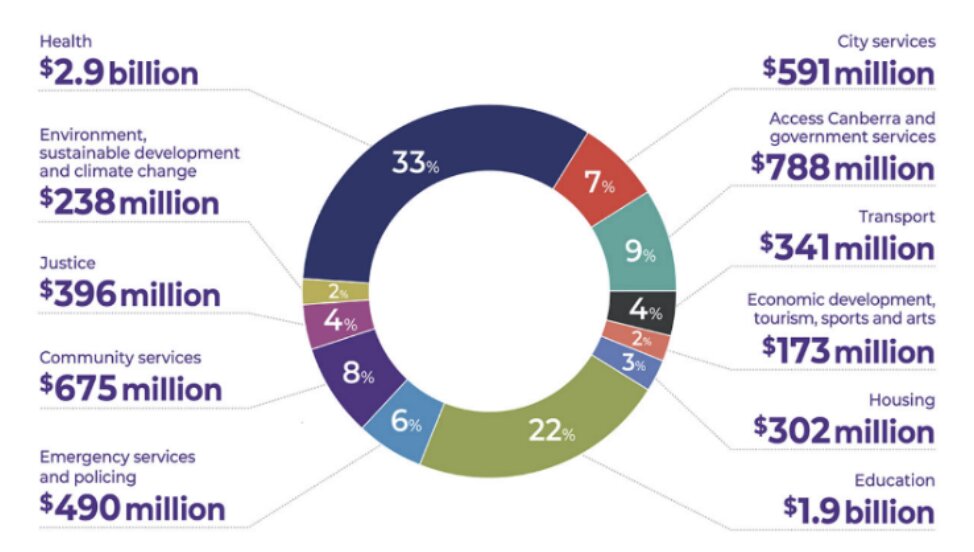
The ACT Treasury’s “Where your Money Goes” graphic excludes interest payments. In the current budget, interest soaks up less money than education, health and government services – but more money than emergency services and policing, housing and justice.
Independents Emerson and Fiona Carrick, in particular, have been extraordinarily effective in using the Estimates Committee processes to expose shortfalls in our government.
In broad terms, these efforts do reveal government incompetencies and complacency. They are serious issues that do need to be addressed.
Michael Moore is a former member of the ACT Legislative Assembly and an independent minister for health. He has been a political columnist with “CityNews” since 2006.
News all day, every day at CityNewsQBN.com.au.



Leave a Reply