By Morgan Reinwald in Sydney
The vast majority of Australians do not know how to spot the biggest killer at the beach.
Rip currents kill roughly 26 people every year along Australia’s coastline and surf lifeguards rescue thousands more from dangerous waters dragging people out to sea.
But an artificial intelligence tool can prevent these situations.
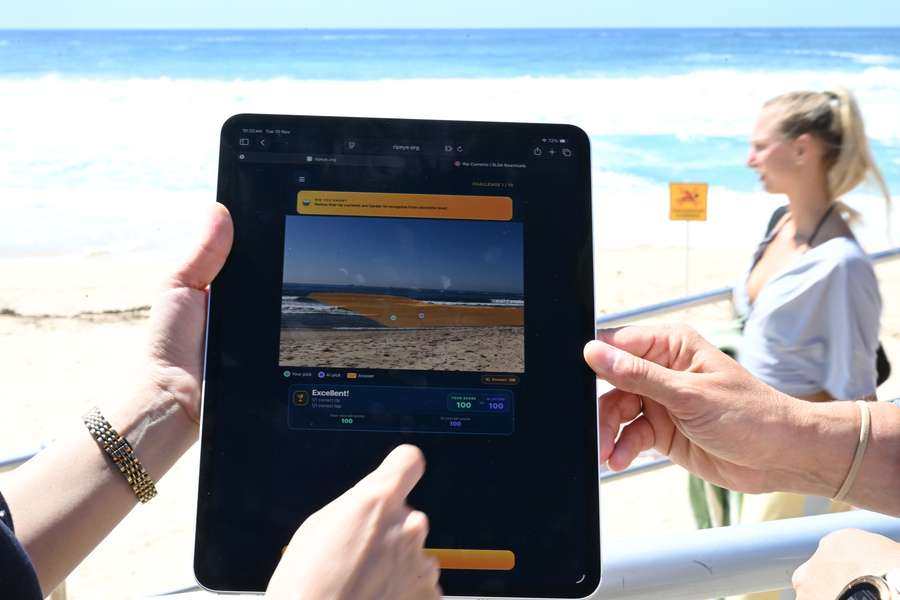
Rip-Eye is an app allowing beachgoers to take a picture of the surf, before an AI-algorithm detects what rip currents are present.
“From the statistics, about one in five average beachgoers can actually spot a rip,” Mitchell Harley, who has led the University of NSW (UNSW) project, told AAP.
“The app can’t replace a lifeguard, but lifeguards can’t be on every beach in Australia … we have 11,000 beaches.”
UNSW’s Water Research Laboratory has cameras along Australia’s coastline that have been photographing the ocean for the past 20 years.
People worldwide have taken part in Dr Harley’s citizen science project and submitted a further 200,000 photos from across the planet to the lab.
For years, his team have identified rips present in the photographs and carefully drawn lines onto them, a process he described as painstaking.
Altered photos were then fed into an algorithm machine and taught to detect rip current patterns.
Federal government funding has backed the project, which is designed with drowning’s most at-risk cohorts in mind.
Those are young adult men and international tourists, Dr Harley said.
Rip-Eye is available in 11 different languages and there is a game educating where dangerous waters are at a beach.
The app is close to public availability, but will be used by surf life savers across the nation to educate some of the millions headed to the beach this summer.
It will be a big boost for Surf Lifesaving Australia, the organisation’s national researcher Jaz Lawes told AAP.
“With lots of people coming and spending time in the water – we’re just generally going to see that increase in drowning deaths,” Ms Lawes said.
“Look for rips and have a plan in place so you and your family and loved ones can get home.”
News all day, every day at CityNewsQBN.com.au.



Leave a Reply