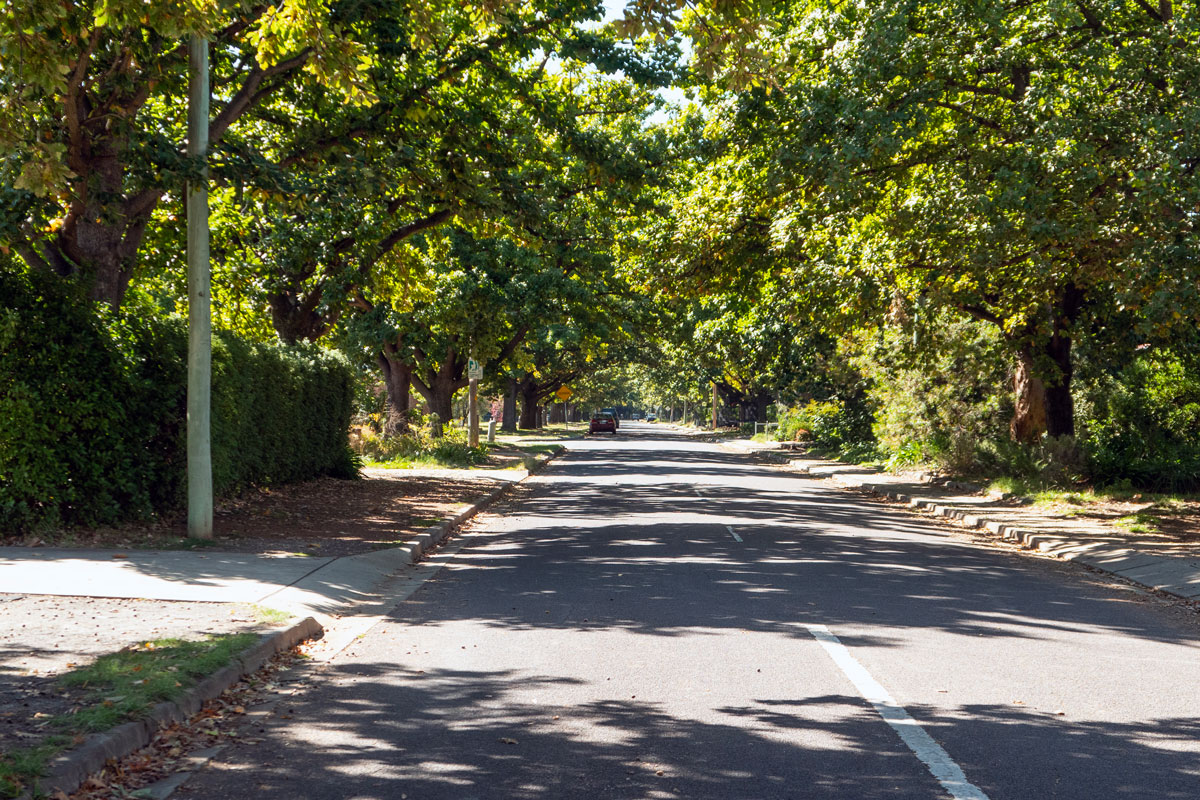
Why is it that instead of being proud to live in the best city environment in the world, our leaders wish to copy other cities that have been such failures, cities that are struggling to get some of the advantages that we have here in Canberra? Photo: Paul Costigan
“A myriad of failures in planning have been made since self-government. Planning Minister Chris Steel is about to preside over the most significant of the failures,” says political columnist MICHAEL MOORE, despairing at the lazy planning that’s being facilitated by a complacent government.
The planned city of Canberra, the source of such pride, is now at risk.
Michael Moore.
The careful planning to facilitate families and to build a bush capital is being strategically bombed by current government policies, to use the words of former chief planner Peter Harrison.
Lazy planning is being facilitated by a complacent government. Planning laws have changed, and in this budget our leasehold system and the environment are being undermined.
Sugar coating the process has already begun by employing standard propaganda techniques – start with a phrase that has some truth to it – and then drive it home. In the US, Donald Trump has used “Make America Great Again”. In the ACT the planning minister and his acolytes constantly use the phrase “the missing middle”.
They argue the missing middle must urgently be addressed. Step one was to relax the planning laws to allow redevelopment of single-dwelling blocks across the ACT to make Canberra as dense as unplanned cities.
The budget has been used to encourage development of current single housing blocks to destroy backyards. The developers will love it. The change of lease purpose will allow 50 per cent back to the developer rather than the current full value of the change of purpose.
The Canberra leasehold system is set up to stop speculation on land through the change of use. The profit coming from a different use of the land belongs with the people rather than the developer. For example, the value of land for church purposes is very low. If the church is to be bulldozed and replaced with a high-rise tower, the value of the land is very high.
In this case the profits from building the units belong with the developer. However, the profits from the different use of the land in a planned city that uses a leasehold system belong with the community.
It is common in other cities to see single dwellings squeezed between six packs of flats. Flats! Flats? Wrong language for the missing middle, they will be referred to as town houses to create the impression that they will have little or no impact on neighbours.
A recent article in The Conversation by Dr Mohammad Rahman from the University of Melbourne argued “trees and greenery can cool cities by as much as 18°C”. He did add that they must be the right sort of trees with a particular focus on “layered vegetation”.
This government pretends to address climate change. Dr Rahman argues that “cities trap heat. Roads, buildings and asphalt absorb solar energy during the day and slowly release it back into the air, especially at night. This ‘urban heat island’ effect, combined with climate change, is making heatwaves more intense and more dangerous in our cities”.
The great delight about flying home into Canberra is looking down at established suburbs and observing houses dotted between the trees. In other cities we see houses with a few trees dotted between them.
Just planting trees is not enough, “a ‘one-size fits all’ greening strategy can fail. A planting design that works well in Melbourne may behave very differently in Hong Kong or Munich” according to Dr Rahman.
However, in a planned city such as Canberra, the presence of an abundance of trees, a strong canopy with the support of shrubs and ground cover reduces heat significantly. He measured radiant heat in Melbourne and cited the 18°C difference between well planted streets and those with no trees.
It is not hard to extrapolate the difference for Canberra when single-dwelling houses are bulldozed and replaced with much more intense development. Where there is no room for the same canopy and layered planting, there will be an increase in radiant heat.
A myriad of failures in planning have been made since self-government. Planning Minister Chris Steel is about to preside over the most significant of the failures.
The city will move to the sort of mixed hotch-blotch that is seen in so many other places. Rather than expanding options, there will be much less choice in the type of dwelling, and environment in which to live.
Why is it that instead of being proud to live in the best city environment in the world, our leaders wish to copy other cities that have been such failures, cities that are struggling to get some of the advantages that we have here in Canberra?
Michael Moore is a former member of the ACT Legislative Assembly and an independent minister for health. He has been a political columnist with “CityNews” since 2006.
"To be credible, the ACT Government has to stop its obfuscation and commission an independent assessment to evaluate if bus rapid transport could deliver the benefits of light rail at lower cost," writes planning columnist MIKE QUIRK.
The attack on Helen Haines has forced politicians to confront the ugliness of political discourse, but lasting change will require a broader reckoning with society’s growing incivility, writes political columnist MICHELLE GRATTAN.



Leave a Reply