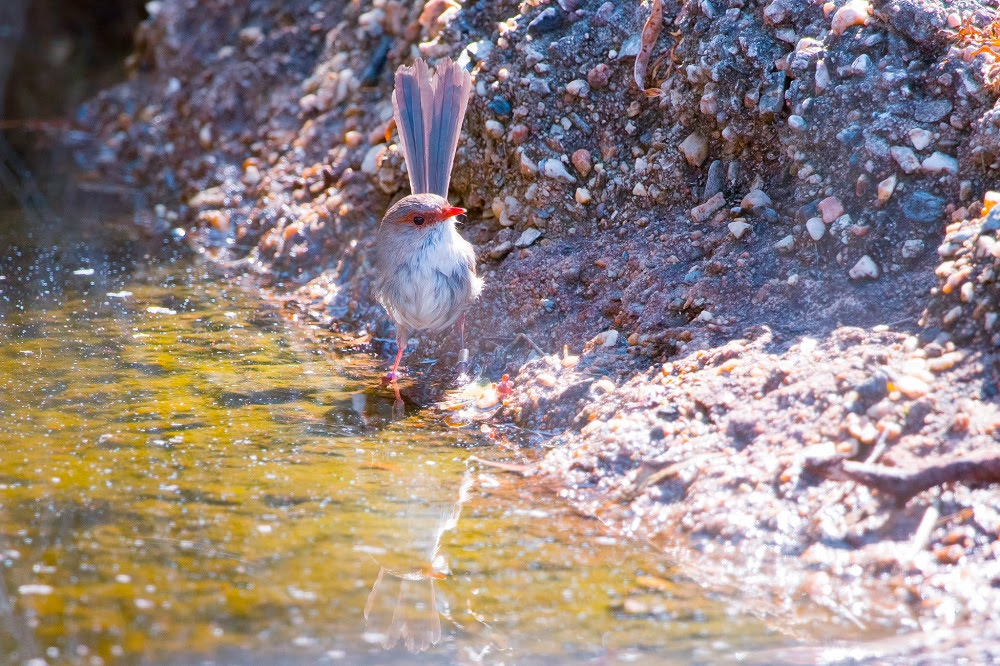
SUPERB fairy-wrens are more likely to take risks to help members of their close social circle, according to new research from Monash University and the ANU.
The study authors found that wild superb fairy-wrens use similar rules to human hunter-gatherers when deciding how much help to offer another in need.
“Both species live in multi-level societies, starting with a core group of just a few closely connected individuals,” lead author and PhD candidate at Monash University Ettore Camerlenghi said.
“We found the wrens, like hunter-gatherers, have three distinct types of relations – those from the same breeding group, familiar individuals from the same community and unfamiliar birds from the wider population.”
The research team tested the birds’ willingness to help others by broadcasting distress calls from individuals with different social relationships.
“Distress calls are a cry for help when birds are attacked by a predator,” study co-author Prof Robert Magrath, from the ANU Research School of Biology, said.
“So broadcasting these calls allowed us to test how willing birds were to help others in need.
“We found superb fairy-wrens are careful about who they aid. They’ll risk life and limb for birds from the same breeding group, but are more careful when helping casual acquaintances.
“As for strangers, amazingly, they completely ignored the cries for help.”
The study is the first to examine the decision-making process of animals living in a multilevel society.
“Like humans, the different social levels seem to have different functions,” Assoc Prof Damien Farine, a co-author from ANU and the University of Zurich, said.
“Core breeding units give individuals access to high value help when needed, whereas the broader society of familiar birds give wrens the power in numbers when facing predators.
“Exploring patterns of co-operation can help us understand the benefits of living in multilevel societies.”
The findings are published in Current Biology.
News all day, every day at CityNewsQBN.com.au.





Leave a Reply