Photography / unBECOMING, Fernanda Pedroso. At Grainger Gallery on Geelong, Fyshwick, until December 14. Reviewed by BRIAN ROPE.
Fernanda Pedroso moved from Brazil to Australia in 2020 and is based in Canberra.
At the age of 40 she transitioned from a 20-year career in advertising to a new life in photography. In the few years since she has achieved a great deal, including being name Australasia’s Top Emerging Photographer of the Year in 2024.
This exhibition of her series unBECOMING is part of this year’s Head On Photo Festival Open Program. It is one of more than 70 diverse, artist-run exhibitions in the festival across Australia.
Her series Silent Currents, 2024 explored “the quiet sadness” of Tokyo. It was an excellent example of how photographers can explore specific urban areas and paint descriptions for those fortunate to see their imagery. And I very much appreciated her piece Transmuted, 2025 in the 2025 Canberra Contemporary Photographic Prize.
Pedroso’s work is described as being “deeply inspired by her personal experiences, music, poetry and the diverse cultures she has encountered. Drawing influence from other notable photographers and artists, she seeks to merge their techniques with her own perspective to create powerful and emotive imagery.”
In a media release by Head On, I read: “Pedroso explores technology’s grip on human identity in a debut solo exhibition. Are we becoming who we want to be, or who technology wants us to be?”
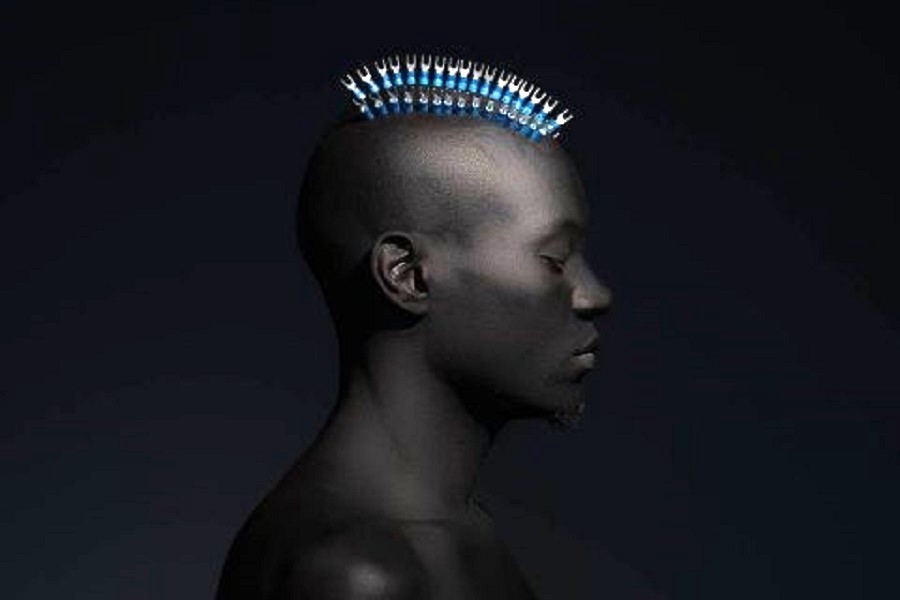
Two years in the making and shot in Brazil in collaboration with make-up artist and designer Rafa Jones, there are 27 striking images that explore how our hyperconnected age is impacting us. Are we truly more connected or are we, in reality, more isolated from each other? Right now we are witnessing and feeling the many impacts of artificial intelligence. Some think it is absolutely marvellous, at least in particular fields. Others are appalled by its current and almost certain impacts on photography and other arts.
So this is a most appropriate time for these artworks, to make us think about issues caused by the technological accelerations in our world. What are the costs to us personally – being more connected, feeling disconnected? How has technology shaped our lives? Is the impact any different to when the first mainframe computers arrived in Australia? Or when digital photography overwhelmed the analogue system?
The exhibited haunting figures, painted entirely black, refer to the black mirrors of our screens. Models are adorned with copper wire masks, terminals, tangled cords and headphones. They are futuristic yet also feel anciently tribal. They’re a visual metaphor for a question we need to ask: “What am I becoming? Can I come back to myself, my own truth?”
News all day, every day at CityNewsQBN.com.au.



Leave a Reply