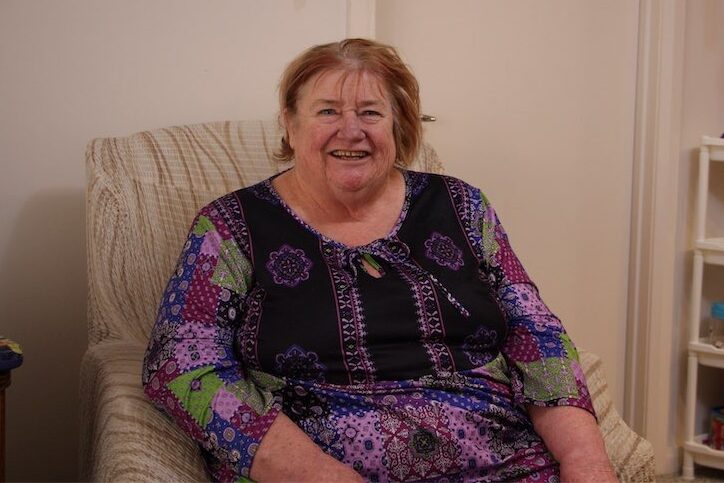
DAVID TURNBULL continues his series of profiles of Canberrans with a story. This week he meets Joan Ross, who is running a ‘book club’ with a difference.
Joan Ross is running a book club with a difference.
Instead of all the members reading the same book and meeting to discuss it, Joan’s group focuses on themes and gives members the freedom to read whatever book they want addressing it.
When the members meet, they share the perspectives they’ve gained from different writers.
The group isn’t a book club as such. It is a course Joan runs on crime fiction through the University of the Third Age (U3A)
“This format provides members with a much wider opportunity to learn – the different writers tease out different issues and that sparks active discussion whether that’s on vigilantes, murders in the snow, hostage situations, racial hatred, whatever,” she says.
Joan has been operating the course for 10 years in the inner northern suburbs, so she must be doing something right.
“We have a membership that ranges between 15 and 20,” she says.
“There’s a core of half-a-dozen who have been with us from the start, but each year we get new members.”
U3A is a non-profit organisation that operates purely from volunteers.
Its aim? To provide people over 50 (or in the third age of their lives) with the opportunity to continue to learn.
U3A does not offer formal qualifications, but rather a chance to learn, a chance to keep mentally active, a chance to engage with other people.
The movement first appeared in France in the 1970s and subsequently spread all around the world.
It was set up in Canberra in 1986 and now offers more than 200 courses to more than 4000 members.
Joan says: “In retirement people suddenly find they’ve got a lot more time on their hands. Some people do courses on subjects they’ve always been interested in but never had the time to pursue.
“Others set off on new journeys.”
U3A offers courses in the arts and film. Current affairs, politics and history. There are people engaged in a wide variety of music groups, specific instrument instruction and a host of choirs.
Languages, personal well-being, science, the environment. You name it. U3A offers something for everyone.
And it is cheap.
“This is a genuine community activity. The people leading the courses are volunteers, the head office is operated by volunteers,” she says.
“U3A deliberately keeps the costs down to make it easy for retirees to get involved.”
Born in 1949, Joan Ross grew up in Brisbane in a house full of ideas.
Her parents, Cedrick and Margaret, were rational humanists and instilled all six of their children with a clear sense of basic human fairness.
Joan is clearly uncomfortable when I ask whether she was a “radical” at university.
“I did take part in protests against apartheid when the Springboks came out, against the war in Vietnam and in favour of equal rights for women, but I was never arrested,” she says.
“I just expressed my view by being there.”
After studying psychology at the University of Queensland she remained on campus, joining the research department to help process grant applications.
From there she moved to the school of external studies – the largest of its kind in Australia.
And after that became the Queensland manager of the Human Rights Commission, where she was actively involved in a wide range of complaints.
“The 1980s was a different time, and equal opportunity, equal pay, sexual harassment and racial discrimination were at the centre of a lot of complaints we handled.”
By 1988 Joan was married with two children, and she and husband John made a deliberate decision to leave Joh Bjelke Petersen’s Queensland
“We identified Hobart, Canberra and Adelaide as possible locations and decided we’d go to the first one where either John or I secured a good job.
“The Department of Employment, Education and Training offered me a position in their Women’s Bureau, and we came here to Canberra.”
Then there were stints of various durations in different roles within DEET, 10 years at the Department of Finance, time with the Prime Minister and Cabinet and a brief attachment to the Asian office of the International Labour Organisation.
Her work was mainly policy related, wrestling with many of the ideas her mother and father had discussed with her as she was growing up.
In 2013 Joan retired, but her lifelong desire to contribute to the community was still burning bright, and that’s how she got involved with U3A.
“I’ve always been very keen on crime fiction. I read all sorts of books, but crime fiction is what excites me most.
“I’d been in book clubs, but a friend and I thought we could change it around a bit, and that’s how we came up with the course structure based on themes and decided to get members to lead the discussion from month to month.
Modest, and very matter of fact: she shuns any praise for what she’s done in her career, or with the crime-fiction course.
“I just like to be part of active discussions on things,” she says.
“I like to see people sharing ideas.”
And the members of the group clearly appreciate it.
Daniela says: “Joan has been a wonderful leader and guide. She is widely read and her genuine enthusiasm for the topic under discussion is infectious.”
And Frances: “Joan’s idea has become an outstanding and rewarding regular activity.”
Journalist David Turnbull is writing a series of profiles about interesting Canberrans. Do you know someone we’ve never heard of? Share the name in an email to David via editor@citynews.com.au
News all day, every day at CityNewsQBN.com.au.




Leave a Reply