
DAVID TURNBULL continues his series of profiles of Canberrans with a story. This week the focus is on two scientists striving to do amazing things with digital data.
Science has changed. Ten years ago, you could study botany at university and emerge with a degree that’d set you up for a career.
But those days are gone. Today, scientists need to marry expertise in their domain science with expertise in technology.
Why? Because digital technology delivers the data they need. No data. No research.
For example, there are two environmental scientists at the Commonwealth Scientific and Industrial Research Organisation who spend their days looking over the horizon.
Eco-hydrologist Dr Ashmita Sengupta and botanist Dr Shaun Levick are trying to find ways to use the latest digital technology to combat climate change.
Their focus?
The two killers in our landscape – floods and bushfires.
The head of Digital Water and Landscapes Program at CSIRO, Peter Fitch, explains: “To be able to predict floods or bushfires, we need to understand the landscape, and to do that we need to gather accurate information from large areas.
“Just collecting so much data is a challenge, even before you try to develop predictive capacity, so we are exploring how much new technologies can help.
“Sophisticated computer systems, drones, satellites, LiDAR pulse technology, machine learning, artificial intelligence are all coming into play.”
Dr Sengupta is an eco-hydrologist, an environmental engineer and modeller, who has extensive experience researching water problems around the world.
“Floods are amongst the most damaging natural disasters in the world,” she says.
“The consequences are huge. For example, in 2022 the floods in southeast Queensland cost about $8 billion.”
There is technology to accurately map flooding, but it is too slow to be of any use as far as prediction is concerned.
“What the digital water and landscapes program has enabled us to do is use machine learning methods to predict floods and hydraulics,” she says.
“Our project developed a next-generation platform that enables rapid flood predictions.
“Where previous model runs took days, this new approach takes hours.”
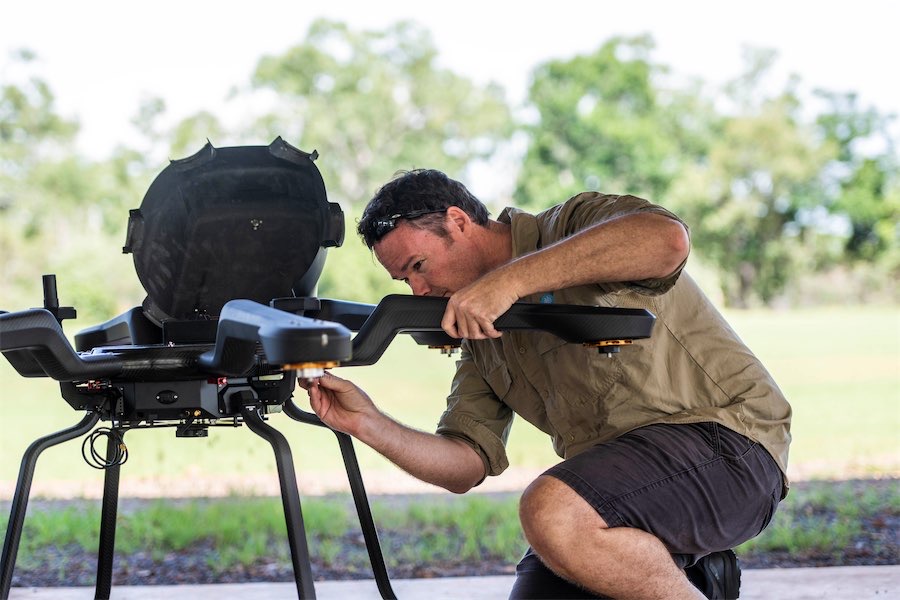
Dr Levick is a botanist.
His challenge is how to measure three-dimensional landscapes when most existing maps are only two dimensional.
And we’re talking about large areas of land. Entire landscapes.
“Whether to find out how much carbon is locked up in the forest, or how extreme the fire risk is from fuel build up, we need to measure the biomass in the landscape – the amount of woody material,” Dr Levick says.
“The only way to truly measure biomass is to cut down a tree, harvest it and weigh it.”
But Dr Levick’s team is trying to develop a non-destructive means of measurement, and to that end he’s reached out to the National Aeronautical Space Agency in the US and the European Space Agency.
“We’ve been working with the space agencies to see if they can tweak their satellites a bit to help us to collect data over large areas of land,” he says.
“Locally, we’ve also been trialling the latest drone technology and we’ve been experimenting with ‘LiDAR’, which stands for light detection and ranging.
“LiDAR instruments emit a laser pulse which interacts with objects like an individual tree or branch, anything.
“We can then reconstruct the environment in three dimensions on the computer.”
But collecting the data is just the first hurdle.
“Imagine how much information there is in documenting the biomass in a tropical rainforest,” he says.
“Grasslands or Mallee are easier, but it takes hours just to document one hectare.
“We need to find a way to do it a lot faster than that.”
While being able to accurately predict bushfires or measure carbon are worthwhile, they are not the only benefits Dr Levick’s work offers.
Collecting detailed data on a large scale of our environment also provides an accurate way of monitoring the health of the environment.
“We could detect changes in vegetation, even predict whether different crops would outperform what is in the ground in particular regions at present,” he says.
Peter Fitch reminds us CSIRO has a commitment to serve industry in its charter.
“We already know climate change is making the north of Australia wetter, and the south drier,” he says.
“That presents a big challenge for agriculture, and for the community generally. We are hoping we can explore new technologies and find tools that will help farmers and the community adapt to the changing landscape.
“It’s my job to select the team of scientists, to motivate them, and to help them find projects that can make a difference.”
Journalist David Turnbull is writing a series of profiles about interesting Canberrans. Do you know someone we’ve never heard of? Share the name in an email to David via editor@citynews.com.au
News all day, every day at CityNewsQBN.com.au.




Leave a Reply