A century on and Reid’s still fighting for its heritage
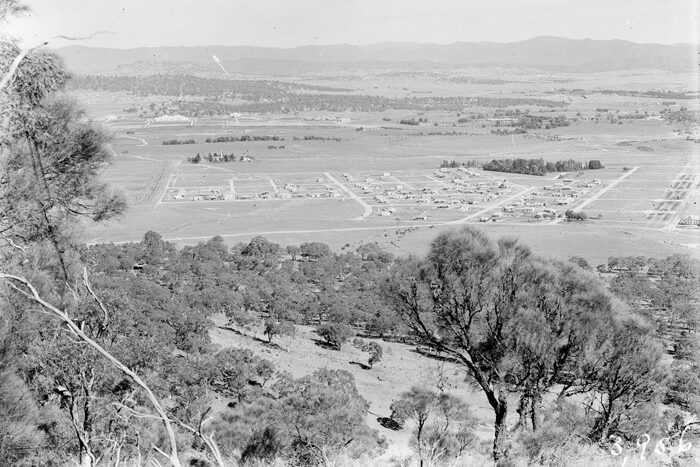
Reid pictured from Mt Ainslie in 1928. Photo: Mildenhall, National Archives.
“Approaches have been made by the Reid Residents Association to the ACT government with sensible suggestions on how to modify traffic behaviour. The response was a brick wall,” writes political columnist MICHAEL MOORE.
The residents of Reid continue to fight to protect the amenity and character of their 100-year-old suburb.
Michael Moore.
The history of Reid reveals an ongoing struggle by residents to preserve the heritage of this historic suburb.
At the celebration of the centenary of Reid in Dirrawan Gardens in mid-October, historian Tony Maples provided an insight into the development of Reid. His presentation was a reminder of the need to ensure the historic amenity is not undermined.
The current concern is about the rat-running of traffic through the suburb that undermines the heritage amenity and design of the area.
Approaches have been made by the Reid Residents Association to the ACT government with sensible suggestions on how to modify traffic behaviour.
The response at bureaucratic and political level was a brick wall.
Politicians at the centenary celebrations included Reid resident Rachel Stephen-Smith, member for Canberra Alicia Payne, Liberal MLA Elizabeth Lee and the Greens’ Rebecca Vassarotti. The residents appreciated their presence and hope it will assist in understanding the current heritage values of the suburb.
Concerns about the design of Reid are not new.
As Tony Maple explained, the original design by Walter and Marion Griffin had all houses backing on to a shared parkland. This was modified by Sir John Sulman who was chair of the Federal Capital Advisory Committee – the committee charged with the next stage of the Griffin plan.
Sulman decided to construct Reid, then known as South Ainslie, as an English Garden suburb. The result was wide nature strips, tree plantations, and room for family activities, including growing vegetables, in backyards.
Sulman was charged with building the first homes to house over a thousand public servants moving to Canberra but did not move quickly enough for the government. In 1924 the Federal Capital Commission (FCC) took over and moved quickly to tender and let contracts for 300 houses.
In 1927 the suburb was renamed Reid, in honour of Australia’s fourth prime minister.
The suburb flourished. However, the good burghers of Reid began agitating for better facilities. In 1944 the Reid Residents’ Association was established, and through their efforts Canberra’s first preschool opened in Reid.
The sport of choice for public servants coming to Canberra between the wars was tennis and the courts that remain in Dirrawan Gardens were established.
The Association was keen to protect the amenity of Reid and the residents, understanding the nature of the suburb, successfully lobbied to have Reid placed on the Register of the National Estate on October 21, 1980. It is also protected by ACT Heritage.
Former resident Shibu Dutta explained in The Heritage of Reid that the “three major elements in the heritage of Reid are the garden-city approach, the importance of street landscaping and urban design, in addition to its historic inheritance”.
It is these characteristics of Reid that drive the residents to protect its special character. In addition to protecting their own amenity, they also ensure the heritage characteristics are protected for all Australians and for posterity.
A row of two-storey, semi-detached houses, under construction in Booroondara Street. Photo: Mildenhall Collection, National Library
The rapid development of Civic in the late 1980s was further motivation for the Reid Residents’ Association to agitate for protection. Under the leadership of John Tucker, the Association successfully lobbied the federal and then the newly formed ACT Assembly to continue protection of the area.
More recently, the Association under the leadership of Marianne Albury-Colless has been vigorous in engaging with the University of NSW to ensure protection of the “The Blossoms”. This is a beautifully treed area at the lake end of the suburb that includes the rail route where the early supply trains made their way to Civic.
The latest agitation for the Reid Residents is to control the excessive traffic through the grid-like arrangement as it undermines the safety of residents and the heritage character of the suburb.
A very unsatisfactory response came from Minister Tara Cheyne who argued: “The volume of traffic is within the safe capacities of our roads; that the average travelling speeds of motorists are within acceptable limits.
“There are no immediate plans for any additional measures on streets in Reid”.
Minor measures would make a big difference. On the centenary of Reid, it is appropriate for the minister to reconsider her decision and focus on protection of the residents and the amenity of this heritage gem.
Michael Moore, a former member of the ACT Legislative Assembly, is a resident of Reid.
“When I started going through my notes, it was like a tale. Like my story with AI, from my point of view as a GP,” says Dr Ferney Bernal Buitrago. He began writing. When he finished, he had about 36,000 words, reports DHWANI PATHAK.
From humble beginnings, Canberra milliner Cynthia Jones-Bryson has forged an international reputation with hard work and by overcoming enormous physical challenges. DAVID TURNBULL continues his series of stories of remarkable Canberrans.







Leave a Reply