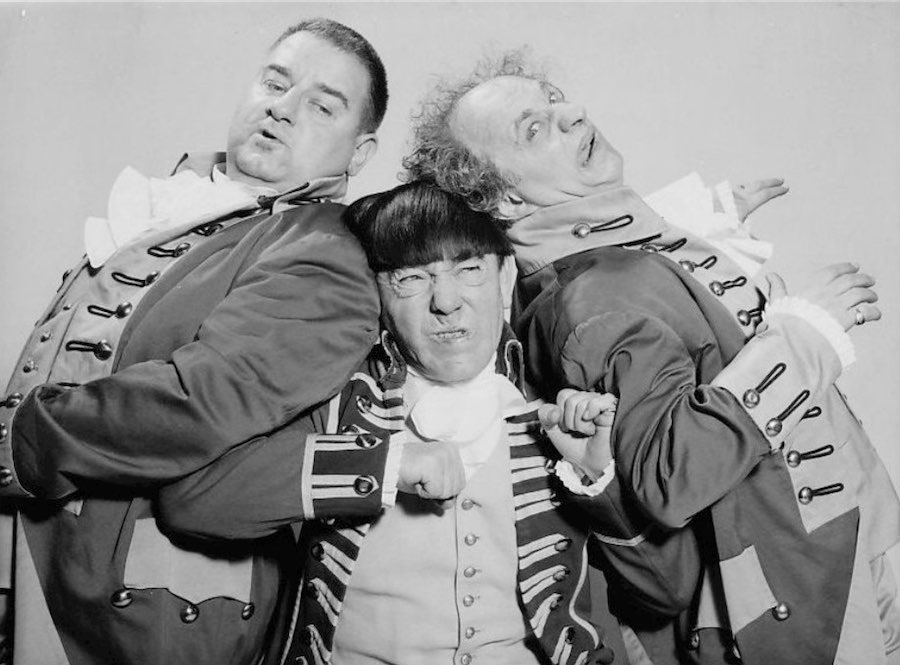
Nincompoops all… the American comedy trio The Three Stooges in 1959.
“Bamboozle and nincompoop are reminders that English develops through usage rather than design, shaped by social interaction, error, and creativity,” writes Whimsy columnist CLIVE WILLIAMS.
“There are over 30 words in the Irish language which are equivalent to the Spanish manyana. But somehow none of them conveys the same sense of urgency.” –Patrick Kavanagh
English contains many words whose sounds appear whimsical or opaque, yet whose histories reveal important patterns in linguistic change.
Clive Williams.
Terms such as bamboozle and nincompoopare often treated as comic curiosities, but their origins illustrate how English continually absorbs foreign words, reshapes learned language, and creates new expressions.
The verb bamboozle, meaning to deceive or thoroughly confuse, entered English in the late 17th century. Its precise origin remains unknown. Early appearances associate it with trickery, gambling and street fraud. Some scholars suggest influence from Romani or other cant languages used by itinerant groups, while others argue it may be a deliberately invented word designed to sound exotic and misleading.
Nincompoop has a more traceable history, though its transformation is striking. It derives from the Latin phrase non compos mentis, meaning “not of sound mind”, a term used in legal and medical contexts. Over time, repeated oral use led to phonetic compression and distortion. By the early 18th century, nincompoop had emerged as a colloquial noun describing a foolish or incompetent person.
Other unusual words owe their character to sound symbolism. Kerfuffle, meaning a disturbance or commotion, is associated with Scottish English and may originate in the Gaelic carbhuil, referring to disorder.
Hullabaloo, first recorded around the same period, has no secure etymology but clearly belongs to a group of words whose structure imitates noise and agitation.
Contact with other languages has also contributed to seemingly eccentric terms. Loon, now commonly used for a foolish person, originally referred to someone perceived as mad or dangerous. Its roots may lie in Middle English loun, meaning rogue, with possible Scandinavian influence dating from the Viking presence in Britain.
Similarly, the American term boondoggle, describing a wasteful or unnecessary trip, gained prominence during the 1930s. It appears to have originated as a joking label for a craft item, later acquiring political significance during debates over public spending.
Not all unusual words remain widely used, but those that persist often do so because they occupy a precise expressive niche.Snollygoster, a 19th century American term for a dishonest or unprincipled individual, has largely faded from common speech, yet it survives in historical and political writing because no exact synonym fully replaces it. Words endure when they efficiently capture a recurring human judgment or experience.
The study of such vocabulary highlights the adaptive nature of English. Bamboozle and nincompoop are reminders that English develops through usage rather than design, shaped by social interaction, error, and creativity. In examining their origins, we gain insight into how language balances order with improvisation, preserving even its strangest elements when they continue to serve a communicative purpose.
On a lighter note: Two hillbillies, Chuck and Elmer, were out fishing on a lake in South Carolina. It had been a particularly good day for both of them – they had caught more fish than they knew what to do with.
As they were about to head back to shore, Chuck said: “This has been amazing! Let’s mark this spot so we can come back here next time.”
“You got it,” said Elmer. Once they were back on shore, Chuck asked,
“So, did you mark that spot?”
“I sure did,” came the reply, “right here on the side of the boat.”
Chuck stared back at Elmer in disbelief. “You idiot! What if we don’t get the same boat next time?”
KEEPING UP THE ACT sees a correlation between a $63-210 million contract for infringement cameras and 65,000 patients getting ceremoniously dumped off Canberra Health Service waiting lists.





Leave a Reply