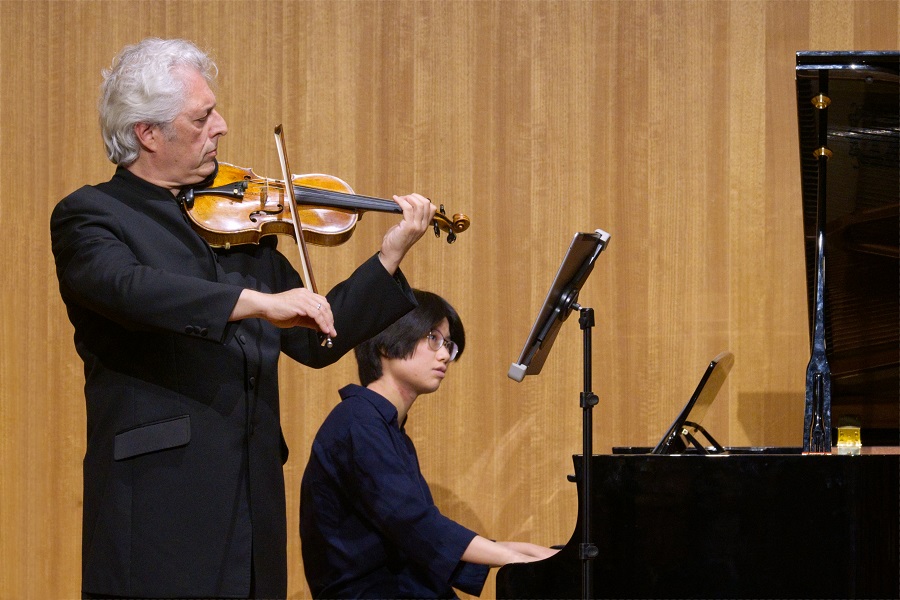
Music / Levinson and Ho recital, Wesley Music Centre, August 14. Reviewed by HELEN MUSA
A full house of violin and piano enthusiasts packed into Wesley Music Centre on Saturday evening for the last of two recitals by American violinist Gary Levinson and pianist Magdalene Ho.
Unsurprisingly, all eyes and ears were on Levinson’s 1726 Antonio Stradivari violin, which, following the performance, he allowed members of the audience to touch.
Levinson, Senior Principal Associate Concertmaster of the Dallas Symphony Orchestra and artistic director of the Chamber Music Society of Fort Worth, has an affable style with audiences. He introduced the opening work, Brahms’ Violin Sonata No. 1 in G major, Op. 78, also known as the “Rain Sonata” because of the delicate evocation of rain in the second movement.
The work, which Levinson told us reflected Brahms’ love of nature and was composed beside a lake in Austria, proved the perfect vehicle for the Stradivari. It opened in the Vivace ma non troppo with warmth and fluidity, growing to a commanding intensity that elicited a surprise round of applause between movements.
The second movement, Adagio – Più andante – Adagio, allowed Ho’s piano greater dominance as it introduced a march motif, while retaining the sense of gentle falling rain.
California-born Ho, the first woman to win the International German Piano Award in 2024, then rose to introduce two short selections from the F-A-E Sonata, a collaborative work by Robert Schumann, the young Brahms and Schumann’s pupil Albert Dietrich, composed in 1853. She explained that F-A-E stands for “Frei aber einsam”, which translates as “Free but lonely”.
Schumann’s short Intermezzo was almost over before it started, then Levinson and Ho turned to the then 20-year-old Brahms’ Scherzo (Sonatensatz from the F-A-E Sonata), a fiery work that allowed Levinson’s priceless instrument its full range. This proved a perfect showcase for the way violinist and pianist can work together and was followed with rapt attention by the audience.
The 70-minute concert concluded with the longer work, César Franck’s Violin Sonata in A, written in 1886, when the composer was 63, as a wedding present for the 28-year-old Belgian violinist Eugène Ysaÿe.
A work full of memorable melodies that are repeated cyclically, it began with the Allegretto ben moderato, a gentle, rhythmical movement that gradually picked up pace as it became more expressive. There has reportedly been some debate over whether it should have been called Allegretto, but that was how Ysaÿe chose to play the first movement. Levinson, however, did his own thing, performing it at a varying pace.
The second movement, the Allegro, was notable for its deceptively quiet opening before building to powerful intensity. In the final movement, the melody returned and the sonata ended on a joyous note, to the delight of an appreciative audience.
News all day, every day at CityNewsQBN.com.au.



Leave a Reply