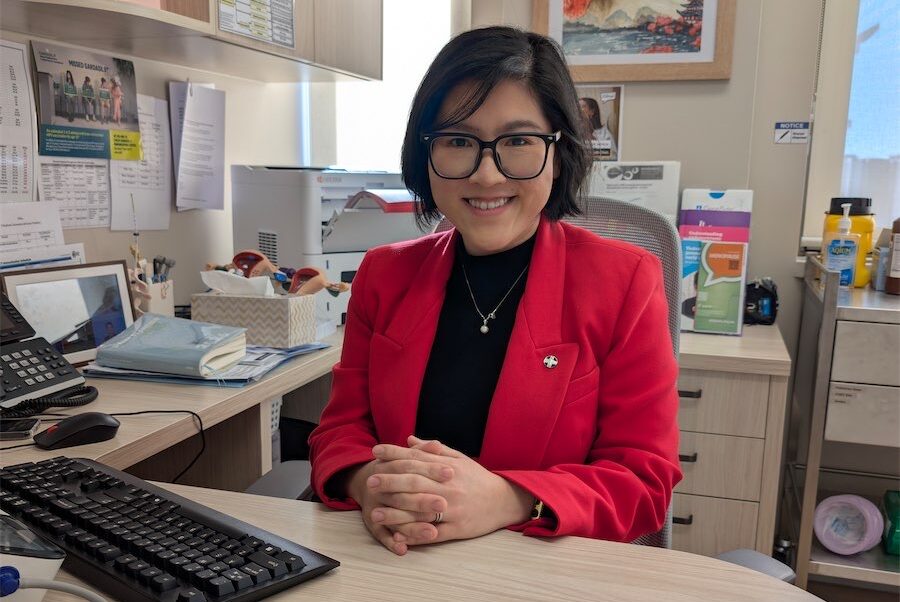
“We’re not asking for a unicorn with a rainbow. We’re asking for a safe and efficient system. We know we can do better,” new AMA president Dr Betty Ge tells reporter DHWANI PATHAK.
With Canberra’s health system under growing strain, the new president of the Australian Medical Association ACT, Dr Betty (Xiaoting) Ge, is stepping into the role with a clear message.
She says the system is not working as it should and pretending otherwise will only make it worse.
“I’m a very practical person,” says Betty. “If we know we’re not performing at our best, why don’t we look at ways to improve it?”
Her appointment comes at a critical moment. The ACT has the lowest bulk-billing rates in the country, primary care is under pressure, and patients are increasingly feeling it in their wallets, in waiting times and in the lack of continuity in care.
“We are under incredible strain,” she says. “Our population is growing, our population is ageing, and we’re getting more complex.”
“We often call general practice the backbone to our system,” she says. “But there’s no real political determination to put it in the centre.”
She describes Canberra’s low bulk-billing rates as the result of “many years of neglecting general practice”.
“The Medicare rebate has been on freeze for many, many years,” she says. “It’s not even keeping up with indexation.
“The cost of maintaining a practice has gone up, whereas our Medicare rebate certainly hasn’t kept up.
“For a short consultation, the recommended fee is around $120 to $130, whereas the Medicare rebate is around $43.
“If you keep bulk billing, the practice is not viable. Then it goes down under the water. Then patients will not have the care.
“Doctors are often the scapegoat,” she says. “We love our patients. We want to provide the care. But the system is not fit for purpose.”
The consequences are already visible.
“A lot of practices are closing their doors,” she says. “You’re also pushing our trainee doctors out of general practice.
“Medical students can see it’s a more secure future in other specialties. They don’t have to have this argument on a daily basis.”
The pressure is not just financial. It is personal.
“We lean on goodwill,” she says. “Doctors stay overtime, work those 18-hour shifts, exhaust themselves, and sometimes compromise their own physical health or mental health. That is not a sustainable strategy.
“If you don’t make general practice sustainable, you won’t have a workforce. And then patients will have nowhere to go except emergency departments, which is not the right place for many conditions.”
The risk, she says, is clear.
“We’re moving to a two-tier system,” she says. “People who can afford the gap fee will be happy to see the same GP again and again and get better health outcomes. Those who can’t, end up in fragmented care.
“They go to emergency, then a pharmacist, then a walk-in centre, then back to emergency. Ultimately our patients are going to lose.”
As a leader, her focus is simple.
“We must put our frontline workers to the centre of the consultation,” she says. “If we raise concern, we raise it for a good reason.”
“I want to push for the doctor’s voice. If we can form a strong voice and be heard, that would be my biggest achievement.
“Doctors are not trying to become businesspeople. We became doctors because we care about patients.”
Weekdays in medical school. Weekends at work
Betty began her career as a nurse in China before moving to Australia. She had her child while working as a nurse, before deciding to retrain in medicine and become a doctor later than most.
Along the way came the unspoken barriers of migration, language and culture.
She does not volunteer this part easily. But when gently prodded, the picture becomes clearer.
There were years of holding down a nursing job while studying medicine full time. Weekdays in medical school. Weekends at work. A young child in tow. Childcare bills to pay. A constant negotiation of time, money and energy.
“It wasn’t a straight path,” she says.
She shrugs it off. But the trade-offs are there. It speaks to a broader truth about women in leadership, particularly in medicine.
Ask her about balance, and she quickly dismisses the word.
“I don’t like that term,” she says.
Instead, she describes it as juggling. Some balls are glass, she explains, and cannot be dropped. Others are plastic.
It is an approach that mirrors how she now views the health system.
She is not asking for perfection.
“We’re not asking for a unicorn with a rainbow,” she says. “We’re asking for a safe and efficient system.
“We know we can do better,” she says. “The frustration is that right now, we’re not.”
News all day, every day at CityNewsQBN.com.au.




Leave a Reply