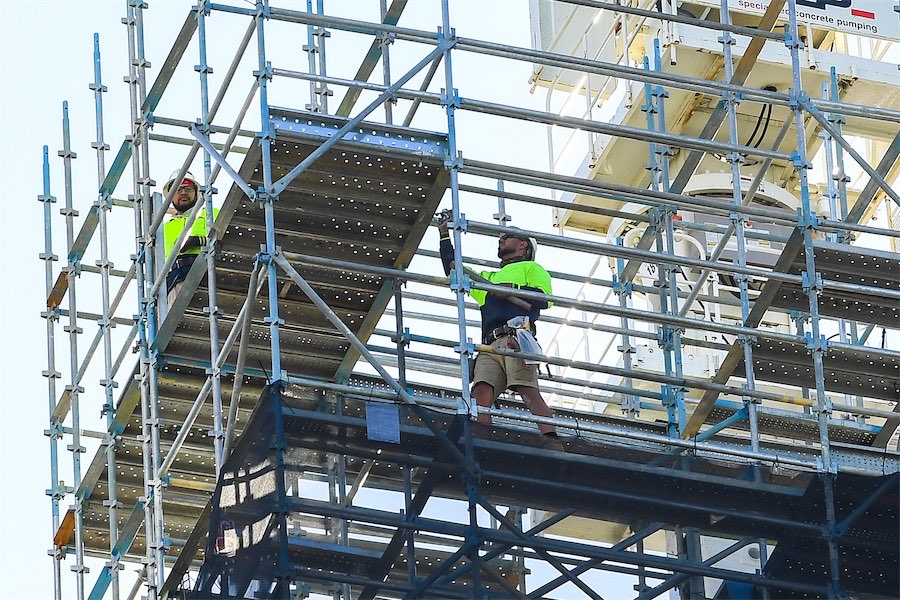
In the construction industry, the changes may also strengthen the hand of the CFMEU. Head contractors responsible for Commonwealth-funded projects can now lawfully take enterprise agreement status into account when selecting subcontractors. (Jono Searle/AAP PHOTOS)
“I fear it will entrench discrimination against businesses whose employees are not covered by union-backed enterprise agreements.” industrial relations lawyer RICHARD CALVER looks at recent changes to the Fair Work legislation.
Buried within the federal government’s latest workplace reforms is a measure that could fundamentally change government procurement by allowing union-backed enterprise agreements to influence who wins Commonwealth-funded work.
Richard Calver.
Critics say it could hand renewed leverage to unions such as the CFMEU in the construction industry.
The Workplace Relations Legislation Amendment (Building Cooperative Workplaces No. 1) Act 2026 contains many worthwhile reforms. Changes to the Fair Work Act aimed at making the Fair Work Commission more efficient are sensible and should improve the way workplace disputes are resolved.
But the legislation also creates a significant new exception to existing procurement rules.
While it does not remove protections against discrimination in government purchasing decisions, it allows decision-makers involved in specified Commonwealth procurement and funding to take into account whether a contractor has a prescribed enterprise agreement.
The amendment creates an exception to the Commonwealth procurement framework by allowing certain enterprise agreements to be considered in procurement and funding decisions, notwithstanding existing anti-discrimination principles
Supporters say the measure is intended to encourage co-operative workplaces. I fear it will instead entrench discrimination against businesses whose employees are not covered by union-backed enterprise agreements, particularly in sectors where the CFMEU has traditionally sought to maximise enterprise agreement coverage.
The practical consequences could be significant.
Businesses seeking Commonwealth-funded work may now find themselves at a disadvantage if they operate without a union enterprise agreement. That is especially significant for small businesses, where co-operative workplace arrangements often exist without union involvement.
In the construction industry, the changes may also strengthen the hand of the CFMEU. Head contractors responsible for Commonwealth-funded projects can now lawfully take enterprise agreement status into account when selecting subcontractors. That opens the door to commercial decisions being influenced by industrial considerations rather than price, capability and quality.
That should sound familiar.
More than two decades ago royal commissioner Terence Cole, recommended legislative safeguards to prevent industrial coercion influencing the engagement or disengagement of contractors and subcontractors. Photo: Sky News
More than two decades ago, the Cole Royal Commission into the Building and Construction Industry examined widespread evidence that the CFMEU exerted pressure on builders and principal contractors to engage only subcontractors operating under union enterprise agreements. The commission, led by former NSW Supreme Court judge Terence Cole, recommended legislative safeguards to prevent industrial coercion influencing the engagement or disengagement of contractors and subcontractors.
Builders frequently complied because clients wanted to avoid industrial disruption. The commission concluded that when subcontractors are selected on industrial rather than commercial grounds, competition is reduced, tender prices increase and taxpayers ultimately bear the cost.
The new legislation risks reintroducing procurement practices resembling those the Cole Royal Commission sought to eliminate by expressly permitting enterprise agreement status to be considered in specified procurement decisions.
Its supporters argue it will promote co-operative workplaces. Yet co-operation achieved through procurement preferences is very different from co-operation developed voluntarily between employers and employees.
The concern is not simply whether unions gain greater influence. It is whether governments should be using taxpayers’ money to favour one model of workplace representation over another.
At a time when Australia’s construction industry is already grappling with escalating costs, labour shortages and declining productivity, introducing procurement rules that may further reduce competition seems an odd policy choice.
History suggests there is a real danger that industrial considerations will once again shape commercial decisions. If that happens, it will not simply be small businesses that pay the price. Taxpayers will, too.
"Could humans live forever? Science says: Not yet, but it’s theoretically possible. There are several directions being actively researched," writes Whimsy columnist CLIVE WILLIAMS.






Leave a Reply