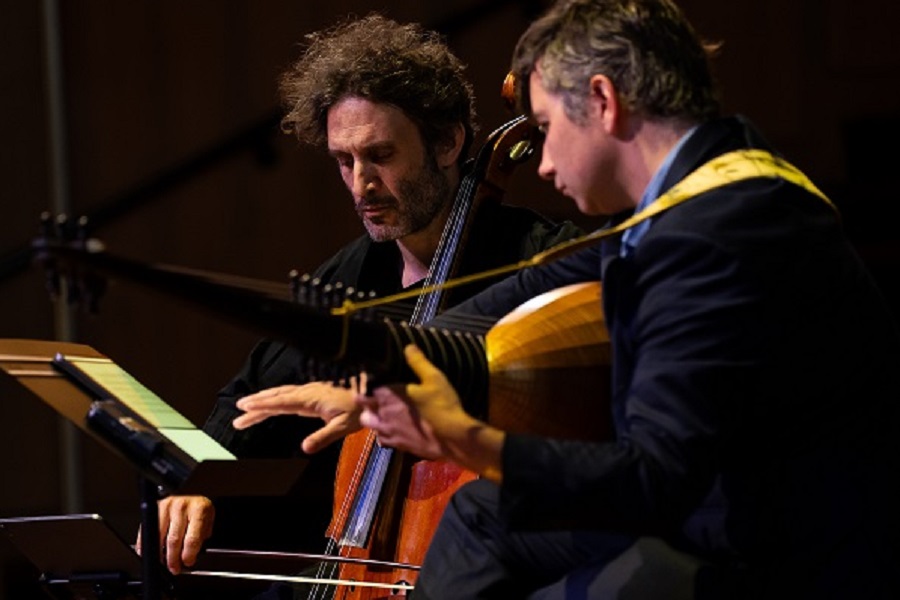
Music / Nicolas Altstaedt and Thomas Dunford for Musica Viva Australia. At Llewellyn Hall, August 13. Reviewed by NICK HORN
Nicolas Altstaedt on baroque cello and Thomas Dunford on archlute presented a well conceived and superbly executed recital at the very highest level of artistry.
The archlute proved a fine companion for the cello; a long-necked lute (similar to a theorbo), ideal in both accompanying and solo roles. It needed only subtle amplification to establish its presence before a rapt audience.
The duo strolled onstage. Dunford started plucking idly, with Altstaedt bowing reflective notes, evolving into a floating vision of Marin Marais’ La Rêveuse (the Dreaming woman, 1717). This turned into a distinctively wakeful version of Antoine Forqueray’s La Leclair, Altstaedt’s vigorous tone matched by strummed lute chords. Altstaedt’s playing was the epitome of the French baroque in phrasing and subtle ornament.
Then came Dunford’s transcription for solo lute of J S Bach’s Cello Suite No. 1 in G major. His cellist partner quietly removed himself from the spotlight, sitting to one side of the stage, seeming every bit as transfixed as we were. This was Bach re-invented, played with freedom, ease and flexibility, each phrase allowed to evolve in its own space, the structural thread never lost. Such a substantial work seemed to pass in a moment. We all let out a long breath.
The rustications of Marais’ Fêtes champêtres (country festivals) were followed by the composer’s take on the baroque hit, Les Folies d’Espagne. Dunford’s improvised continuo supported Altstaedt’s passionate rendering of increasingly dramatic variations, shifting between vigorous, rough attack and a gorgeous singing tone. What a delight to witness this intent relationship between two masters, each closely listening and enthusiastically responding to the other!
After interval, Bach was again centre stage, with Altstaedt’s solo performance of the Cello Suite No. 5 in C minor sounding a darker note. For this work the high A string of the cello is lowered a tone, deepening the timbre of the string and allowing for more openly tuned harmony. Altstaedt played in an exploratory, meditative style, culminating in a controlled rendering of the Sarabande at triple-pianissimo that cast a spell over the hall.
After this, Arvo Pärt’s minimal Spiegel im Spiegel (mirror in mirror) seemed an anti-climax, segueing into the fleshed-out romanticism of the Lento from Henri Duparc’s 1867 Cello Sonata in A minor. Then we were back where we started—in the expressive world of Marin Marais, with cello and archlute combining joyfully in Les Voix humaines (the human voices), the Grand Ballet and the suitably turbulent Le Tourbillon (the Whirlwind), a final flourish of notes set loose into the air and suspended by enthusiastic applause.
For a special treat, Thomas Dunford then formed us all into an impromptu choir to accompany the duo in a lovely rendition (sung by Dunford) of a lovely Paul McCartney song, Altstaedt demonstrating yet another aspect of his art, how a baroque cello can be made to sound like a blackbird.
News all day, every day at CityNewsQBN.com.au.


Leave a Reply