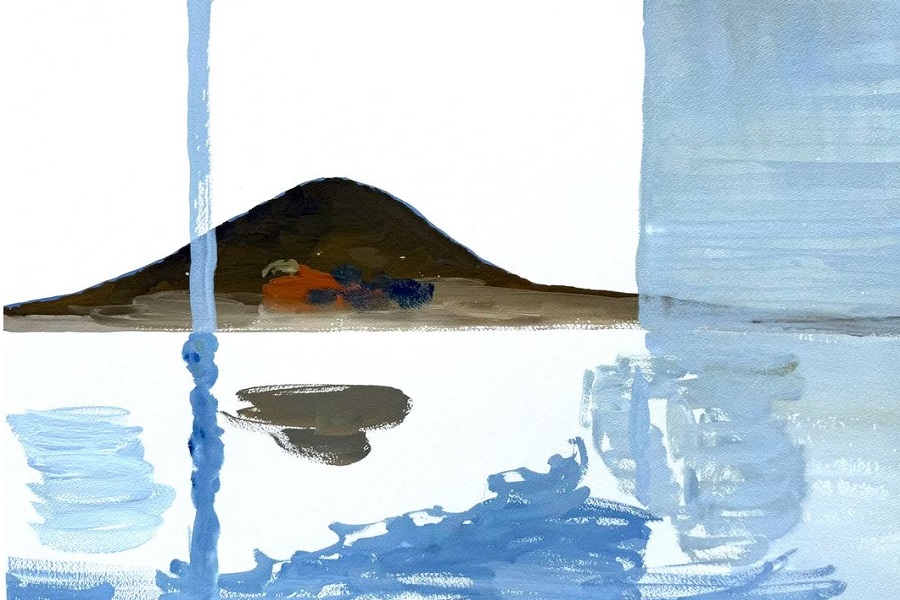
Art / The Capital and Beyond, The Landscapes of Andrew Sayers. At Barton ArtBox, part of Canberra Art Biennial, until October 31. Reviewed by ROB KENNEDY.
Andrew Sayers, once director of major arts and cultural institutions in Canberra, had something to say in his art that reveals another side of this champion of Australian art.
As one of Australia’s most important cultural leaders and art historians, Andrew Sayers was also a painter. He influenced Australia’s perception of art in his roles as assistant director of the National Gallery of Australia, first director of the National Portrait Gallery, and then director of the National Museum of Australia. He died, aged 58, in 2015.
The landscapes of Canberra, where Sayers spent a large portion of his public career, as well as the plains, mountains, and coasts around the capital, influenced his painting style, and this exhibition gathers them in one room.
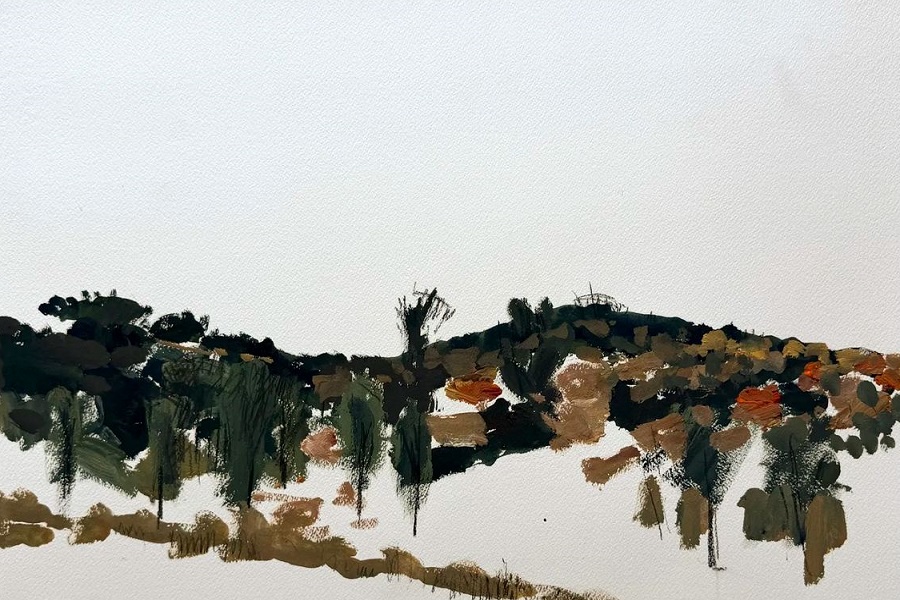
Sayers has something to say artistically in his style, let alone his career so closely connected to the arts. His style is minimalist, with an emphasis on immediacy. He seems to grab what is essential in a landscape and make that the focus of his works in this exhibition. Several even seem to suggest a sparse loneliness.
On paper, all 20 artworks in this exhibition are painted with gouache and not too different in scale. There’s a strong use of negative space in each work, which seems to be intentional and adds depth and difference.
These works are more about what’s left out rather than what’s included, and like rests in music, this says so much in the structure of each piece. It’s hard to take the focus off what is not there, almost as though absence has something permanent to say.
Are they finished, complete artworks they seem to ask? This question is raised by the constant use of white space, which in some works is the major component.
But what is there is a highly personal placement of shapes, forms, and colours that scream out restraint and portray the landscape at the same time.
Are these impressions? Certainly not in the style that most would align with what is known as impressionism, but they sit between representation and impressionism through a personal style that is distinctive and full of character.
With all that said, Sayers had a strong artistic eye. He draws out particular aspects of what nature offers as though it is seen through a specific lens. And that’s not an easy thing to do for any artist. To be true to yourself, the art, and offer a statement that can stand alone while saying something special that most could understand and appreciate is not common.
Sayers truly was a major force in Australian art. He clearly had a wide view and an intimate knowledge of the art world he lived in and created.
News all day, every day at CityNewsQBN.com.au.


Leave a Reply