Art / David Hockney: Portraits in Print. At National Gallery of Australia. To May 9, 2027. Reviewed by ROB KENNEDY
An ongoing aspect of English artist David Hockney’s work was portraiture. This exhibition shows how his use of portraiture functions as an aesthetic anchor in his art.
David Hockney: Portraits in Print, which spans almost 30 years, reveals the artist’s involvement in the cultural environs of Los Angeles, Paris, and London in the 1970s and 1980s while documenting his closest personal connections.
At the media preview, the Head Curator of International Art, Magda Keaney, who wrote the NGA’s tribute piece on Hockney following his death in June 2026, wrote, “I would not say that David Hockney had a career as an artist. Hockney was born and lived as an artist.” She reiterated that at the preview by saying he had a compulsion to draw since he was a child and he pursued his art as a lifestyle; it was not a job for him.
And this is most evident in this exhibition. But what does Hockney reveal in his portraits? Is it his style, statements on his subjects, or that he bothered to capture them at all, as most are not known outside his circle? Maybe that’s the revelation in these works. People who we mostly don’t know revealed in ways like a photo album captures the workings of a family life as only the creator can.
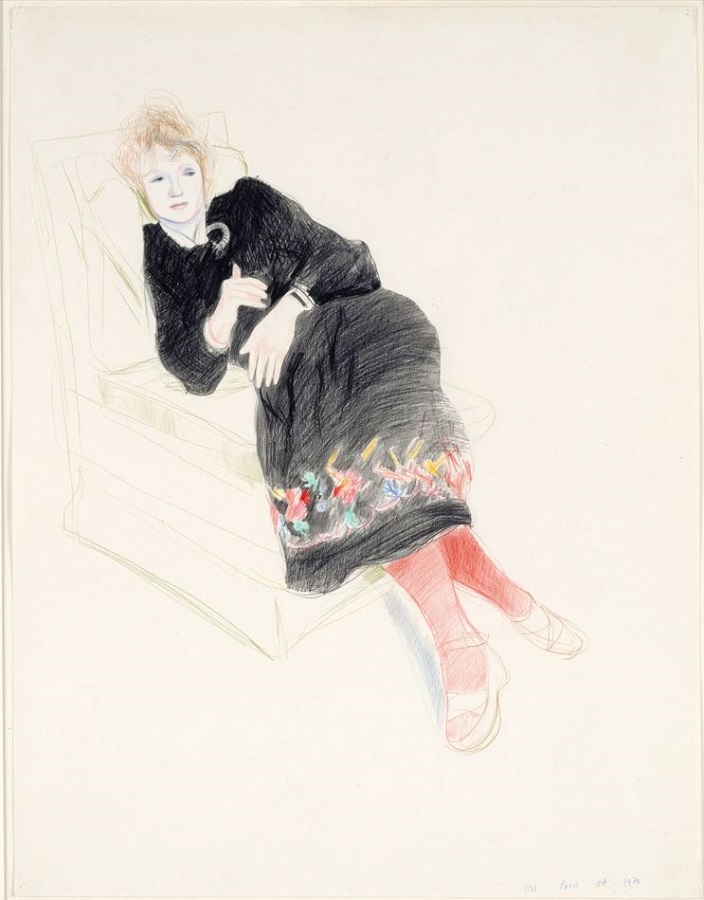
In this exhibition, we are not only spectators of his craft but also those who made up his world. We don’t have to know them to feel what Hockney did; we can see it. Looking at his 1973 work, Celia in a black dress with red stockings, it’s a drawing in coloured crayons; it’s sort of half-finished, maybe like the sitter’s life was at the time, but she seems comfortable in being drawn, like intimacy was the most natural thing.
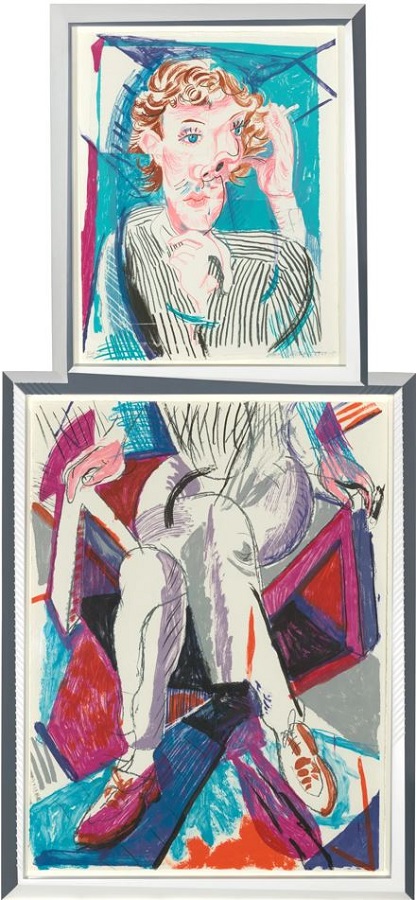
In one of Hockney’s neo-cubist works, Image of Gregory, 1984-85, not only is it a standout artwork, but the bespoke frame carries on where the print leaves off. Diagonal lines are cut through the frame, extending the artwork giving it a 3D effect. The backgrounds surrounding the neo-cubist works were designed by a commissioned team who have drawn from the imagery of several of his artworks in this selection, which adds a compelling inclusion.
His long connection with the American printmaker and publisher Kenneth E. Tyler is seen throughout this exhibition. Hockney worked in all four of Tyler’s workshops where he developed new techniques for printmaking, which sparked a new artistic focus.
What can be seen is Hockney’s skill in slow drawing and applying it with love. Visitors can see his artworks slowly come to life on the iPads installed on the outside wall. This technology was to be a revelation for Hockney. He saw and used its potential, I think, before any other artist did.
Gallery director Nick Mitzevich told everyone to stay tuned, as this was one of several exhibitions on Hockney planned for the gallery, as the NGA has one of the largest print holdings of his works, possibly the largest in the world.
News all day, every day at CityNewsQBN.com.au.


Leave a Reply