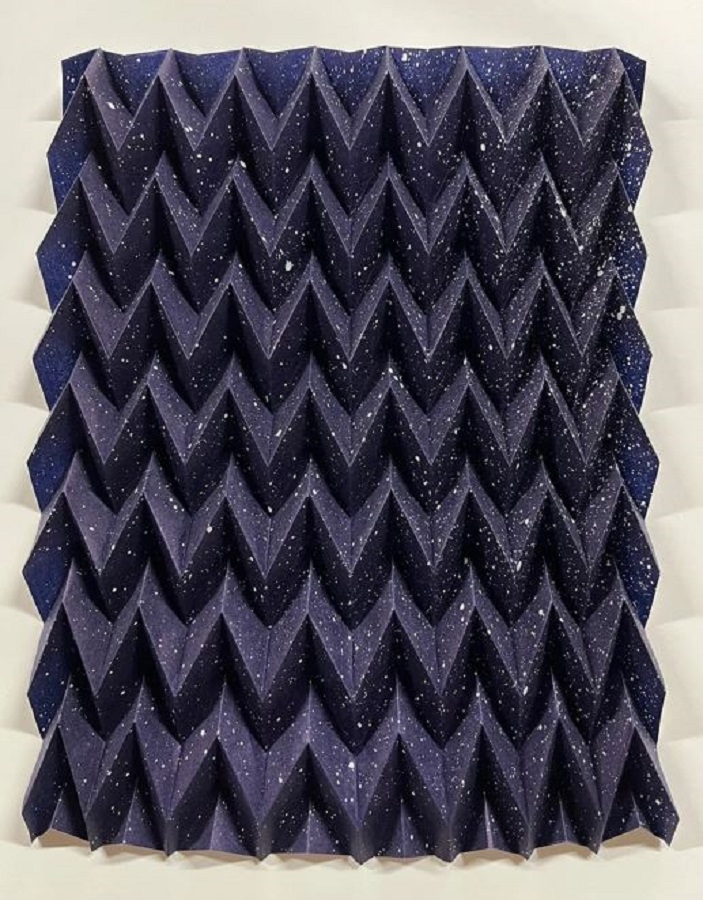
Visual Arts/ A Most Peculiar Star, Patsy Payne. Megalo Print Studio, until October 10. Reviewed by KERRY-ANNE COUSINS
Patsy Payne is the former Head of Printmaking and Drawing at the ANU School of Art and Design.
Her art practice extends across a wide range of art forms including printmaking, sculpture, drawing and weaving. Informed by an enquiring mind that brings together her background in science and the visual arts, Patsy Payne has a deep interest in the human experience and our place in the universe.
In her current exhibition at Megalo, Payne’s interest in the cosmos was inspired by a discovery by the artist when doing research at Mt. Stromlo Observatory in Canberra.
When looking through the archive of old scientific glass plates she noted that there was evidence that depicted a new and unusual star in the sky (HD101065). It was identified because of its unusual chemical properties and named after the Polish Australian astronomer Antoni Przybylski who had discovered it in 1960.
Intrigued and fascinated by these now redundant glass plates, Payne sees them as fragile objects, physically holding time on their surface. In researching online she also found glass slides from other observatories, focusing on the Southern Hemisphere where star HD101065 was discovered.
It is this focus of the night sky that she uses for this series of prints and folded and cut paper sculptures.
In these works Payne uses relief and laser engraved intaglio prints to highlight what she calls the infinite space of the universe. Some of the most visually attractive prints are laser prints on plywood where the dark ground is penetrated by pinpricks of yellow light.
One of the most imposing works (NZ2278) in the exhibition is made up of nine joined engraved plywood panels. Together they form an evocative and magical image of the sky. Other single works on paper also depict the darkness of the night sky while others have the stars picked out in blue against a white background.
Payne’s interest in the evidence of the early astronomers in the slides is also apparent in some works. She has for example retained the long streaks caused by over exposure of the slide, the round mechanical marks of the original telescope and the coloured hand written numbers marking the ’new’ star HD101065.
Anyone who has ever looked at the stars or been fortunate enough to see the wonder of the Milky Way in a night free of pollution will find pleasure in this exhibition. If you also have an interest in astronomy, this depiction of images from old glass slides gives them new life resurrected through an artist’s eye.
News all day, every day at CityNewsQBN.com.au.





Leave a Reply