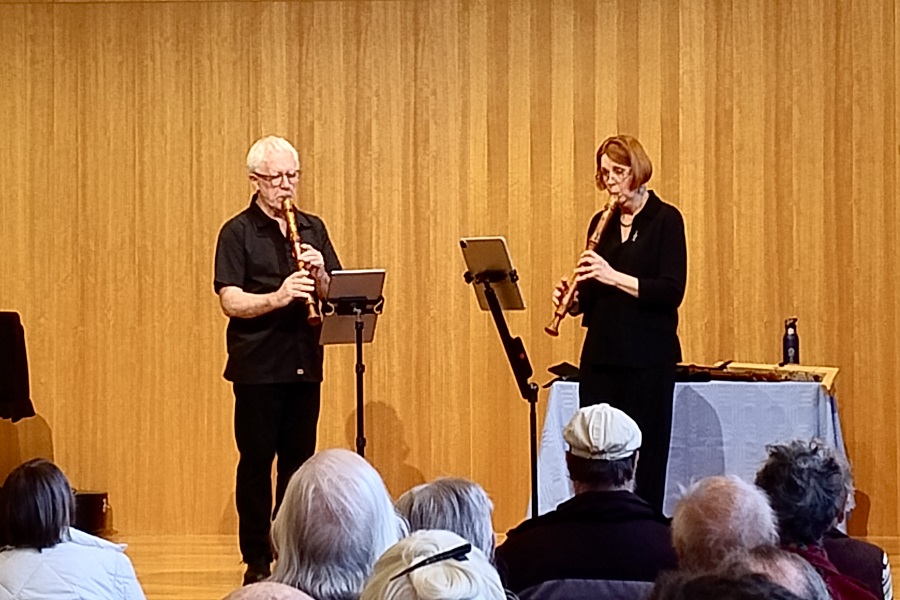
Music / Woodsong, Robyn Mellor & Rodney Waterman. At Wesley Music Centre. August 1. Reviewed by ROB KENNEDY.
Local early music expert Robyn Mellor was joined by Melbourne virtuoso Rodney Waterman in a concert highlighting the musical artistry of recorder music over 500 years.
Throughout the concert both performers played more than 10 different instruments. They offered the sound of stillness; love songs, elegant French baroque music; the sparkle and pizzazz of Australian composer Lance Eccles; the rhythmic intensity of Sören Sieg’s African-inspired work, and the jazz of Pete Rose’s crazy clock Pendulum.
Including works by Diego Ortiz, Jacques Hotteterre, Quantz and anonymous pieces, this program captured some of the diverse music that has let the recorder maintain its place in history as an instrument that can speak across centuries. The naturalness of its sound, its smoothness, and its flexibility across all the types of recorders produces a distinctive resonance that fits ancient and contemporary music.
Beginning with three anonymous songs, Trios Chansosns, which were most likely composed in the 1520s, with Waterman on Lute, which is the perfect accompaniment to the recorder and Mellor on her instrument opened this concert in front of one of the biggest audiences I have ever seen in Wesley Music Centre.
After Mellor spoke about the parts of and types of recorders they used, we heard two Recercadas by Spanish composer Diego Ortiz (1510-1570). These melodically elaborate pieces were entertaining due to their improvised style of composition; they amused through their constant fresh sound and the play between the performers.
Next, the performers moved to two recorders for the three Renaissance Duos from The Cancionero de Uppsala. These anonymous works from this 1556 Spanish music book had tunes that followed each other around, creating a tranquil setting.
The five movements from Deuxieme Suite de Pieces (1717) were indeed happy moments as the program notes indicated. They consisted of several dance movements; the lively pieces lived up to their name.
Then the noted flutist and author of On Playing the Flute, 1752, Johann Joachim Quantz. His Duet V in three movements, fast, slow, fast, as with Bach’s music, the clarity in these compositions stands out. Inventive and quality music flowed.
Then a massive jump on the musical timeline to the sounds of Australian composer Lance Eccles. His diverse music with all its chromatic variations, and hypnotic soundscape created an irregular but attractive three movement composition.
Danish German composer Sören Sieg’s Umlanjana, in three movements, all with playful titles showed another side of the recorder’s versatility. Steeped in African rhythms, the driving pieces bounced along with the sounds of wind, water and children playing and also with Waterman singing.
To finish, an amazing work in any musical language, Pendulum by American composer Peter Rose. The blues were a good part of this piece, but blues on a recorder? Who’d have thought. It had a mysterious side too. Every 20 bars or so it changed. There was also clapping, and a one point, Waterman playing two recorders at once.
Many in the capacity audience laughed and smiled throughout this highly entertaining concert.
News all day, every day at CityNewsQBN.com.au.


Leave a Reply