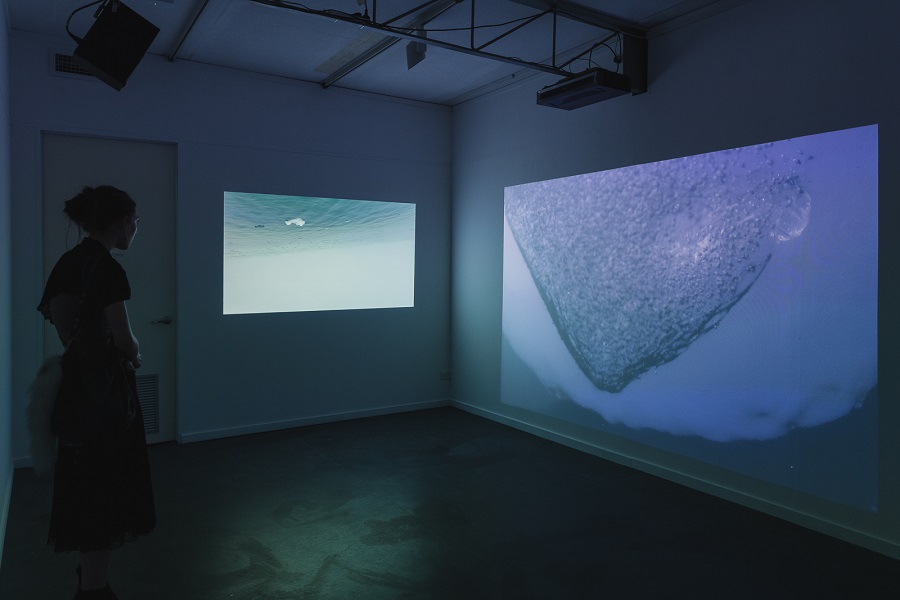
Photography / Once Was by Rebecca Wickham and Ecologies (Arctic) by Anna Munster and Michele Barker. At PhotoAccess until February 28. Reviewed by CON BOEKEL.
Underlying both these exhibitions is a vivid sense of the trajectory of global glacier ice mass balance.
The world’s oldest glaciers have been with us for nearly three billion years. Their air bubbles store traces of ancient atmospheric conditions going back to before dinosaurs roamed the land.
They contain traces of the soot from fires lit by the Romans two millenia ago to smelt Iberian gold. As the glaciers melt, they yield the lost arrows of long-gone Inuit hunters. Most of the world’s 200,000 glaciers will be gone by the end of this century.
Wickham focuses on grief at the loss of glaciers. Her montane imagery depicts grey landscapes sculpted by glaciers. Her stills show relict patches of ice in a cemetery of vertical rock faces, moraines and scree slopes. The barren landscapes embody emptiness. Lithographs are inked once and then printed over and over until there is virtually nothing left to see but a vague shadow of what once was. The vanishing lithographs echo the vanishing glaciers.
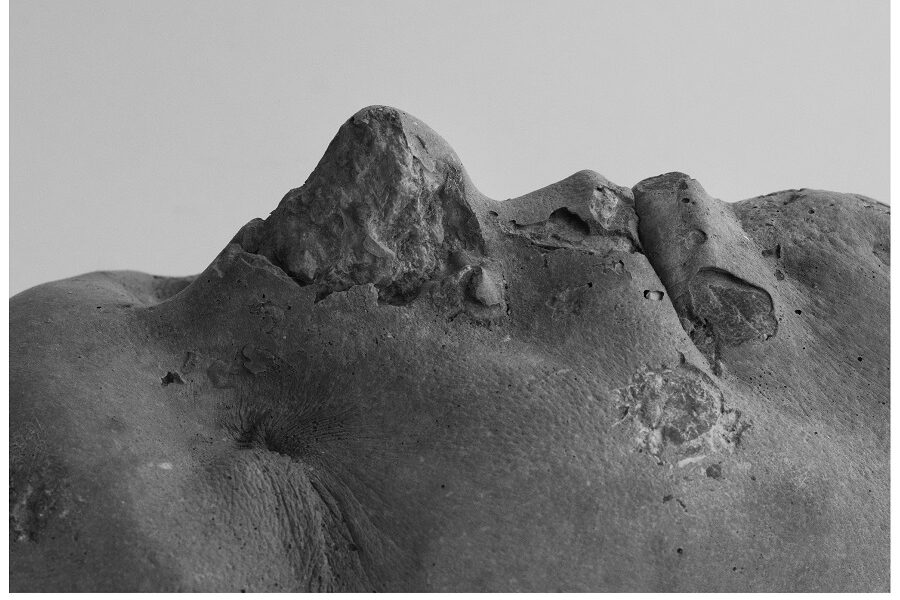
Her imagery includes death masks created using glacial materials – sediments and melt water. They are incredibly powerful responses to loss. They reduce the mediation between being human, the materiality of the art and, ironically, the increasing immateriality of the glaciers. Wickham’s exhibition is a sombre funerary arrangement for our times.
Munster and Barker also focus on glacier loss. They use drone footage, sound recordings, and AI. Their geographical focus is the Svalbard Peninsula – an Arctic area where temperatures are increasing at over four times the global average. There are expansive images of sea surfaces littered with melting ice fragments. A lone bird flies away from us. We are enveloped in sounds of ice-free wavelets rhythmically lapping the shore and by the pops, crackles and dripping sounds of melting ice. The exhibition experience is a sense-surround set in times past, time present and times future – we are all at sea.
I was particularly taken by the AI output. Asked to predict what the world would look like without glaciers, AI came up with some fake clouds, a mish mash of remote sensing technical terms, and the AI equivalent of throwing up the hands in confusion. When it comes to glaciers, humans and their tools are not in control.
Gabrielle Hall-Lomax’s curation is inspired. Art and science meet at the melting point. The exhibitions share a concern with the intertwined themes of time, of physics, of nature, and of being human. Individually, the two exhibitions are crackers. Combined, they gain synergistic meaning and powerful intensity.
News all day, every day at CityNewsQBN.com.au.


Leave a Reply