
“Garner mixes the mundane with the profane, juxtaposing washing the dishes with the creativity of writing.” COLIN STEELE reviews the collected diaries of “national treasure” Helen Garner.
How to End a Story: Collected Diaries 1978-1998 (Text, $59.99) brings together the three volumes of Helen Garner’s diaries, Yellow Notebook (2019); One Day I’ll Remember This (2020) and How To End A Story (2021).
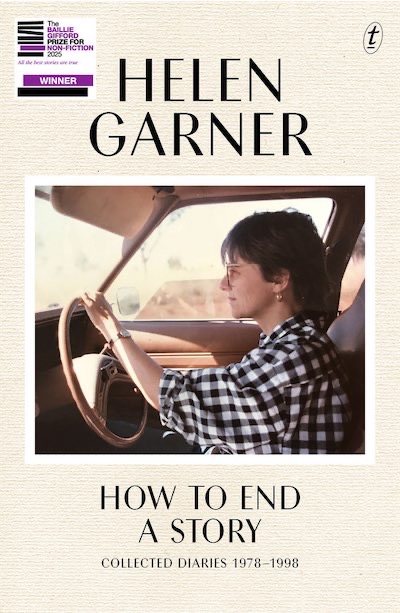
In November, Garner’s 800-page book won the UK 2025 Baillie Gifford Prize worth £50,000 ($A100,000), the first set of diaries to win the prize. Robbie Millen, literary editor of the UK Times, who chaired the prize jury, compared Garner to Virginia Woolf in the canon of great literary diarists.
Millen said the judges were captivated by Garner’s “sharp observation” and “reckless candour” resulting in “a remarkable, addictive book, taking the diary form, mixing the intimate, the intellectual and the everyday, to new heights… there are places it’s toe-curlingly embarrassing. She puts it all out there”.
Garner, who certainly does, has said: “In my heart I always like my diary better than anything else I wrote”.
Garner mixes the mundane with the profane, juxtaposing washing the dishes with the creativity of writing. The reader follows her, in real time, through her troubled marriages, her self-doubt leading to therapy, her mixed relationships with her daughter and her parents, her dental and medical operations, including an hysterectomy, her love of books, films, dance and music and her interaction with fellow authors and publishers.
In the first volume, she is separated from her first husband Bill Garner and her second marriage, to a Frenchman, Jean-Jacques Portail, is ending.
On the literary front, however, Garner wins a major prize with her first novel Monkey Grip (1977), although she reacts to criticism that it is provincial, writing: “My work seems piddling, narrow, domestic”. Self-doubt contrasts with a strong inner resolve throughout the diaries.
In the second book (1987-1995), she begins an affair with a fellow writer, whom she ultimately marries, referred to in the text as “V”, but now identified as the Australian novelist Murray Bail.
Garner reflects: “I wanted so much to be loved that I tried to turn myself into the sort of woman I thought I would have to be, in order to be lovable. In the process I falsified myself, lost part of my soul and made myself sick with swallowed rage”.
Garner, describes one scene in which she is cleaning the toilet while V is telling her to stop writing fiction about the 1970s. V also believes “women’s writing lacks an overarching philosophy”.
Garner reflects that V’s criticism may have led her subconsciously to prefer writing non-fiction.
V tells Garner he can only work on his novel Eucalyptus if he is alone in the apartment. Garner is forced to “wander the streets” and, if she wants to write, she has to resort to public libraries. Garner reflects she is “learning there’s the kind of man who believes he can have everything”. The marriage to V disintegrates, accelerated by V’s affair with an artist X.
Garner, on one occasion tries to destroy V’s blue straw hat by repeatedly punching it, but infuriatingly, “it keeps popping back into shape”.
Garner is more successful when “I wrench the cap off his Mont Blanc fountain pen and stab the proof copy (of Eucalyptus) with the nib, gripping the pen in my fist like a dagger. I stab and stab, I press and screw and grind. The nib gives way, where bleeding ink, and twists into a little golden knot”.
Garner writes: “There’s no way he’ll ever understand writing about my life is the only thing that makes it possible for me to live it. I can’t (or won’t) give it up.”
She later acknowledges that “it must be awful to be married to me”. Garner ends up regularly consulting a therapist. In typical Garner fashion, she persuades the Australian Tax Office to accept her therapy bills as “professional development”.
Then in 1995, Garner learns of two students accusing the Master of Melbourne’s Ormond College of sexual impropriety.
Garner writes: “I wrote the guy a letter. Hope I won’t regret it”, which, in one sense, she certainly will. The publication of the bestselling, The First Stone, led to legal injunctions and Garner being attacked by young feminists.
Garner reveals her own “street fighting” abilities and discovers “a hard nut of something in the centre of my heart”.
Garner’s diaries, How to End a Story, are engrossing reading. Her ruthless self-examination comes with an inner resilience that has enabled her to produce an outstanding corpus of fiction and nonfiction. Garner is a national treasure.
News all day, every day at CityNewsQBN.com.au.




Leave a Reply