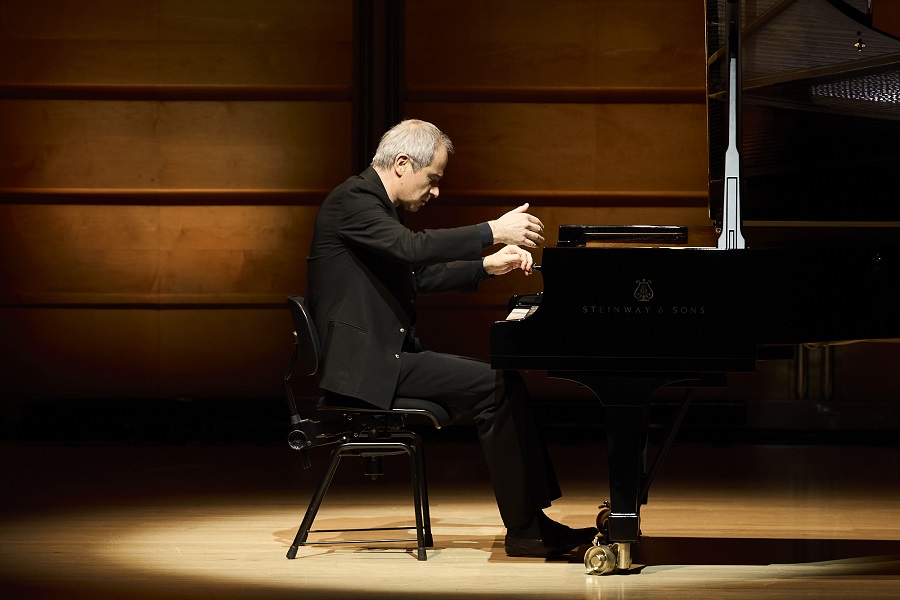
Music / Piotr Anderszewski. At Llewellyn Hall, November 21. Reviewed by NICK HORN.
For Musica Viva’s final offering in its 80th birthday season, we were privileged to share the sound world of noted pianist Piotr Anderszewski, with works by Johannes Brahms, Johann Sebastian Bach and Ludwig von Beethoven.
Half the program was devoted to a selection of Brahms’ late piano works from 1892-1893. These were presented as a continuous suite, as if the composition were being invented from moment to moment.
From the first descending notes of the first intermezzo, floating like snowflakes, for 60 minutes we were caught in a spell as Anderszewski tracked mercurial changes of mood between pianissimo meditation, melancholy introspection, dance-like energy, thumping bombast and hints of Hungarian folk idioms.
The pianist’s spontaneous playing, broad dynamic range and sensitive rubato retained with all a sense of the ideal placement for each note, particularly in the more contemplative passages.
But how would Anderszewski’s romantic pianism adapt to the strictures of JS Bach’s Preludes and Fugues in E and G-sharp minor?
His playing of the preludes was a revelation, with a sense of discovery in each twist and turn of phrase.
For the fugue in E, Anderszewski’s efforts to show what the modern piano can bring to Bach’s counterpoint, in terms of dynamics and balance, threatened to distort the logic of the original.
However, for the glorious double-fugue in G# minor, these flourishes were restrained in luminous delineations of the long and winding subject of the first fugue, the chromatic sequence of the subject of the second, and the dramatic climax of the work as the two themes come together.
There was barely a breath between the second Bach fugue and the quiet beginnings of Beethoven’s Sonata No. 31 in A-flat with a cantabile movement gradually blossoming out of the stricter form (still ringing in our ears).
Then another idea – this time a boisterous scherzo, assimilating, we are told, two popular drinking songs heard on a late-night binge. What a contrast with the sublime artistry of the third and fourth movements that followed, two ariosos with fugues (mirroring the structure of the Bach)!
The long line of the initial arioso, punctuated by tolling repeated notes, evolved into the rippling step-like progress of the first fugue, reaching a climax with the bass striding majestically up the keyboard.
Another, more hesitant arioso then found voice (as noted in Dr Edward Neeman’s excellent pre-concert talk on late style), its weariness movingly rendered, building to a crescendo of insistent G major chords crashing on to the beach then washing back into the ocean as a delicate final fugue emerged and gathered to its sublime conclusion.
Anderszewski, like any good host, left us with a delicious bon-bon: a fourth B – Béla Bartók, whose delicate Hungarian tune was effortlessly made to shift shape within a minute from Bach to Beethoven to Brahms. Our host returned with a happy dance, completing the nod to his Polish/Hungarian heritage with a Chopin Mazurka.
News all day, every day at CityNewsQBN.com.au.



Leave a Reply