
Jane Harper is credited with creating a new sub-genre of crime fiction, Australian rural noir, writes book reviewer ANNA CREER.
From the publication of Jane Harper’s first novel, The Dry, in 2016, all of her novels since have been international best-sellers and won prestigious awards.

Last One Out (Macmillan) is Harper’s latest novel and, again, it explores both a tragedy and a country town hiding secrets in its past.
To Ro Crowley, Carallon had once been an idyllic country town. She had lived there with her family until five years ago when, on his 21st birthday, her son Sam disappeared, his footprints in the dust of three abandoned houses the only clue. As a result, her marriage has broken down and she has left to live in Sydney.
Five years later Ro returns for the annual memorial for her son, knowing this might be the last one. Although from a distance Carralon “looks delicate and beautiful… Bathed in the evening light, Carralon glowed peaceful and inviting”, the town is dying, its shops closed and most of its inhabitants have moved away.
Carralon is being destroyed by the Lenzer coalmine, which operates 24/7, is fully self-contained and staffed by Lenzer’s specialised and vetted workforce who are brought in from elsewhere on rotation.
Before his disappearance Sam had been researching the mine and its demographic consequences for his thesis. Ro still has his notes from his interviews with the townspeople and is convinced the truth of his disappearance can be found within them.
Last One Out is a story of grief and lost lives. Harper uses the sorrow of Ro and her family to reflect the collective grief of the townspeople. It is a slow burn of a novel only increasing in pace towards the end, as the truth is finally revealed.
HOWEVER, Garry Disher pre-empted Harper in rural noir with the publication of Bitter Wash Road in 2013, introducing Senior Constable Paul Hirshhausen (Hirsch), a lone policeman protecting his community, set against the backdrop of the dangers of the South Australian outback. Now he returns in the sixth novel in the series Mischance Creek (Text).
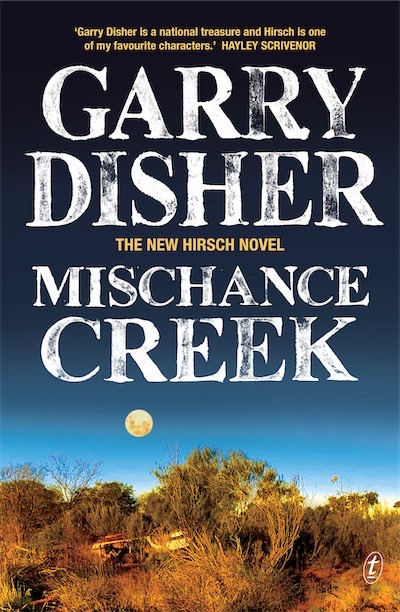
Unlike many of the novels in the new wave of Australian rural noir, Disher doesn’t begin his novels with acts of violence or terror. The Hirsch novels begin with Hirsch patrolling vast areas of farmland in his Toyota four-wheel drive and Mischance Creek is no exception.
It’s mid November and Hirsch is undertaking a firearms audit, checking gun safes and ammunition storage on the remote farms and properties of his beat in northern SA. The country and its farmers are suffering from drought, “worse than 1967, according to the old-timers whose fathers had almost walked off the land back then, or 2008, or 2024 according to later generations, who were thinking of pulling their kids out of boarding school in Adelaide and sending them to Redruth High”.
As a result tensions are high, teachers at the primary school are being threatened by angry parents; the local council meetings are fractious with accusations of corruption, particularly against the mayor, Clarissa Stanyer, married to the wealthiest grazier in the district.
A number of angry farmers have joined a group called My Place that “at a simple level seemed to be about covid-era anti-lockdown, anti-vaccination and freedom-of-movement ideas, but mostly it argued local councils were corporate entities set on undermining property rights”.
When Hirsch breaks up an angry dispute between farmers and bankers trying to issue a foreclosure notice he thinks: “This could be a Trump rally… taking in faces everlastingly stunned, angry, fearful, unsophisticated and suspicious of the mainstream”. A number claim to be sovereign citizens.
And then Hirsch is called out to Mischance Creek to help a distressed motorist who has driven into a ditch. But Annika Nordrum is not a foolish tourist. She’s looking for the body of her mother.
Her parents had owned a gem shop in Adelaide and liked to go fossicking three or four times a year – “poking around the outback for gold, opals and semi-precious stones”. They were experienced and well prepared.
Her father’s body had been found at the bottom of a mineshaft seven years ago but her mother had disappeared. Hirsch is intrigued and opens a cold case investigation.
Mischance Creek with its complex plot and empathetic policeman, is crime fiction at its best. Disher’s delaying and withholding tactics create suspense and the urge to keep reading. And at the end, he ties up all the loose ends and order is restored.
News all day, every day at CityNewsQBN.com.au.





Leave a Reply