Music / Little Sounds Great Noises, Apeiron Baroque. At Wesley Uniting Church, November 3. Reviewed by MICHAEL WILSON.
A thoroughly charming, but thoughtful and structured program concluded Apeiron Baroque’s 2025 concert series.
Organised loosely around five of Shakespeare’s 154 known sonnets (numbers 18 and 20, and then much later ones: 83, 129 and 120), brackets were introduced entertainingly by narrator Duncan Driver.
Driver gave some background to the historical context of the poems, and scholarship around the meaning of the text. Especially fascinating was his recitation of some of the sonnets twice, with different moods and emphasis to show how the works could mean very different things when read in different ways. As such, Driver reminded: we don’t read Shakespeare; he reads us.

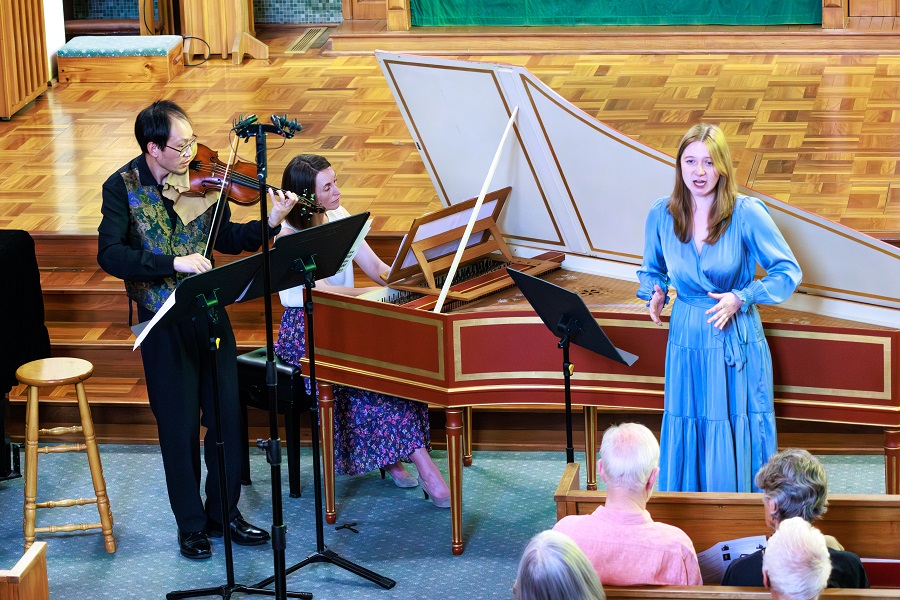
Musically, this was a festival of mostly cheerful duets between Apeiron founders John Ma on violins and Maria Searles on harpsichord, joined in several songs by soprano (and composer) Rylee De Salis, recently graduated from the ANU School of Music. The Purcell brothers (Henry and Daniel) featured, alongside lesser-known baroque composers like Francesco Geminiani, Christoph Graupner and Johann-Paul Westhoff.
Searching beneath the words of the sonnets and the songs, themes of adoration, lust and desire bring with them obsession, jealousy and even madness. So the lightness and lyricism in the music became darker on engaging with the texts, especially as the concert drew on.
Still, it was clear that Ma and Searles were having immense fun with this music, Ma standing beside the keyboard so that visual and physical cues were easy. De Salis’ easy light soprano, with a pure clarity and using relatively little vibrato, was a perfect match to the baroque art song style. Her performance was confident, well coloured to match shifting moods, and underpinned by great technique which had her filling the (sometimes difficult) Wesley space effortlessly.
Particular highlights were Carlo Lonati’s Chamber Sonata No.2, with a heart-stopping, dramatic beginning and very fast bow strokes up and down the scale before a largo section where Ma was playing different lines on separate strings simultaneously in a virtuosic display of double-stop technique.
In Henry Purcell’s If Love’s a Sweet Passion, Ma and De Salis achieved a lovely, sympathetic interplay, followed by Westhoff’s Imitatione delle campane (imitation of bells), which is almost a violin study on two strings, occasionally discordant, with phrasing like easy breathing.
In Nicola Matteis’ Aria Burlesca, a raunchy folkish mood was emphasised by De Salis taking up tambourine and shakers, with Tartini extending the theme in competitive gypsy dance (his allegro assai from Sonata No.5).
Despite the final bracket being headlined by Shakespeare’s almost cruel sonnet 130 – My mistress’ eyes are nothing like the sun – this summery afternoon’s beautifully assembled and precisely executed performance finished with Daniel Purcell’s Chaconne from The Unhappy Penitent: sweet and longing in minor mode, in the style of variations around a central melody, complete with a final mischievous, improvised flourish (which was for an instant, perhaps, not strictly baroque?).
News all day, every day at CityNewsQBN.com.au.


Leave a Reply