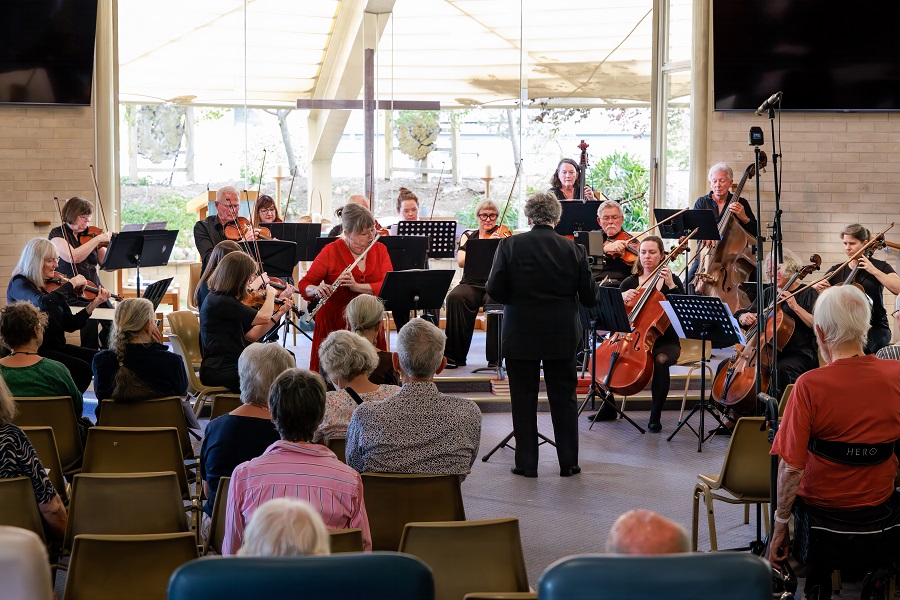
Music / Inspire, Imagine, Hope, Musica da Camera. At Holy Covenant Anglican Church, Cook, November 1. Reviewed by SARAH BYRNE.
A small but rapt audience turned out for Musica da Camera’s latest outing, a challenging program of Swiss and Australian music curated by this quarter’s invited musical director, eminent conductor Monica Buckland.
The concert opened with Schoeck’s Sommernacht (how very Canberran), an attractive piece but possibly a little ambitious for the reduced ensemble, a slightly scratchy start redeemed later by some lovely individual work, particularly from concertmaster Tanya Jenkin. The group struggled to synchronise at times, in the faster and more complex passages, but did well with the longer strokes of the slower passages, yielding some beautiful and aptly summery harmonies.
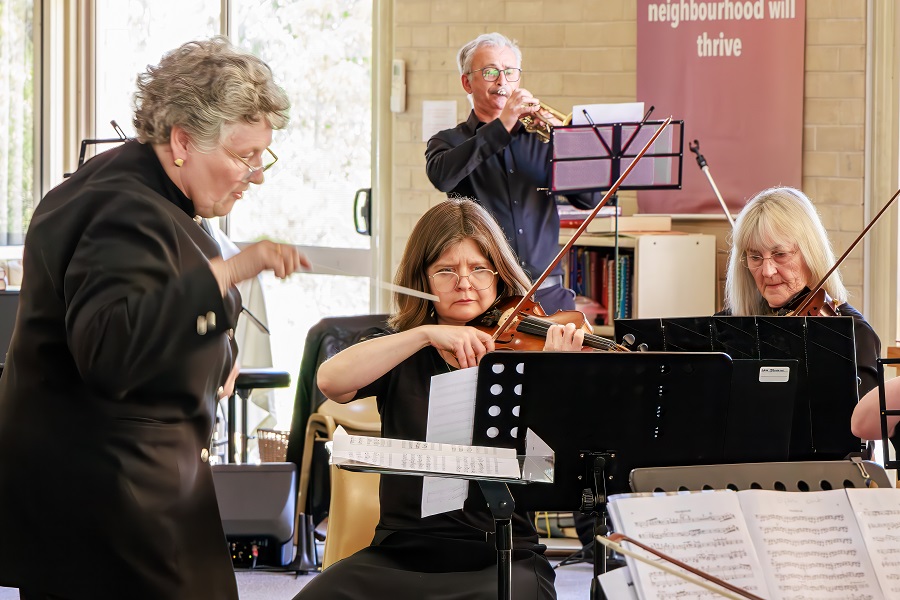
This was followed by the impressive Guwara, by First Nations composer and ANU professor in composition Christopher Sainsbury, evoking the eponymous high wind of early spring in the composer’s Dharug country. There is a grandeur to the piece, the sweeping interplay between first and second violins underpinned and punctuated by gusts and rushes from cello and bass.
My favourite entry on the program was another Australian piece, flautist and composer Christine Draeger’s 2019 suite Three Dances for Imaginary Animals, featuring Draeger herself as soloist. This was utterly delightful, with the ensemble appearing more comfortable in a supporting role.
For the first movement, Quadruped, think of a baby goat or fawn (or faun, even) capering to a cha-cha humoresque. At least, that’s what I was doing. In the words of Noel Coward, I couldn’t have loved it more.
Our next imaginary animal was the Bird, soaring and diving graciously through a rural landscape, with pretty bird calls so beloved of flautists – and their audiences.
Finally was the Fish, not so much an imaginary creature as very clearly Schubert’s Trout, an amusing and attractive pastiche to a tresillo/habanero rhythm. We entered the interval in excellent fettle.
We returned to Swiss composers for the second part of the program via Honegger’s Symphony No 2, another ambitious piece, accurately described by Buckland as “hard, dark” music.
The influence of Honegger’s film composing is evident, as is the anguish and trauma of living under Nazism, an opening of sinister cello giving way to anxious violins.
The third movement was well-performed and is a disturbing parody of cheerfulness, some interesting work from the violas and cellos yielding to a frenzy of sound with occasional glimpses of tonality.
Melody and a sense of hope arrives at last with the entry of Mark Strykowski’s solo trumpet, plangent and noble, soaring above the strings until they find their own melody, resolving into a magnificent, beautiful final chord, epitomising the hope of the concert’s title.
If this is what Musica da Camera can do with a reduced ensemble, they should be truly impressive when at full strength.
News all day, every day at CityNewsQBN.com.au.


Leave a Reply