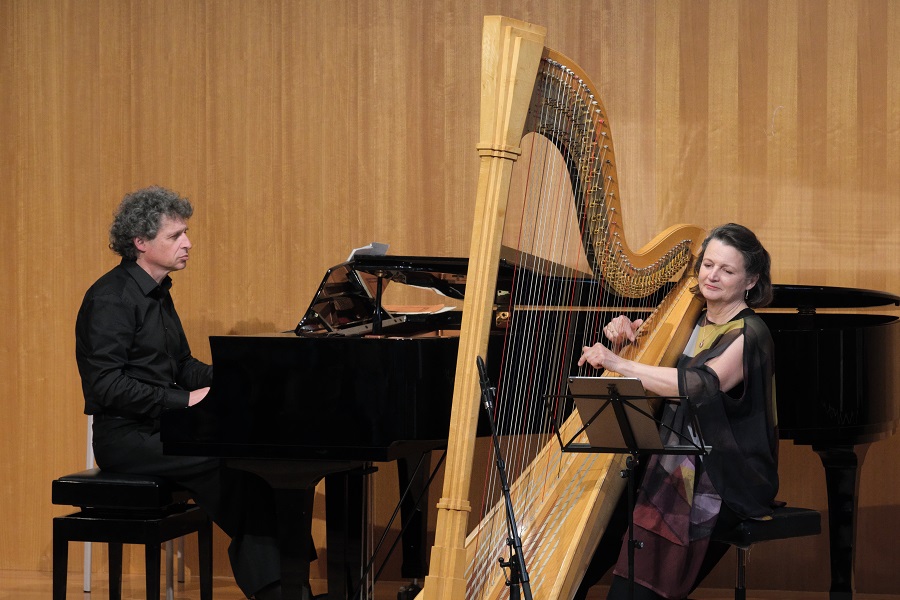
Music / Harmonic Curves: Harp and Piano, Alice Giles, harp, and Arnan Wiesel, piano. At Wesley Music Centre, September 21. Reviewed by LEN POWER.
In a concert of harp and piano, you might think that the piano could easily dominate a delicate instrument such as the harp.
The artists – Alice Giles, harp, and pianist Arnan Wiesel – showed how both instruments can harmonise with each other in a program of music by CPE Bach, JS Bach, Charles Eakin, Emile Deltour and Carlos Salzedo.
Giles has had a wide-ranging career and has appeared as guest artist at international chamber music festivals. She has given master classes in harp around the world and is a lecturer at the Sydney Conservatorium of Music.
Wiesel’s career as solo and chamber musician has taken him to many countries internationally. He has performed with numerous orchestras around Australia and is the former head of the ANU School of Music keyboard area. He currently has a teaching studio in Canberra.
The program began with Four Little Duets by CPE Bach. The first was a sparkling, melodic work that contrasted with the more reflective and delicate slower second and third duets. The fourth was again melodic and bright and all four were a great choice to show the harp and piano working successfully together.
Wiesel then played a piano solo, Toccata in D Major for keyboard, by JS Bach. This dramatic work was given a superb performance. Wiesel also mentioned that the organisational skills of CPE Bach, a fine composer himself, and the son of JS Bach, ensured that much of his father’s music is still with us today.
Giles introduced the next duet, saying that it was one of their favourites to play. This modern work by Charles Eakin required the use of extended techniques. It was edgy, colourful and dramatic, and both artists gave it an extraordinary performance. It was one of the highlights of the program.
After a short break, Giles and Wiesel played Carlos Salzedo’s Sonata for Harp and Piano in one movement. The work showed the power and clarity that both instruments can achieve together. Giles explained that the work featured sonorities and resonances that could make it hard to tell which instrument they were coming from. It was fascinating to hear this in action. It was a very dramatic work and another highlight of the program.
Giles then played two works for solo harp by Salzedo – Ballade Op. 28 from 1914, composed near the start of his career, and Traipsin’ Thru Arkansas from 1955, near the end of his career. The first was a lush, romantic work with hints of the modern works to come from the composer, and the second showed his connection to folk music of the time. This was a joyful, melodic, almost foot-tapping, work.
The final piece on the program, Boogie Woogie for Harp and Piano by Emile Deltour, was delightful with its boogie woogie beat bouncing between the instruments. The artists then played a passionate, rousing Spanish Dance No. 5 by Granados as an encore.
Highlighting the sonoric meeting places and differences of these two instruments produced a beautifully played concert that was educational as well as highly entertaining.
News all day, every day at CityNewsQBN.com.au.


Leave a Reply