Photography / Paradox of Control, by Maddie Hepner. At CCAS Platform, Forrest, until September 21. Reviewed by CON BOEKEL.
Hair has pervasive power: we tear our hair out because of frustration; intimate moments may involve hair play; we twirl our locks by way of relaxation.
Schools may impose hair rules by way of student control. Hair, genderised, may be a crowning glory. The absence of hair in men is treated as if it were a disabling social disease requiring an industry to provide expensive ‘cures’.
US marines are shorn bare as one of the preliminaries to stripping them of their individuality. The musical Hair expresses the opposing ideology – hair control as individual freedom.
Gabrielle Hall-Lomax’s excellent exhibition essay explores such ideas and sets them in art history. Hall-Lomax neatly encapsulates it thus: “Hair is always more than itself.”
Hepner suffers from compulsive hair pulling – trichotillomania. The two poles of this disorder consist of playing with hair by way of relieving anxiety and pulling hair out because of a surfeit of anxiety. The exhibition explores this personal paradox and relates it to the larger paradox of our digital world. We use digital means to alleviate anxiety. This may then turn against us by increasing our anxiety – often to self-destructive levels.
Hair and hands are the dominant visual motifs of the exhibition.
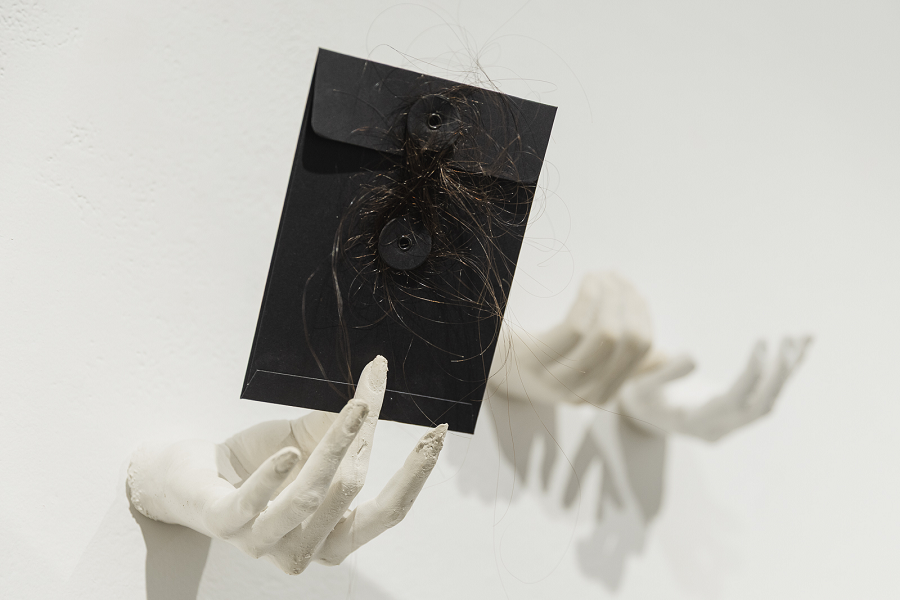
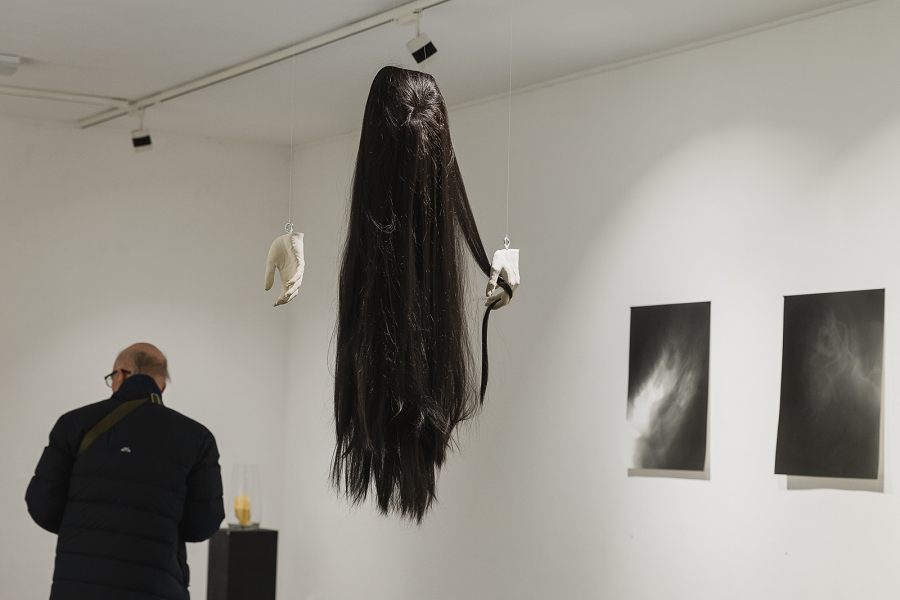
Plaster casts of Hepner’s hands, palm up, line one wall. Symbolically, these hands signal openness and acceptance. The major central installation involves a hand with hair entwined between the fingers. This is both intimate and menacing. Wax candles, also cast from Hepner’s hands, light the corners of the exhibition space.
Two videos enrich the exhibition. In one, a woman cradles her “baby” – a wig. In the other, wind-blown hair mimics hair product ads and expresses beauty, freedom, individuality and personal power.
The exhibition features a series of photograms made using hair. The title of the series “Haptic” means “relating to the perception and manipulation of objects”. In keeping with the exhibition title, the results have both an immediate and an elusive quality.
This is a wonderful exhibition layered with paradox upon paradox. It is personal and political. It is about fragility and courage. It is unsentimental and sensitive. It is tough and gentle. It is accepting and questing. It is evocative without being proscriptive.
The hand candles anchor us in real time. To be human is to live with unresolved paradoxes.
News all day, every day at CityNewsQBN.com.au.




Leave a Reply