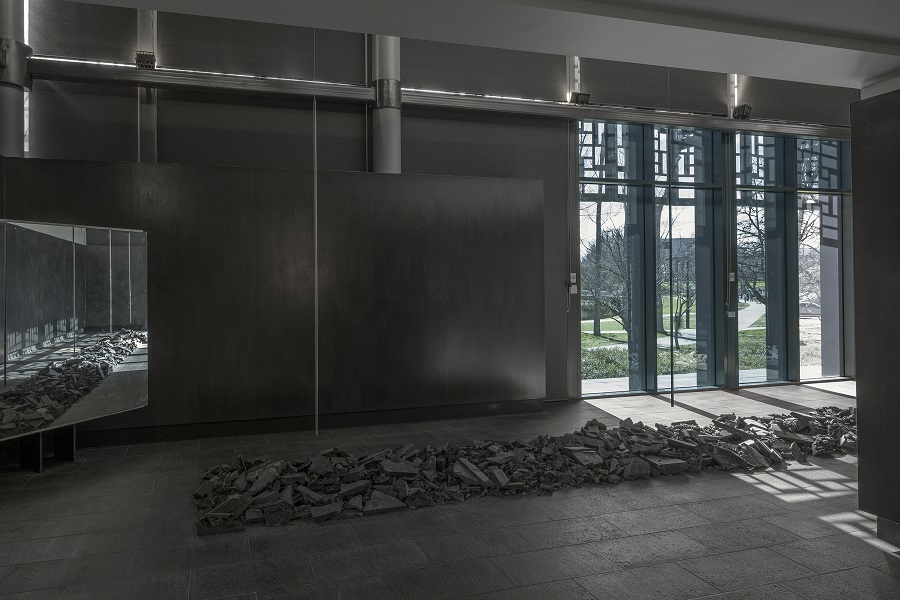
Visual art / Metal. At Australian Centre on China in the World Gallery, until November 14. Reviewed by SOPHIA HALLOWAY.
The Australian Centre on China in the World, part of the embattled Australian National University’s College of Asia and the Pacific, is a leading institute in Chinese Studies.
The centre’s small gallery demonstrates the value of visual art in its role in research, education and outreach to Australians on China.
The CIW Gallery is at times difficult to visit – it’s only open on weekdays – but the exhibition program curated by director Ari Heinrich and exhibitions and collections officer Chin-Jie Melodie Liu punches well above its weight.
The program includes the kinds of established artists you’d expect to see at major galleries and biennales, as well as some new favourites and emerging artists.
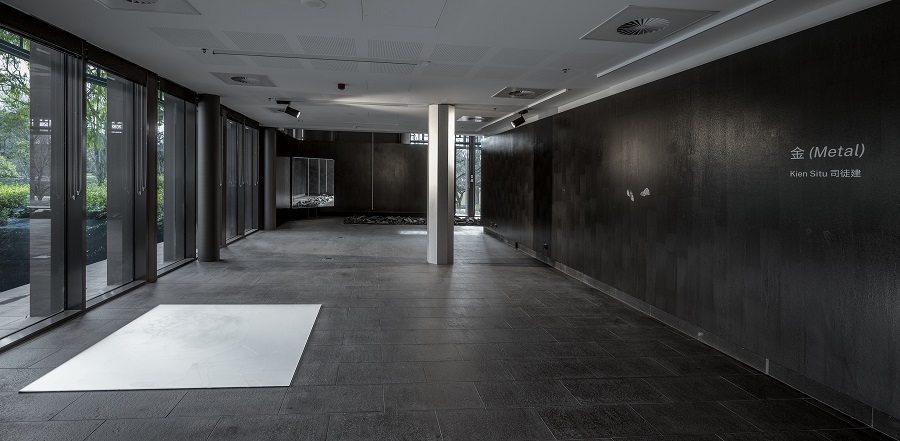
The CIW Gallery’s latest exhibition, 金 (Metal), is a solo show by Asian-Australian artist Kien Situ. Situ is an architect by training, and the architectonic nature of his art practice is evident in the site-specific nature of the exhibition.
The exhibition unfolds slowly before you, not unlike the sensation of eyes adjusting in a darkened room. At first glance, you wonder where all the art is, but slowly realise it is all around you.
The walls are drenched in black Chinese Mò ink, which has hardened to create lacquer-like cracks. One work, Titan, at first seems as though it has always been there, a structural aspect of the gallery, when in fact it is an intervention of the artist who has clad an existing column in titanium.
A mirror in the far-left corner draws you into the rear space of the gallery, which has been overtaken by meticulously arranged rubble. The rubble is a pile of shattered landscape plates that correspond to the 64 hexagrams of the I-Ching, an ancient Chinese divination text.
Every material is chosen thoughtfully to further the conceptual premise. Titanium evokes extraction and the geopolitical nature of metals. Incense, historically used to keep track of time, is incorporated into the landscape tiles in ash form, capturing the artist’s own time in his work.
Some materials are recycled from earlier works, relating Situ’s own work and practice to philosophies of ruin and reincarnation.
The overall effect is immersive and meditative. The exhibition effectively invites us into the world of Chinese-Australian contemporary art.
The conceptual premise might seem a bit puzzling to visitors unfamiliar with contemporary art or Chinese philosophy – further reading may be required to make sense of it all – but this serves to encourage exploration into the spiritual and historical concepts that Situ is referencing, and a greater understanding of China in Australia.
News all day, every day at CityNewsQBN.com.au.



Leave a Reply