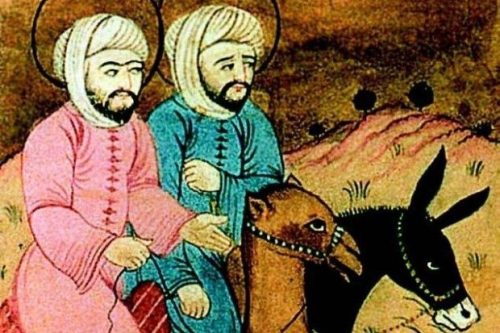
Despite the complex differences, Whimsy columnist CLIVE WILLIAMS finds many parallels between between Christianity and Islam.
“Some people say there is a God. Others say there is no God. The answer probably lies somewhere in-between.” –WB Yeats
Christianity and Islam are the world’s two major monotheistic religions.

They’ve had a complex relationship for 14 centuries – but there seem to be many parallels between the two.
I thought the differences and parallels between the two religions were something I needed to know more about, so I did a bit of research. The result is as follows:
- Christianity and Islam both have sacred texts that guide their beliefs and practices. Christianity primarily relies on the Bible, which consists of the Old Testament and New Testament, while Islam’s sacred text is the Koran. Both religious traditions also include supplementary texts that provide additional guidance, such as the Hadith in Islam and various Christian theological writings.
- The Old Testament, also known as the Hebrew Bible, is considered sacred by both Jews and Christians. It contains history, laws, prophecies, and poetry that lay the foundation for Jewish and Christian beliefs. Many of the figures and stories in the Old Testament have direct parallels in the Koran.
- Both the Bible (Genesis 1-2) and the Koran (Surah Al-Baqarah 2:30-34) describe the creation of the world and the story of Adam and Eve. While both texts mention their disobedience in the Garden, the Koran does not include the concept of original sin, which is central to Christian theology.
- The Koran acknowledges many biblical prophets, such as Noah (Nuh), Abraham (Ibrahim), Moses (Musa), and David (Dawood). Their roles and stories often align closely, though with variations. For example, Moses is a key figure in both traditions, leading the Israelites out of Egypt (Exodus in the Bible; Surah Taha 20 in the Koran).
- The Ten Commandments (Exodus 20) have counterparts in Islamic teachings. The Koran emphasises similar moral principles, such as monotheism, honouring parents, and prohibiting murder, theft, and adultery (Surah Al-Isra 17:23-39).
- The New Testament is the central text of Christianity, particularly because it details the life, teachings, and resurrection of Jesus Christ. The Koran also speaks about Jesus (Isa), though it differs in key theological aspects.
- In the New Testament, Jesus is the Son of God, the divine saviour who dies for humanity’s sins and resurrects (Gospels: Matthew, Mark, Luke, John). In contrast, the Koran recognises Jesus as a great prophet but denies his divinity and crucifixion, stating instead that he was raised to heaven (Surah An-Nisa 4:157-158).
- Mary (Maryam), the Virgin Mary is highly revered in both Christianity and Islam. The Koran has an entire chapter named after her (Surah Maryam 19) which describes the miraculous birth of Jesus, similar to the accounts in the Gospels (Luke 1-2).
- The moral teachings of Jesus, especially in the Sermon on the Mount (Matthew 5-7), share similarities with Islamic principles in the Koran. Both emphasise humility, charity and devotion to God.
Just as Muslims refer to the Hadith (sayings and actions of the Prophet Muhammad) for further guidance, Christians have early church writings, theological works, and church traditions that shape their faith.
Early Christian theologians such as Augustine and Aquinas helped define Christian doctrines, much like Islamic scholars who compiled the Hadith and wrote legal interpretations. The Hadith, though not comprising divine revelation like the Koran, plays a role similar to the Gospels in preserving the words and actions of a central figure – Muhammad for Islam, and Jesus for Christianity.
While the Christian Bible and the Koran differ in theology and specific narratives, they share significant common ground in moral teachings, reverence for prophets, and belief in one God. The Old Testament’s laws and stories parallel many Koranic accounts, while the New Testament’s focus on Jesus finds both agreement and divergence with Islamic teachings.
Over the centuries it’s estimated that fighting between Christians and Moslems has resulted in 15-20 million deaths, and between Catholics and Protestants more than 10 million deaths, while between Sunni and Shia it’s at least several million deaths.
When you look at the parallels between the two main religions, and what the main protagonists have in common, that’s an awful lot of seemingly pointless deaths when all parties concerned believe in one similar god. The animosities seem to be mainly due to competing religious bureaucracies.
On a lighter note: Charles pulled a nose hair out today to see if it hurt. Judging by the scream of the man sleeping next to him on the bus, it certainly did.
Clive Williams is a Canberra columnist
News all day, every day at CityNewsQBN.com.au.




Leave a Reply