
Book reviewer ANNA CREER slips back in time to review two books of historical fiction that focus on two women overshadowed in history by powerful men.
Alison Weir is the biggest-selling female historian in the UK since records began in 1997.

She has published 32 titles and sold more than three million books worldwide. Her historical novels bring into focus the lives of England’s Queens, particularly from the Tudor period, including the Tudor Rose Trilogy and her critically acclaimed Six Tudor Queens series about the wives of Henry VIII.
Her latest historical novel, The Cardinal. The Secret Life of Thomas Wolsey, (Headline) explores the extraordinary rise and fall of Wolsey.
Weir says in her author’s note that her aim is “to show Wolsey as a statesman with an international, or European vision, and a player and peacebroker on a world stage”, while at the same time revealing his hidden private life.
Although Weir keeps close to the contemporary sources in her portrayal of Wolsey, particularly George Cavendish’s The Life of the Cardinal (1641), she has had to imaginatively reconstruct the story of Joan Larke, Wolsey’s mistress from 1509-1520, a woman who was hidden away to avoid scandal.
Weir’s story begins in 1482 with an 11-year-old Tom Wolsey, the intelligent, gifted son of a Suffolk tradesman, at school in Oxford, becoming a fellow at Magdalen College before being ordained and appointed as chaplain to the Archbishop of Canterbury.
His diligence and organisational skills bring him to the attention of Henry VII. He becomes the King’s Chaplain and Almoner. It’s the beginning of his rise to power.
However, it’s when Henry VIII becomes King in 1491 that, through a series of promotions, Wolsey becomes the most powerful man in England. Henry realises he can leave matters of state to Wolsey, while he hunts and plans indulgent pursuits. They form a close bond with Weir suggesting Wolsey “regarded this golden young man as a son”.
Once the Pope makes Wolsey a cardinal, his power is confirmed in both church and state. At the same time, he has installed Joan Larke as his mistress and while his public life is extravagant and ostentatious, his other secret life is as important until he has to choose between the two.
Weir argues that when Wolsey arranged an advantageous marriage for the king’s mistress Elizabeth Blount, the mother of Henry’s bastard son, a furious Henry, orders Wolsey to give up Joan.
Wolsey had made many enemies during his time at court, in particular Anne Boleyn and her family. It will be the King’s Great Matter and pressure from Anne Boleyn that bring about his downfall.
The Cardinal is not the equal of Hilary Mantel’s Wolf Hall, nor has Weir the elegance of her prose but she does bring the world of the past to life with skilful story telling.
THREE centuries later in 1788, on the other side of the world, in the new colony of New South Wales, another powerful man takes a mistress and Sue Williams tells their story in her latest novel, The Governor, His Wife and His Mistress (Allen & Unwin).
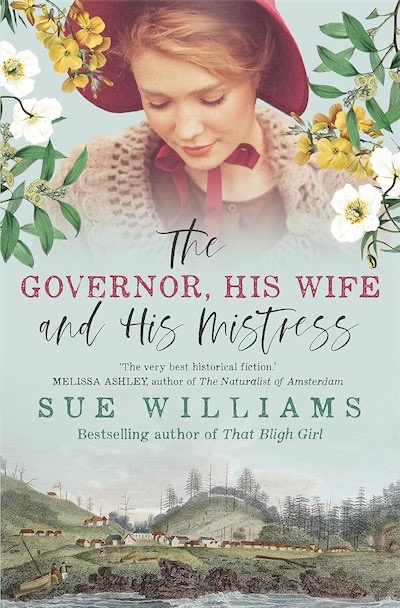
Williams is a journalist and travel writer and, until 2021, she wrote mainly nonfiction. However, her first two historical novels, Elizabeth and Elizabeth (2021) and The Bligh Girl (2023) were best sellers.
Her third novel is a prequel to her series on the early days of colonial Australia. Her aim, in all three novels is “to give a voice to some of the most fascinating characters, usually women, who have been the most unheard until now”.
Philip Gidley King, who sailed on the First Fleet, second lieutenant on the Sirius, was chosen by Arthur Philip to establish a second penal colony on Norfolk Island, describing him as “an officer of merit… whose perseverance may be depended upon”.
As commandant of the colony, he was allowed to choose a housekeeper from the female convicts and he chose Ann Innett.
Ann has been transported to Botany Bay for seven years for theft. Forced to abandon her two small children, she survives the sea journey but is reluctant to become King’s housekeeper knowing all that it implies. But King is kind and eventually she bears him two sons.
However, when Phillip sends King back to England in 1790 to report on the problems facing the new settlement, he returns with a wife. Ann is devastated.
Apart from the harrowing descriptions of conditions on the female convict ship, this is a rather sanitised version of life in the early colony. However, Williams, like Weir, does bring into focus two women overshadowed in history by powerful men.
News all day, every day at CityNewsQBN.com.au.





Leave a Reply