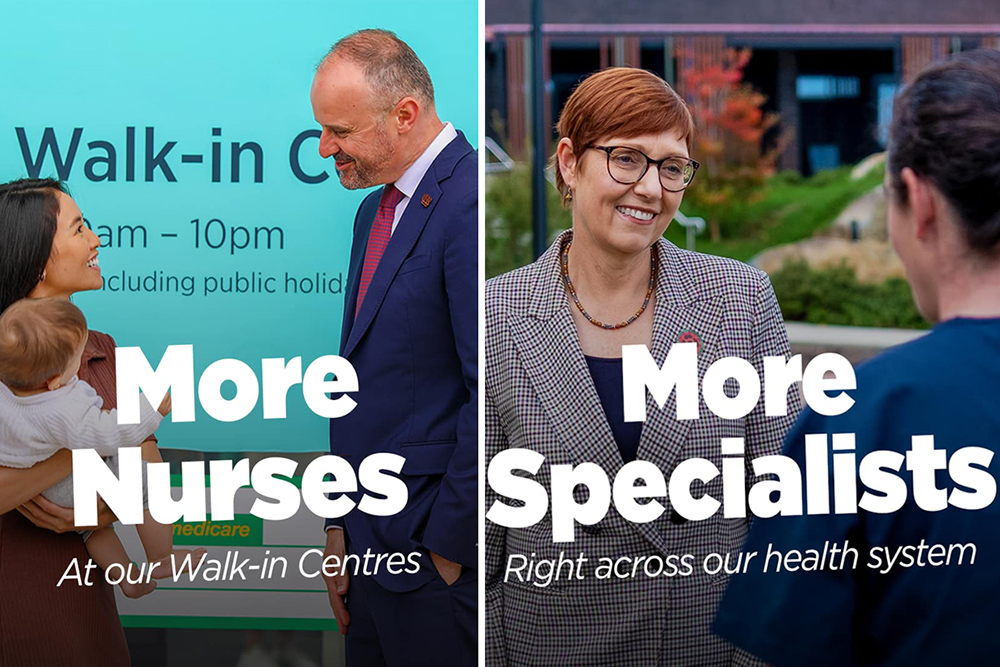
“Interest costs alone for light rail Stage 2A amount to $94 million over the next four years. The health levy would just about cover those costs.” JON STANHOPE & KHALID AHMED lay bare the budget trainwreck.
The ACT’s finances are a shambles and Treasurer Chris Steel’s first budget is a trainwreck, universally condemned, even by his federal colleagues, and amended by the Legislative Assembly within a week.
To our knowledge, this is the first time since self-government that such a backflip has been forced on a government, notably even before the commencement of Estimates Committee hearings.
The changes, demanded by the Greens, have reduced the “Health Levy” from $250 on every residential and commercial property to $100 for residential properties.
The tax on commercial properties will remain unchanged and the revenue shortfall – an estimated $120 million over four years – will reportedly be made up by increasing the payroll tax rate to 8.5 per cent, which will be the highest in Australia.
While the government is legally required to publish the revised budget estimates, we have assumed that the changes will be in the revenue lines, rather than on the expenditure side.
The budget strategy – if it can be called that – is no different than previous budgets, being comprised of an unrealistic assumption of revenue growth and expenditure constraint along with a risible forecast of a miraculous turnaround in the operating budget, with the operating cash deficits and capital program largely consisting of unworthy and uneconomic vanity projects funded through borrowings.
Blame for the parlous state of the finances will, of course, fall on someone or some event but most assuredly anyone other than the ACT government (eg, the Commonwealth government, Grants Commission, pandemic, the weather, global events, the Catholic Church, climate change or even the GFC!) when agencies overrun their budgets, and the actual revenue collection falls short of the imaginary numbers in the budget.
The $250 flat health levy on all residential and commercial properties may possibly have succeeded, despite being regressive in nature and contrary to the Medicare Principle in optics, since regressive taxes and breaches of some basic principles have gone unnoticed in the past.
Assuming the Treasurer is able to substantiate his claims of:
(a) health expenditure now constituting 36 per cent of the total budget;
(b) growth in health costs putting the budget on “life support”; and
(c) underfunding by the Commonwealth government.
Based on data from the ABS, the budget share of health expenditure in the ACT has, since 2016, remained below the weighted average share across all states and territories.
Remarkably, information published in the 2025-26 budget papers also paints an entirely different picture than contained in the Treasurer’s budget story (points a-c) above.
Table 1 details the expenditure allocations in the budget for hospitals and health services, and the corresponding Commonwealth funding.
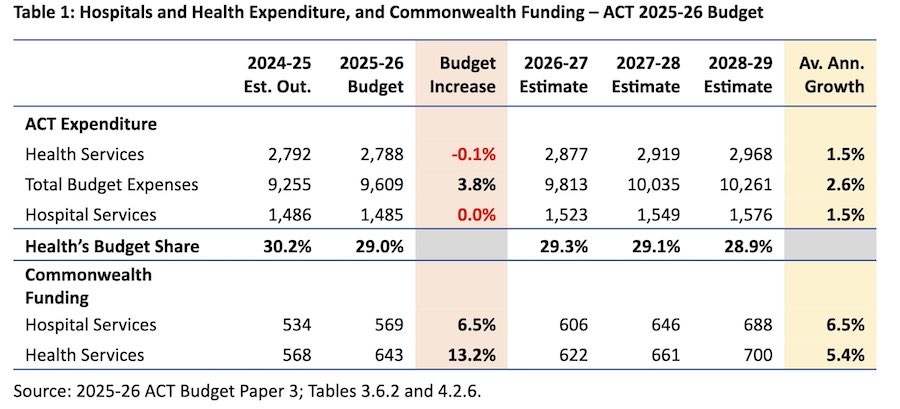
In 2025-26 (the budget year), health expenditure will be 0.1 per cent less than the estimate for the previous year. The budget provides for health funding growth over the forward years, to 2028-29, at an average rate of 1.5% a year.
The 2025-26 budget for hospital services (a component of the total of health services) likewise decreases from the previous year and grows at a meagre 1.5% per annum in the next four years.
The budget forecasts change in the CPI at 2½ per cent and the Wage Price Index at 3¼ per cent. Health’s share of the total budget decreases from 30.2 per cent in 2024-25, not 36 per cent as claimed by Treasurer Steel, to 28.9 per cent in 2028-29.
In stark comparison, in 2025-26, Commonwealth funding for hospitals increases by 6.5 per cent, and for total health services by 13.2 per cent. Across the forward estimates, Commonwealth funding growth for health services is 6.5 per cent annually, which is more than four times the rate of growth of the expenditure that the ACT government has provided for in the budget.
Table 1 shows, unequivocally, that neither ACT hospitals nor the health services budget generally, will receive the funding that will be raised through the now infamous health levy.
In fact, on our reading of the budget we have been unable to identify funding for health sufficient to cover inflation or growth in the wage costs of existing employees.
We are at a loss to understand the basis on which Chief Minister Andrew Barr and Treasurer Chris Steel heaped the blame for the chronic underfunding of health and hospital services in Canberra on Prime Minister Anthony Albanese and Minister for Finance Katy Gallagher.
The budget papers include many pages of “health initiatives” which lack credibility, just as did the Labor pre-election promise to employ an additional 800 extra health staff. A promise, the keeping of which has not been reflected in either health staff numbers or the budget.
In reality, Canberra Health Service has a massive challenge in both maintaining activity at last year’s level and paying its existing staff.
The revenue changes, negotiated by the Greens, do not improve the budget or make it any fairer or progressive. There is still a “Health Levy” raising $80 million from residential dwellings over the next four years. It is still flat – the same for battlers on low-to-moderate incomes as for millionaire politicians.
It is not necessarily directed to health services. It is the same for those who use the services and those who don’t. In short, it is a blunt revenue-raising measure without regard to principle.
The Greens now “own” this budget, just as they do the past 13 Greens-Labor coalition deficit budgets.
We will provide detailed comment on the revenue measures once the government releases the revisions to the budget. Notably, it is naïve to think that the remnant health levy will have no impact on the cost of living, or that the increase in payroll tax will have no economic impact on employment or prices.
So, if the new money from the levy has not gone to health, what new expenditure will it cover?
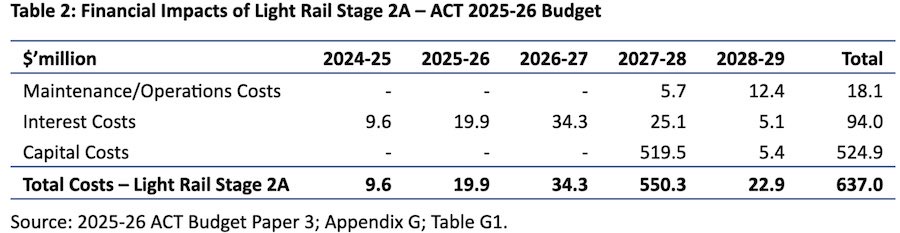
Table 2 provides the financial impacts of Light Rail Stage 2A over the budget and forward estimates period.
Interest costs alone for Stage 2A amount to $94 million over the next four years. The health levy would just about cover those costs.
Immediately after the budget, local mainstream media asked its critics what they would have done differently. It has also been claimed that the territory’s financial woes should not be attributed to the tram project.
To solve the territory’s budgetary woes – a medium-term task – the treasurer would be best advised to revert to the first principles of sound financial management and sound policy that have regrettably now been abandoned by the ACT government for well over a decade.
He may start by having a rethink about light rail, knowing that the health levy would not have been necessary – all else being equal – if Stage 2A had not commenced.
The still vivid images of an electioneering Anthony Albanese, flashing his Medicare card in order to reassure Australians that it was only under a Labor government that universal access to healthcare could be guaranteed, together with the bashful voices of local ALP candidates asserting that “support for Medicare is in Labor’s DNA”, were more than a tad undermined by ACT Labor’s 2025-26 budget “strategy”.
In the meantime, “Health Levy” could be more appropriately named “Tram Levy”. That would draw less ire from Steel’s federal colleagues, some of whom, ironically, have been urging him to persist with the project.
Jon Stanhope is a former chief minister of the ACT and Dr Khalid Ahmed a former senior ACT Treasury official.
The budget: how about heartless, thoughtless, lazy and regressive?
News all day, every day at CityNewsQBN.com.au.



Leave a Reply