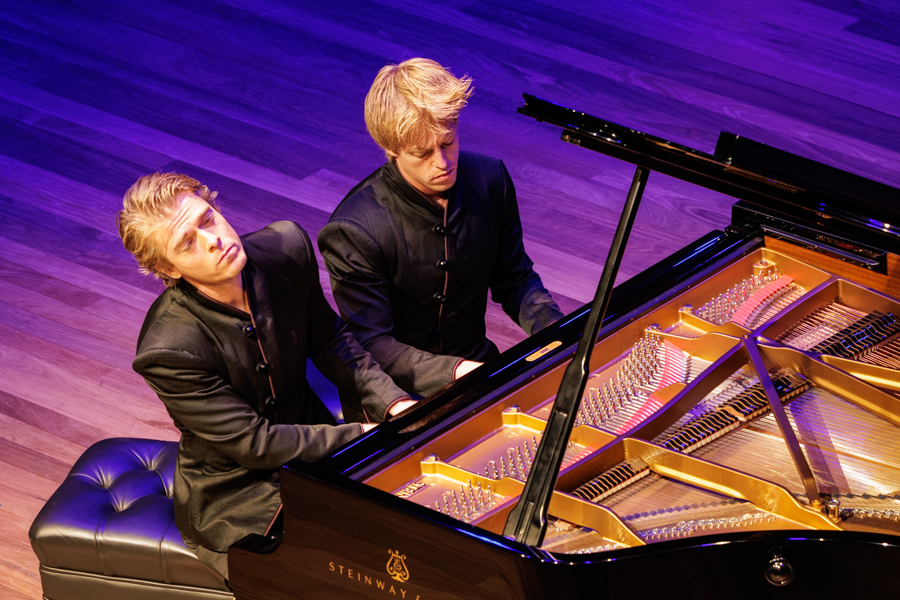
Music / Lucas and Arthur Jussen, Snow Concert Hall. August 28. Reviewed by DAVID WHITBREAD
Arthur and Lucas Jussen proved why they are in demand around the world with an almost perfect program showcasing works for four hands on one piano.
The brothers from the Netherlands captured attention with their spirited playing.
The opening work, Mozart’s Sonata for piano in D, instantly established the clarity and precision of their technique. But also their lively interpretive skills, finishing with a delightfully playful dance movement. Notable too was the almost conversational answering lines between the players, yet an uncanny unison between their right hands when required.
Schubert’s Fantasie in F minor was a great contrast. They captured the stylistic requirements of the early Romantic period and found the drama in the work, notably when the original theme returned (twice). Surely noone could doubt Schubert’s position in the pantheon of great composers after hearing this impressive work. It still bears the hallmark melodic invention of his songs and ballets, but has large scale ideas beautifully expressed by the two pianists. They were rewarded with cheers from the comfortably full audience in Snow Concert Hall.
And completing the first half was a real showpiece. The pianists swapped places and moved their piano stools. They then demonstrated how their touch was indistinguishable from the other with significant swapping of the main theme of Mendelssohn’s Andante. In fact, even though their hands were visible, aurally you could not identify the changeovers which magically maintained the shape of the lines, the touch and dynamics. The response was rapturous and they needed to do a curtain call to calm us, despite a second half to come.
Stravinsky’s Rite of Spring (Le Sacre du Printemps) version for four hands is a phenomenal piece de resistance. The full orchestral work is rightly considered a masterpiece, but this four-hand version has a clarity that is revelatory.
The dynamism of this performance captured the fantastic chunky chords, accented with great pulse, and yet there were moments of incredible lightness and tenderness.
Lucas and Arthur created a full range of dynamic excellence. Indeed the Steinway may never recover. They captured the tempo changes, rhythmic urgency and the instrumental character of the familiar orchestration in their playing. The transition to the slow Khorovod theme was simply wonderful.
Such clear delineation of melodic lines across and through the complex harmonic and rhythmic textures was exciting to hear from one instrument.
Prodigious memory is required to perform such a work, and indeed the whole program.
But more than that, performing these works on a single keyboard required choreography of bodies, hands, arms and feet. It was fascinating to watch the subtle shifts in positioning that enabled hands and arms to intertwine or overlap, to share the pedalling and somehow allow each other the room to play with precision, panache and power.
Of course, the standing ovation required an encore. They told us they have loved Canberra, despite it being on the other side of the world, because of their favourite tennis player Nick Kyrgios – but they now loved how attentive we’d been to their work. And Canberra loved them too.
They finished their recital with a reverent performance of Bach’s lovely peaceful chorale, God’s Time is the Best Time.
News all day, every day at CityNewsQBN.com.au.


Leave a Reply