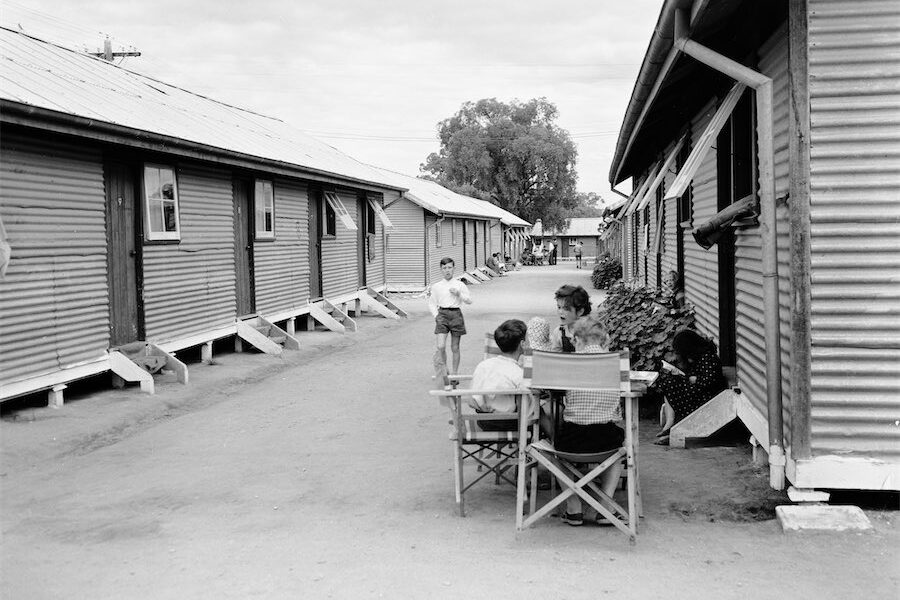
Thousands of post-war migrants passed through the Bonegilla migrant camp near Albury-Wodonga. So Bonegilla – The Migrant’s Journey is likely to strike a particularly resonant chord with ACT audiences, writes HELEN MUSA.
For many Canberra families, the story of Bonegilla is also part of their own story.
Thousands of post-war migrants passed through the migrant camp near Albury-Wodonga, with many going on to work on the Snowy Mountains Scheme before eventually putting down roots in Canberra.
So Bonegilla – The Migrant’s Journey, a multimedia work coming to Belco Arts on August 28, is likely to strike a particularly resonant chord with ACT audiences.
Creator Simon Reich describes the migrants at the heart of the work as “gutsy pioneers who left everything behind and travelled to a country they knew nothing about”.
The production combines filmed interviews with post-war migrants from across Europe with their photographs, home movies and personal documents.
Two large screens dominate the stage, sometimes creating a screen-within-a-screen, while Reich performs his own original musical score on piano with Ukrainian-born violinist, composer and improvisational specialist Alex Burkoy.
The stage itself is decorated with possessions migrants brought with them on the voyage or used during their early years in Australia, while a sea of LED candles helps create the emotional atmosphere.
For Reich, the project is also deeply personal. His German-born father, Manfred, lived through the final days of World War II in Berlin and was only nine when the war began. The family lived just 50 metres from Hitler’s bunker and waited in terror for the Russians to arrive.
Manfred later spent time at Bonegilla and began working in nearby Wangaratta. Reich says his father’s wartime experiences left him with undiagnosed PTSD, something he came to understand more fully while creating the work.
“I’ve had many descendants come up to me in tears after the show, realising what their parents had gone through,” he says.
Reich himself grew up with the uncomfortable burden of a German surname. At school he was called “the Nazi”, while one classmate famously announced at roll call, “Here comes the Fourth Reich.”
His research has taken him back to Bonegilla itself, where museum staff corrected a common mispronunciation of the name. The original name, he says, is the Koori word “Bone-gilla”, rather than the often-heard “Bona-villa”.
The production unfolds in six chapters, beginning with the journey to Australia and first impressions, moving through camp life and the transition into Australian society, and ending with “Home Sweet Home”.
The darker experiences are not ignored. Migrants speak about war, displacement and racism, but Reich is careful to balance the tragedy with humour, warmth and the often surprising details of starting a new life.
The final chapter looks at what happened when the migrants left the camps and began building their lives in Australia. Many became homeowners within five or six years, either buying or building their own houses, despite having arrived with very little.
“Many of them had left school by 14,” Reich says. “They took up trades and learnt on the job. They were a real inspiration.”
And Australia, he points out, was not their first choice. Many had hoped to go to America, with Australia often an accidental destination.
Yet for many, it worked out. Among their descendants is federal politician Tanya Plibersek, whose Slovenian-born parents came to Australia after the war, passed through Bonegilla and whose father went on to work on the Snowy Mountains Scheme.
Reich says the contemporary relevance of the work is becoming increasingly obvious as questions about multiculturalism and Australia’s identity continue to surface.
He is also finding that the production is bringing families together. Some are booking multiple tickets so children and grandchildren can hear stories their elders have never shared.
“It’s also healing families,” Reich says, particularly because the early part of the show allows migrants to talk openly about their wartime experiences and what motivated them to leave Europe.
The production can be scaled for larger venues, where Reich uses a string quartet, but at the intimate Belco Arts Theatre the music will be created by Reich and Burkoy. The score moves between nostalgia and darker passages, with the musicians sometimes improvising in response to the images on screen.
It is clearly a multimedia show with many moving parts, but Reich says audiences often respond viscerally, even wanting to take photographs in the theatre after the performance.
“Everything works together,” he says. “It’s so topical.”
Bonegilla – The Migrant’s Journey, Belco Arts Theatre, August 28 and 30.
News all day, every day at CityNewsQBN.com.au.


Leave a Reply