
ANNA CREER reviews Booker Prize winner Douglas Stuart’s new novel, which is set in the lonely remoteness of Scotland’s Outer Hebrides.
Scottish author Douglas Stuart won the Booker Prize in 2020 for his second novel Shuggie Bain, which has since sold two million copies.

The inspiration for his latest novel, John of John (Picador), came during a visit to the Outer Hebrides seven years ago, where he “learnt everything from psalm singing to sheep shearing”.
He says: “I wanted to see Scotland for myself and sensed that I wanted to write about loneliness. By the time I got to Harris the story had started to form within me”.
John on John begins with John-Calum Macleod (Cal) travelling to Harris and the small fictional village of Falabay. His father, John, has called him home because he fears Cal’s grandmother is gravely ill.
Cal has graduated from art school in Edinburgh but has failed to find work since.
Cal reluctantly returns to life in the small croft where he grew up with his father, a sheep farmer, weaver and pillar of the Presbyterian church and his tough Glaswegian grandmother, Ella.
Cal looks at the barren landscape around the croft and thinks: “It was impossible to look at the unforgiving beauty and not feel the hand of God albeit a God that cared nothing for your comfort, a God who expected you to struggle if you were to endure”.
Life is hard in Falabay especially in the winter. The community is dominated by the church and “the word of God”.
The church itself is simple and unadorned. “The interior was clad in smooth white plaster and the roof was lined in blonde fir wood, which bowed gracefully upwards like the hull of a capsized boat”. Its pews are of hard oak and deliberately uncomfortable while the congregation is segregated.
“The senior churchmen sat at the front with their families. Behind them were the Converted, a smattering of those who had gone forward and declared their faith in Jesus. Behind them sat the Unsaved”.
It’s a claustrophobic world of obedience and conformity, a world in which Cal has concealed his homosexuality since he was a teenager. Stuart reveals early in the novel that his father too has had to conceal his true nature, loving his neighbour Innes for decades.
John of John is on the longlist for the Booker Prize this year with the judges praising its “vivid sense of time and place” as well as its “beautiful imagistic detail and – unexpectedly but wonderfully – shades of hope”.
AUSTRALIAN author Rebecca Lim is a multi-award winning author of young adult fiction, a book illustrator and a lawyer.
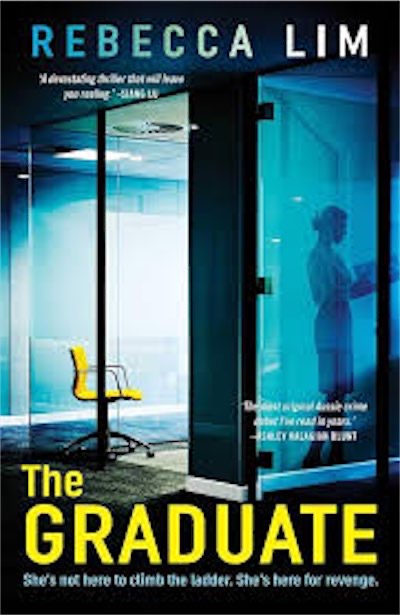
However, she is appealing to a different audience with her debut crime novel, The Graduate (Affirm Press), which she describes as “a piss-take of colonialism, the Australian legal industry, 1970s career criminals and pedophiles”.
Fei Fei Chou is one of the graduate intake into the prestigious Melbourne law firm of Eckersley Mapplethorpe Lincolne. They are told by the head of chambers that they are “the cream, the very cream of our law schools, and each one of you is here because you were meant to be here”.
However, Fei Fei is an outsider. Known as the “diversity hire” she is only one of two female graduates and the only Asian. She has the build of a malnourished 10-year-old boy” and “it was a huge turn off, how artificial and shiny she looked… she looked like a cartoon Asian woman… she was a collection of expertly shaded strong features, leaving the real person beneath rather hazy”.
But Fei Fei isn’t there to progress her career in law. She’s there for revenge. Thirty years earlier three schoolgirls from the same Melbourne high school were abducted and abused by a man who has never been identified. Fei Fei knows that his identity is hidden in the law firm’s records.
Lim has said, in an interview, that in The Graduate she is questioning “the canon – which, in the crime context, suffers from a lack of diverse Australian narratives and a tendency towards portraying an a-historical Australia peopled with a narrow subset of archetypes. Why can’t Australian crime novels also be set in cities and gleaming high rises, peopled by sophisticated, complex Australians?” (Some of Peter Temple’s iconic crime novels answer her question).
However, Lim answers her own question with this novel, a thriller within a satirical look at lawyers and the legal system. Although her characters tend towards caricature, The Graduate is riveting reading, as secrets and plots are revealed and Fei Fei’s revenge is complete.
News all day, every day at CityNewsQBN.com.au.



Leave a Reply