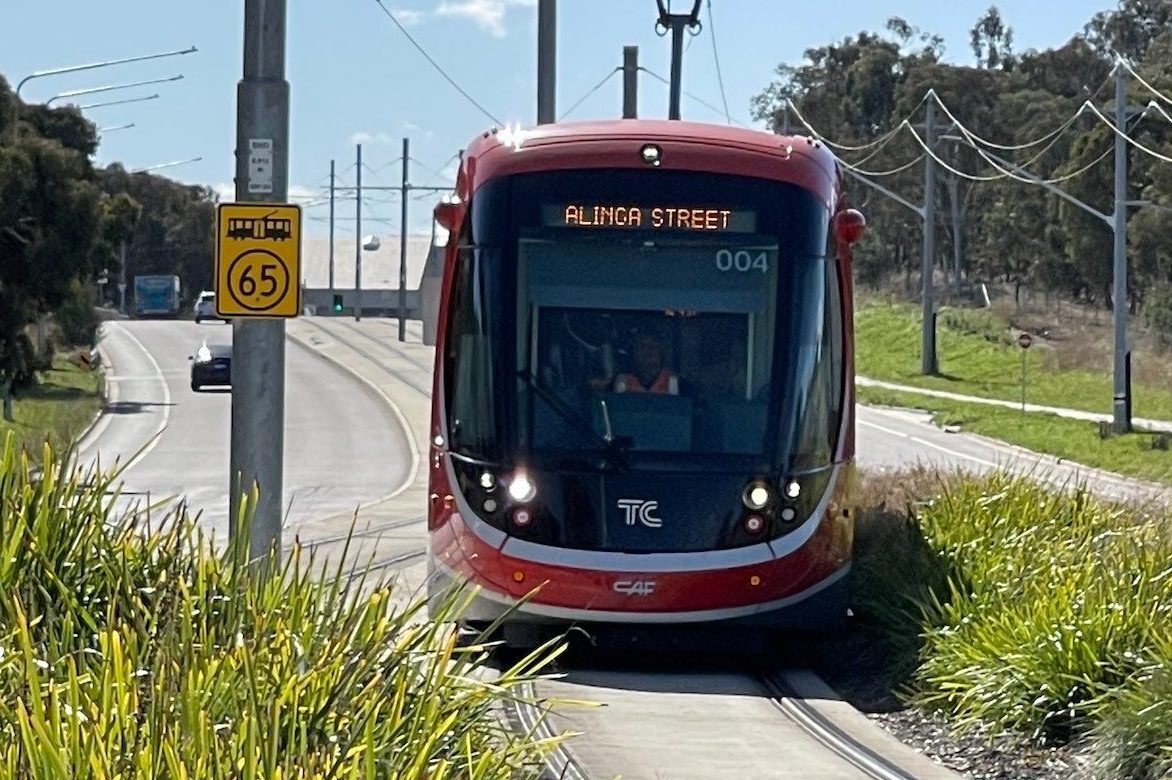
“Light rail has probably unnecessarily already cost the ACT community hundreds of millions, money that could have been used to address unmet community needs including housing, health, sport, recreation, education and reducing debt,” says letter writer MIKE QUIRK, of Garran.
I agree with Albert Oberdorf (letters, CN February 12) of the need to unlock Labor’s grip on power given its poor governance.

However, even if a coalition of non-Labor Assembly members were to occur, two glaring examples of poor governance, light rail and the low level of greenfield land release, are unlikely to be addressed.
Both are decisions based on rhetoric, not analysis and the consequence of the alliance between Labor and the Greens.
Calls to provide the analysis justifying the policies have been resisted. The analysis may not exist.
The adoption of light rail has probably unnecessarily already cost the ACT community hundreds of millions, money that could have been used to address unmet community needs including housing, health, sport, recreation, education and reducing debt.
Similarly, the land release program, which aims for 90 per cent of housing supply to be met by multi-unit dwellings, lacks an analytical base, ignores housing preferences and is contributing to increased house prices and car-dependent development in the region.
Labor, if it sought Assembly agreement to independent reviews of both policies, including a commitment not to approve light rail Stage 2B before the next election, would signal to the community it is aware of its shortcomings and is taking action.
If they are part of wider actions to address its deficiencies, Labor’s vulnerability to a coalition between the Liberals, Greens and independents would reduce as would the likelihood of a hemorrhaging of votes at the next election.
The Liberals would benefit as they would be seen as acting to achieve the best outcomes for the Canberra community. Green opposition to the reviews would raise questions about their commitment to sound policy.
The fundamental question is whether Labor has the humility and insight to see the need for change.
Mike Quirk, Garran
Ending old technologies leads to clean air
Thanks to Clive Williams for reminding us about the composition of the air we breathe (“A big gulp, with breathing there’s a lot to take in”, CN February 12).
He’s right we take air for granted, unless it’s polluted.
Australia’s real-time Air Quality Index map is worth exploring. In the ACT, monitoring stations at Civic, Florey and Monash report current and historical levels of ozone, nitrogen dioxide, carbon monoxide, PM10 and PM2.5 – the latter two being fine particles that pose serious health risks. In January 2020, Florey recorded three days when PM2.5 from bushfire smoke exceeded hazardous levels, and seven more when air quality was poor.
But our cars are also contributors. While the ACT leads on EVs, more than 90 per cent still run on petrol or diesel. These fuels emit nitrogen dioxide and carbon monoxide directly from their tailpipes, and concentrations can build up in places such as shopping-centre car parks. A health risk for car-park workers.
These five key pollutants all arise from burning fossil fuels. The sooner we replace these old technologies, the cleaner the air we will breathe.
Karen Lamb, North Geelong, Victoria
A simple treasure insufficiently patronised
Kudos to columnist Hugh Selby for his paean to the park bench (“A place to sit and a time to engage our senses”, CN February 19) – a necessary public asset so often ignored, under-appreciated, neglected and sometimes abused.
There’s one a couple hundred metres up the hill from my home. I sit up there each time I walk that path, it’s easy to sit there for half an hour, appreciate the view, consider the meaning of life. A simple treasure insufficiently patronised.
Ray Atkin, Ngunnawal
There may be something in the water
As Labor is unlikely to field a candidate in the Farrer by election, it’s likely the high-profile independent Michelle Milthorpe, who polled 20 per cent of the primary vote at the last general election in May and has already hit the ground running, will be the seat’s next representative in federal parliament.
Should that occur, those who live on either side of the Murray will be represented by independent women. Could there be something in the water?
Ian De Landelles, Murrays Beach, NSW
If they can’t, how can we manage waste?
Interestingly, two correspondents point the finger at the waste associated with the nuclear power industries (Letters, CN February 19).
The countries with the largest unresolved waste inventories are the US, France and the UK. Despite over 60 years of use, these countries have been unable to reach internal agreement about how to safely store the radioactive waste.
In the US, disagreement has led to about 90,000-100,000 tonnes of spent nuclear fuel stored in pools and casks for decades.
And while the UK and France employ vitrification, there is still no agreement on permanent repositories.
In Australia, the Barngarla traditional owners successfully challenged a proposed nuclear waste dump at Kimba in SA because there was bias in the decision-making process.
If countries with significant nuclear industries and greater GDPs than Australia have not yet resolved the location of permanent waste dumps, it shows just how expensive and unappealing they are.
While Finland is building an underground repository it has been described as the “world’s costliest tomb” at around $US7.8 billion ($A11 billion).
Clearly, nuclear power is more than just an “expensive way to boil water”.
Anne O’Hara, Wanniassa
My costs come from ABS data, Fiona
Fiona Collin (letters, CN February 19) claims without evidence that “my cost of nuclear power does not match up with much of the research”. As much of the research relies on modelling with which – as with statistics – you can prove anything, I am not surprised.
My costs are not modelling. They are real and come from the ABS data. As Fiona is a Victorian I invite her to do the arithmetic for “Victorian Big Battery” which the government proudly announced, “will power one million homes for 30 minutes” and costs $170,000.
Using only ABS data for numbers of homes, other buildings, plants and factories, etcetera and their use of power, do the arithmetic for no wind and sun for eight hours and for 24 hours, which can often happen in winter – NOTING that there must be two batteries, one for the daytime of no wind and sun and the other for night time.
My arithmetic says $1.4 trillion! Or with other costs, not that far from 10 times the nuclear power.
Fiona should not make fun of “impossible” meltdown, without reading my paper as referenced in my letter.
Also, her claim that “nuclear waste is a critical problem humans have not solved” is not true. Humans have solved it as evidenced from many years of spent nuclear fuel reprocessing in France of which 96 per cent becomes reusable and the remaining 4 per cent is vitrified for long-term disposal.
The strongest case in my book for nuclear power in Australia was given by Dr Adi Patterson, the recently retired chief of ANSTO in his speech on receiving an AM last month. He was particularly advocating what he called a “pebble reactor” and I called HTGR in my letter.
Nick Standish, Macquarie
Grace may trigger exodus of wobbly warriors
The Islamist grip on Woke/Left sensibility should loosen thanks to Grace Tame’s spectacular re-entry to public gaze.
By exhorting more violence against Jews, despite the overriding revulsion produced by the Bondi massacre (including unequivocal condemnation from The Australian National Imams Council), an unwitting Grace may trigger an exodus of wobbly Woke warriors for whom “virtue signalling” might require a modicum of virtue.
If Islamists answer Grace’s call with more bloodshed, hard-core Woke will be forced to bulwark their ideological trench each time with more intense demonisation and threats pointed at Jews, Israel, and their sympathisers.
This socially disastrous feedback loop is fuelled by absurd logic: high status in the Woke identity hierarchy excuses ugly behaviour and exalts myopia.
Peter Robinson, Ainslie
News all day, every day at CityNewsQBN.com.au.




Leave a Reply