
“Canberrans are being asked again to believe that in two years’ time there will be a surplus. And, yes, pigs may fly.” JON STANHOPE & KHALID AHMED despair at the government’s farfetched, hollow promises.
We’re confused by media comments from Treasurer Chris Steel and Health Minister Rachel Stephen-Smith on the 2025-26 Budget.
She says the budget update doesn’t include the additional $557 million over four years from the Commonwealth, and that the extra funding for ACT hospitals from the Commonwealth would free up ACT government funds, which could therefore be used for other purposes.
He says the agreement “will be reflected in the budget in June and that will provide some upside to the figures forecast in the budget review”.
As for the Budget Review, he says the reduced deficit is a result of the government’s sensible fiscal strategy and efficiencies made within government directorates.
Stephen-Smith is correct when she says that the federal funding will ease pressure on the budget. However, Steel’s assertion that health funding would provide an upside to the Budget Review figures could surely not be correct, unless he expects a special dispensation from the Commonwealth to use the funds to boost his budget bottom line, rather than spending them as intended – an unlikely outcome.
We will return to the treasurer’s claim about the improvement in the budget later in this article.
Stephen-Smith’s comment must also be of concern to the Commonwealth as well as Canberrans, in that it does not make mention of an increase in health services or improvement in performance – merely that she will not need to go to Cabinet asking for more money – ie, the federal funding will fill a budget hole.
Readers may recall that immediately after the October 2024 election, Stephen-Smith was stunned to “discover” that there was a blowout of more than $200 million in the health budget in 2024-25.
A similar blowout of more than $200 million in the health budget also occurred in the year 2023-24, which was plugged through one-off funding.
It was disappointing that the Pre-Election Budget Update by the Treasury, supposedly independent of the government, did not pick up the potential blowout, because for those in the health system and observers of the budget, it was hardly a surprise.
Needless to say, the minister must surely have known because of her role in the budgeting process.
Despite knowing full well of the hole in the health portfolio budget, in the 2025-26 budget, the government incorporated a cut of 0.1 per cent in nominal and much larger in real terms.
Across the forward estimates the budget provided for 1.5 per cent per annum growth, which is below the CPI and wage growth. We noted at the time the massive challenge for the Canberra Health Services in both maintaining activity at previous years’ levels and paying existing staff.
The shortfall in the health budget is not a recent occurrence, and while the Commonwealth funding will fill it – albeit, only in part as we explain below – the responsibility for the budget hole rests squarely with the ACT Government.
It is the only government in Australia that, according to Productivity Commission data, cut health funding in real terms when the demand for services was increasing and has, from 2015-16 onwards closed hospital beds.
We have estimated that by 2018-19 the hospital system was being underfunded by $175 million compared to the 2015-16 levels and up to $238 million when compared to national average growth.
During the pandemic, of necessity, funding was reinstated only to be withdrawn resulting in the blowouts against budget in the past two completed years.
Based on past blowouts, we estimate the shortfall in the health budget over the next four years (having grown over time) is in the order of $950 million to $1 billion.
With Commonwealth funding covering about half of this amount, the challenges for Canberra Health Services, that we have previously highlighted, will remain. That is, unless the health minister is able to secure additional funding from the budget.
We welcome the increase in funding from the Commonwealth Government, which in our opinion, should also prioritise their policies towards Australians who depend on public services such as health, education and housing.
We also hope that Stephen-Smith can now focus on addressing the capacity issues and the serious inequities in the ACT health system. She may, for example, improve access for Aboriginal people, who as revealed in the latest Productivity Commission report wait 38 per cent longer than their non-indigenous Canberra peers for elective surgery.
Treasurer Steel’s statements following the Budget Review, while studiously ignoring the changes he incorporated in the estimates just eight months after the 2025-26 Budget, take us to the forward estimates.
In a previous article we provided an analysis of the Budget Review update, which in summary has increased the deficit by $100 million in the current year and $150 million over the forward estimates, while the cash deficit has increased, and total borrowings have increased by more than $500 million. Stunningly, since the budget was brought down, net debt has been increasing by an extra million dollars a day.
As for the forward estimates returning the budget to surplus, we provide just two exhibits to show how farfetched that claim is.
Table 1 provides the forecasts of Headline Net Operating Balance in the 2023-24 Budget, the audited results for the completed years since then, and the 2025-26 Budget Review forecasts. We have presented the government’s own measure, which no other government in Australia uses, to highlight how its promise of a surplus vanishes but then reappears again in the distance.
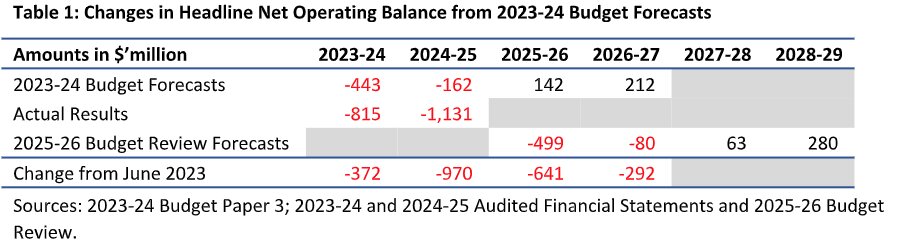
Just two budgets ago, the government promised a surplus of $142 million in 2025-26. The Budget Review now forecasts a deficit of $499 million, a deterioration of $641 million – and the year is not yet complete. As revealed in the table, the 2024-25 actual result was wrong by $970 million from the forecast just one year earlier.
We could produce a dozen such tables that prompt the question, again and again, how do you explain that? Canberrans are now being asked again to believe that in two years’ time there will be a surplus. And, yes, pigs may fly.
Chart 1 provides the average annual expenditure growth over the four-year cycles since 2012-13, and the current estimates in the Budget Review.
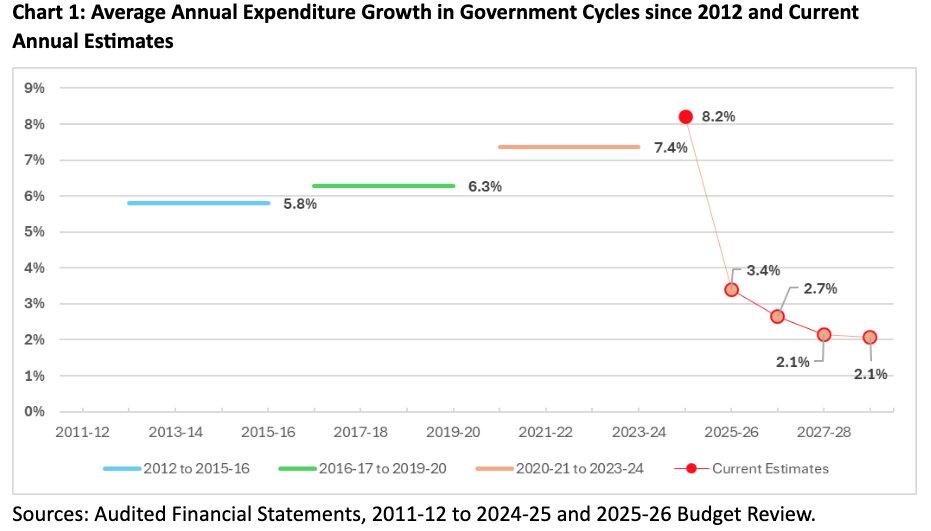
Expenditure growth increased from 5.8 per cent annually over the 2012-16 period to 7.4 per cent over the 2020-24 cycle. Expenditure grew by 8.2 per cent in 2024-25 and is now forecast to grow by 2.6 per cent over the estimates period and a mere 2.1 per cent over each of the last two forward years. We have highlighted above similar and totally unrealistic expenditure forecasts in previous budgets.
Short text in the budget papers on savings claims that employee expenditure (other than in health and schools) will be restricted to 0.86 per cent annual growth over the next four years. In other words, a cut in wages in real terms or a cut in employees.
For the sake of current Canberrans and those yet to be born, we do wish Chris Steel every success in restraining expenditure and returning the budget to balance, but through genuine efficiencies and reprioritisation rather than cuts and hollow promises.
Jon Stanhope is a former chief minister of the ACT and Dr Khalid Ahmed a former senior ACT Treasury official.
News all day, every day at CityNewsQBN.com.au.



Leave a Reply