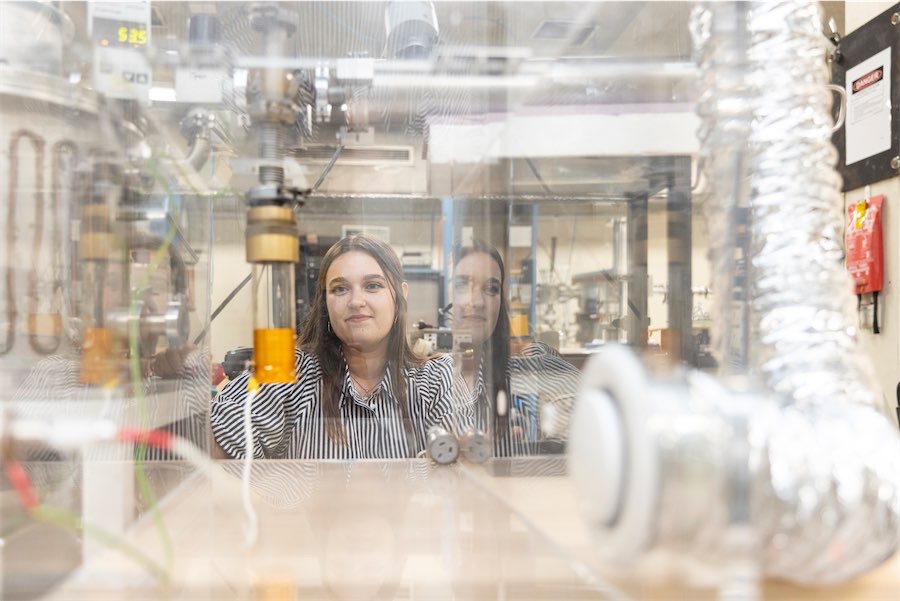
A Sydney PhD student has recreated cosmic dust in a laboratory bottle, offering new insights into how the building blocks of life may have formed billions of years before Earth existed.
Linda Losurdo, a materials and plasma physics candidate at the School of Physics, used a simple mix of nitrogen, carbon dioxide and acetylene to mimic the extreme environments around stars and supernova remnants.
By exposing the gases to intense electrical energy, she generated carbon-rich cosmic dust similar to material found drifting between stars and embedded in comets, asteroids and meteorites.
The results, published in The Astrophysical Journal of the American Astronomical Society, could help answer one of science’s most enduring questions: how life began on Earth.
“We no longer have to wait for an asteroid or comet to come to Earth to understand their histories,” Ms Losurdo said. “You can build analogue environments in the laboratory and reverse engineer their structure using the infrared fingerprints.
“It’s like we have recreated a little bit of the Universe in a bottle in our lab.”
The dust contains carbon, hydrogen, oxygen and nitrogen – known collectively as CHON molecules – which are central to organic substances essential for life.
Between 3.5 and 4.56 billion years ago, Earth was bombarded by meteorites and interplanetary dust from asteroids and comets, thought to have delivered vast amounts of organic material to the planet’s surface.
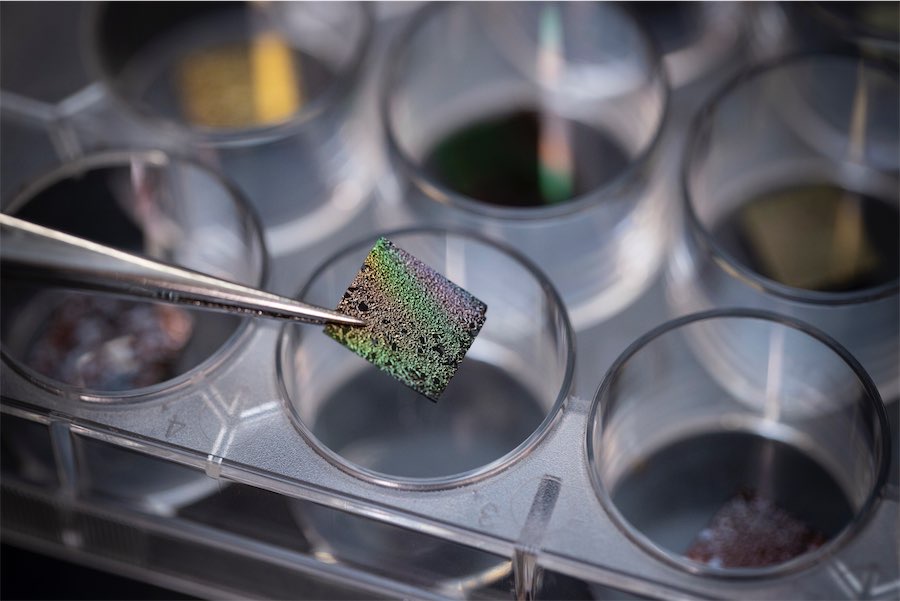
In the experiment, Ms Losurdo and her supervisor Prof David McKenzie used a vacuum pump to evacuate air from glass tubes, recreating the near-empty conditions of space. The gas mixture was then exposed to around 10,000 volts for about an hour, creating a plasma known as a glow discharge.
Under this intense energy, molecules broke apart and recombined into complex structures, eventually settling as a thin layer of dust on silicon chips inside the tubes.

The dust showed the same infrared signatures as cosmic dust in space, confirming the laboratory process closely mirrors what happens in the universe.
Prof McKenzie said the work would allow scientists to probe conditions otherwise impossible to study directly.
“By making cosmic dust in the lab, we can explore the intensity of ion impacts and temperatures involved when dust forms in space,” he said. “That’s important if you want to understand the environments inside cosmic dust clouds, where life-relevant chemistry is thought to be happening.”
The researchers aim to build a database of infrared fingerprints from lab-made cosmic dust that astronomers could use to identify promising regions of space and understand the processes shaping them.
News all day, every day at CityNewsQBN.com.au.





Leave a Reply