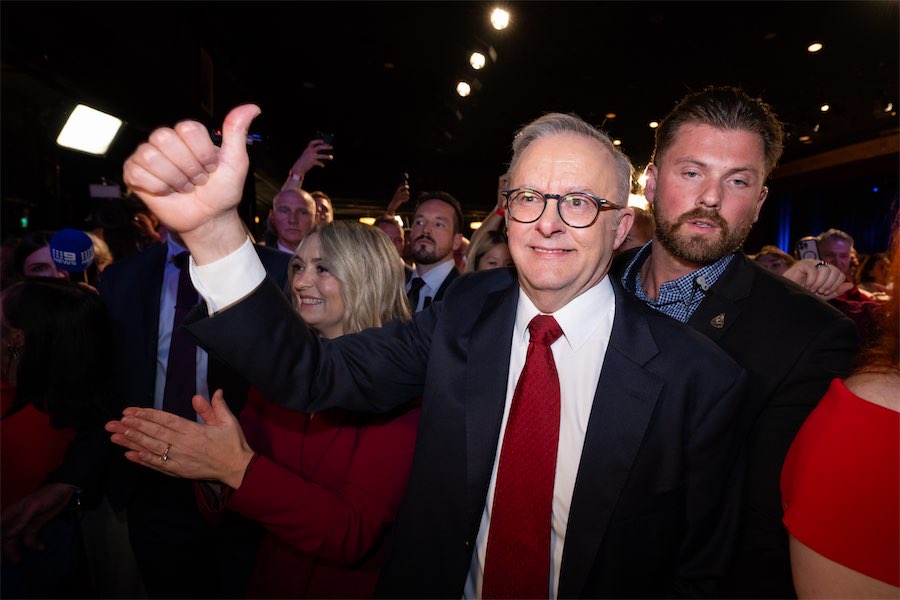
Niki Savva’s book Earthquake is a damning account of the election that shook Australia, writes MARK KENNY.
As federal polling day neared on May 3 2025, the ground was silent but the people of Australia stirred, some restless with fear, others hankering for a change of government. History favoured the incumbent. There had been no single-term governments nationally since the interwar years.
Deep in the bedrock of Australia’s political establishment, forces were building.
In 2022, despite his poor campaign, Anthony Albanese had been preferred, narrowly, by voters desperate to see the back of a dishonest Coalition government. He secured a very low primary vote (32.6%) and a majority of just two seats. A repeat of that uncertainty, as a sitting prime minister, might be politically fatal.
On paper, it could be close again, given the variables: a tremulous government out-argued in its 2023 Voice referendum; polling inaccuracies in several recent elections, which had under-measured outsider resentment; and a hard-charging opponent in Peter Dutton, leading a united team energised by his referendum success.
In the end, this would be an election like no other and it would deliver a result like no other.
As the days counted down, it became clear that “Team Dutton” was running on little more than bloke-energy, a risky and unaffordable nuclear power policy and, crazily, higher taxes.
Albanese began well and became more assured as things progressed, despite an unusually large percentage of undecided voters. Labor’s campaign was measured and methodical. Its household-focused promises – such as an $8.5 billion Medicare boost – were iterative rather than novel, but at least well calibrated and thoroughly explained.
When the results came in, the electoral earth moved, all but banishing the Liberal Party from metropolitan Australia and eliminating Dutton from parliament.
Identity crisis
In her keenly anticipated new book, Earthquake: The Election that Shook Australia (Scribe), veteran journalist Niki Savva charts the journey to an election result that caught everyone by surprise. But Earthquake is also a journey to the dead heart of the centre-right’s Trump-addled identity crisis.
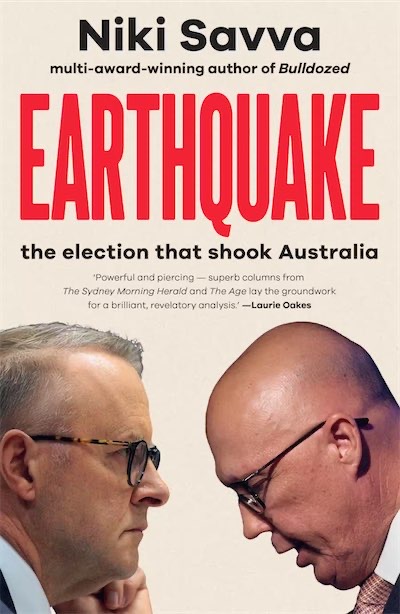
In hindsight, the opposition’s failure was obvious. “By the time of the election, people knew what the Liberals opposed,” writes Savva: “What they couldn’t tell anymore was what they were for – or, if they could, they could no longer stomach it. The Liberal Party simply did not look, think, speak or act like modern mainstream Australia.”
This damning critique grinds and yields like the San Andreas Fault under Savva’s savage, learned commentary. Perhaps more than any single promise or tactical error, it explains the career-ending, terrain-altering outcome.
Savva’s account has her trademark declarative tone. She chronicles the belligerent failures of a Liberal Party that careened from its enviable position as the mainstay of Australian postwar governing to what, on its current trajectory, could soon make it a historical footnote.
The decomposition seems wholly avoidable, yet it occasions no urgency and even less courage internally. It suggests a strange, disastrous pathology: that of a conservative party at war with the modernising community it seeks to represent, particularly women and younger voters, but migrants too.
How does it end? Is a split of the once great Liberal Party possible, even imminent? Perhaps it has already happened – not in the usual or expected way with the defection of sitting MPs, but through the emergence of small-L liberal competitors, who have captured the party’s key metropolitan sinecures and much of its professional base. It is an electoral split akin to an earthquake: devastation from the ground itself.
Tectonic force
Savva’s authority is compelling. She is a longstanding press gallery journalist, old enough to have covered the dismissal of the Whitlam government. She also worked for both former prime minister John Howard and former treasurer Peter Costello. Her CV infuses her journalism with a deep corporate knowledge and a certain inside-the-tent conservative credibility.
Perhaps this rare mix explains why so many people agree to talk to her. As a critique, Earthquake gains its tectonic force through its breadth of testimony and multitude of examples.
One is an account of the politically disastrous moment when Senator Jacinta Nampijinpa-Price, “a darling of the hard right”, tied the Coalition to US President Donald Trump by declaring Dutton would “Make Australia Great Again” if elected. “Dutton knew immediately how it would play out, that it would hurt him,” observes Savva, “but, because he was loyal to her, he had to act as if he was delighted with her performance.”
“It was said, and couldn’t be unsaid,” Dutton told people later. “It wasn’t helpful. It played straight into Labor’s hands.”

Another example is the assessment of Dutton’s campaign by the former minister Karen Andrews, who was aghast when her leader told a friendly talkback host that he would live on Sydney Harbour at Kirribilli House, rather than in Canberra. “It was the most basic political question you are going to be asked,” Andrews told Savva: “it wasn’t even a tricky question.”
Savva writes with clarity, but also with a discernible regret for the missing moral core of a party that, at its best, sustained a prominent, if never quite dominant, liberal tradition. Now, its liberalism survives largely in its name: an exercise that is in equal parts marketing and whimsy.
Some readers may be inclined to skip the first half of the book, which begins with Savva’s newspaper columns. It is not until page 219 that Earthquake really starts in with its detailed retrospective analysis of the separate election campaigns and their stunning denouement.
These shorter essays nevertheless make the book at least partly contemporaneous and not merely the wisdom of 20-20 hindsight. They display the author’s well-trained instinct for political artifice and her contempt for instances of outright shape-shifting. Savva wrote of Dutton in mid-April, just weeks before the poll: “First, he was against working from home, then he wasn’t. First, he wanted a series of referendums, then he didn’t. First, he was gushingly pro-Trump, then he wasn’t.”
And, as the saying goes, there’s plenty more where that came from.
On message, off target
The Liberal Party failed on just about every level, from its choice of leader, to its unquestioning acceptance of his bizarre suburban strategy – which involved surrendering the cities to the Labor-Teal-Green competition – to its vapid campaign, which was longer on indignation than hope for a nation.
As Savva says, the voters always get it right.
A key insight is the extent to which Dutton’s reclusive personality and the fecklessness of his front bench combined to leave nobody of sufficient weight and neutrality in charge of strategy.
Where Labor’s Paul Erickson worked closely with Albanese and his office to co-ordinate policy announcements, advertising, visits and debates, too many senior Liberals deferred to their leader, deluded, just as he was, by the outcome of the Voice referendum in 2023. Under this licence, Dutton made bad calls on tax policy, nuclear power stations and defence spending, allowing himself to be repeatedly out positioned by Albanese.
As the respected Liberal Party grandee Nick Minchin notes in Earthquake, “you must never let the leader run the campaign”.
Meanwhile, Savva notes, Dutton kept up his habit of talking to conservative-friendly media, such as talkback hosts and Sky After Dark, where the conversations too often dragged him on to peripheral ground where there were no undecided voters to convince.
Constantly surrendering the initiative is a strange way to run from behind, yet that is what Dutton set out to do. Core policy announcements were left too late, attracting negative attention for their absence, rather than positive coverage for any merits they might have had.
Labor’s campaigning approach was comparatively dynamic, even when the election had to be delayed due to Cyclone Alfred bearing down on the Queensland coast and, crucially, on Dutton’s own marginal seat.
The delay benefited Labor, notes Savva, because the expectation of an April poll had already brought additional scrutiny on Dutton. Thus, when he was found to have “skipped off to Sydney for a fundraiser”, it not only revived memories of Scott Morrison’s Hawaiian holiday in 2019, but gave Labor a devastating line that the Liberal leader had “sold out his constituents” by leaving his Dickson electorate at a moment of crisis.
“He was filling Liberal Party money bags while his own community was filling sandbags,” Labor’s then minister for agriculture Murray Watt charged on Insiders.
Both sides of the fence
Earthquake is an important account, featuring insights from a wide range of parliamentary and campaign insiders on both sides of the fence.
In its long-form journalism – telling the story via key players on the record – and its accounts of human failings under extreme pressure, it is a crucial adjunct to the political science from the Australian Election Study and other analytical work by psephologists.
Will the election result inform future actions? Given current behaviour, it seems the only people who weren’t rocked by the earthquake were the remnant Coalition MPs. Indeed, any remedial transformation of the federal party in its wake might be described as a work in regress.
Already, the Liberals have disavowed their Morrison-era commitment to net-zero by 2050, rejected quotas for women, doubled down on nuclear energy (as a way of claiming continued support of emissions reduction), and flagged migration cuts as a priority, despite the risk of further alienating migrant cohorts.
Earthquake, though, should be read as a cautionary tale for both sides. Their concrete silos stand half-empty; their grains of truth are no longer a staple in a world of fluid allegiances and ephemera.
A Labor meltdown cannot be ruled out, nor the corrosive effects of the hubris evident in the government’s defiance of the transparency and accountability it promised. It is possible the next election will bring a return to orthodoxy, with the Liberals recovering support in inner-city seats. Possible, though that would require another tectonic shift.
Mark Kenny, Professor, Australian Studies Institute, Australian National University. Republished from The Conversation.
News all day, every day at CityNewsQBN.com.au.



Leave a Reply