
‘This is a dismal and embarrassing performance from an agency that appears to have lost focus on its core business.’ JON STANHOPE & KHALID AHMED reveal the shocking failure of the Suburban Land Agency to meet its targets.
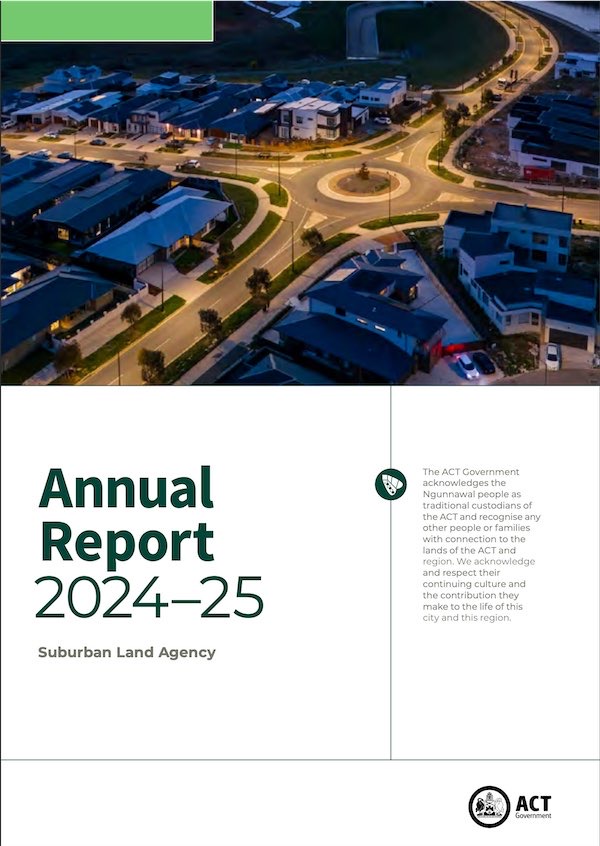
The Suburban Land Agency’s annual report contains stunning pictures of children playing, artists painting and families in bright dresses enjoying festivals.
There are slick graphics highlighting lofty objectives and colourful charts and tables conveying an air of accomplishment and high achievement.
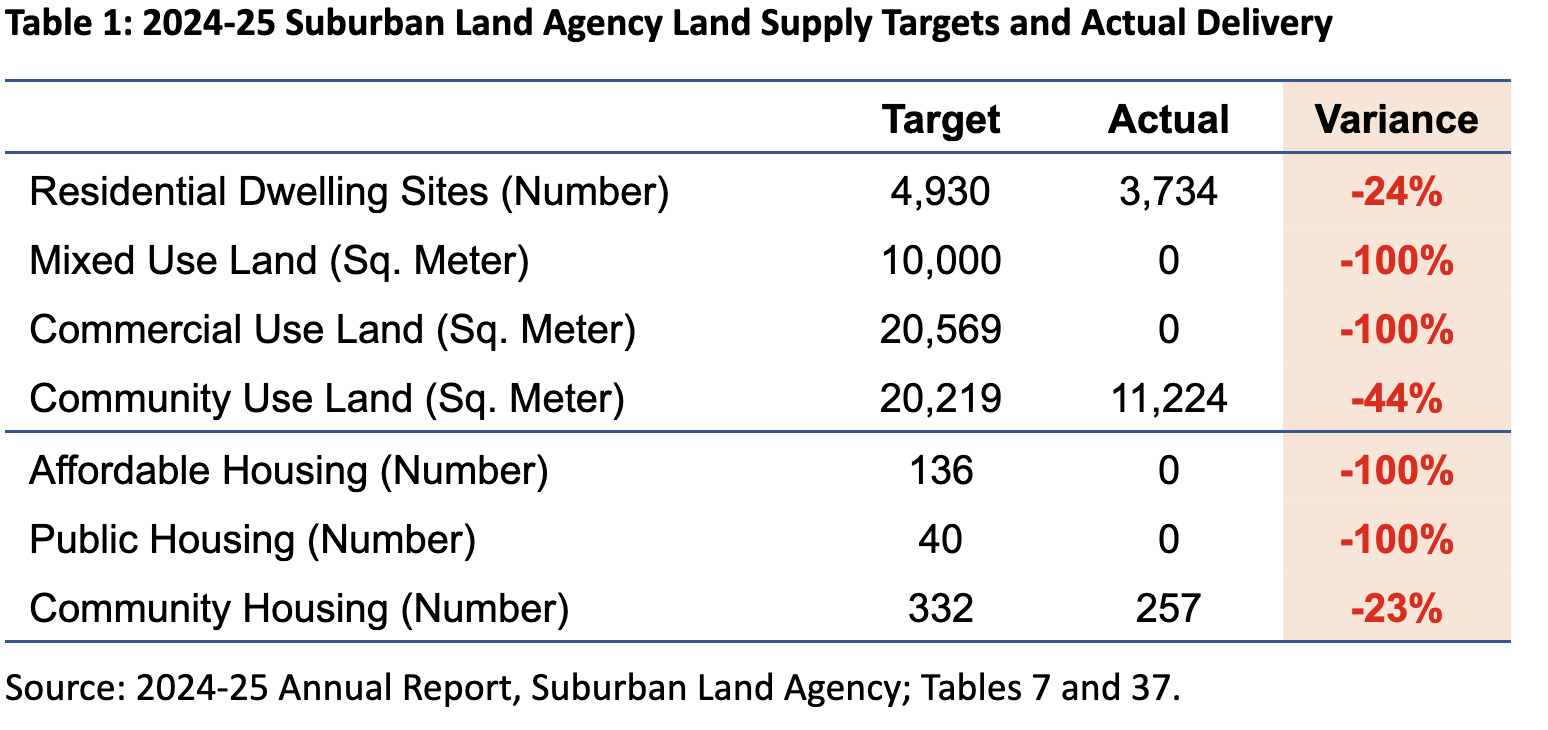
However, reality hits hard, as the outcomes of the core business of the Suburban Land Agency (SLA) reveal:
- a 24% shortfall in residential dwelling supply against the mandated budget target;
- a 100% shortfall (zero achievement) in mixed use land supply against the target;
- a 100% shortfall (zero achievement) in commercial use land supply against the target;
- a 44% shortfall in community use land supply against the target;
- a 7% increase in staffing over the previous year; and
- 14% to 18% shortfall in meeting targets relating to financial obligations.
This is a dismal and embarrassing performance from an agency that appears to have lost focus on its core business, without any apparent accountability or direction.
Remarkably, the SLA has also established a $100 million loan facility, with a private bank, for working capital, from which it has drawn $25 million. This raises several serious questions.
We note firstly that this is due to a cash withdrawal from the SLA by government when surely it could not be justified based on its financial performance.
In fact, without this private loan, the SLA would not have been able to meet its short-term financial obligations.
Further, and concerningly, this borrowing is not reflected in the General Government Sector debt that we regularly comment upon. In effect, the ACT government appears to be using a trading enterprise to raise debt. However, the cost of this debt will inevitably be directly borne by homebuyers through higher prices.
We should note that the original dwelling supply targets were low when taking into account demand, population growth and household formation. The government’s supply arm has nevertheless failed to deliver even on those targets.
We have previously pointed out that for low-income households in private rental, the ACT has the highest level of housing costs across all jurisdictions in Australia.
In fact, according to the Productivity Commission, 61% of low-income households in the ACT are paying more than 30% of their income on private rental compared to the national average of 52%.
The ACT government’s claims, in the budget papers, that rental affordability in the ACT remains relatively better than other Australian jurisdictions is not supported by the Productivity Commission.
For any government committed to meeting its social obligation to households whose needs are not met in the private market, the supply of public housing and community housing would surely be a high priority.
As the table shows, the SLA failed to deliver a single site against the meagre targets on affordable housing (136 or under 3% of total supply) or public housing (40 or under 1% of total supply).
 As for homebuyers, according to the most recent ABS data release, the median house price in Canberra was $1.020 million in the September quarter of 2025, an increase of 5% over the past six months from the March quarter. The SLA reports the total supply of standalone dwelling sites in 2024-25 was 325, that is less than 9% of the total supply.
The government seeks to demonstrate its commitment to affordability by announcing targets on the supply of affordable dwellings. The word “affordable” is mentioned 51 times in the annual report including in its objectives, and directors’ backgrounds.
The actual achievement against the notified (or mandated) affordable housing supply targets was, however – zero.
The undersupply would, of course, have delivered gains in value for those who already own a standalone house, and speculators, including the SLA itself, whose inventory would have increased in value.
However, for those seeking to enter the housing market and for whom a standalone dwelling is most suitable due to their family circumstances, this is distressingly bad news.
Does cutting standalone dwelling supply to a mere fraction of the demand stop urban sprawl as the ACT government and its fellow travellers are wont to claim?
The population explosion in the villages and towns within commuting distance of Canberra such as Murrumbateman, Googong, Bungendore, Yass and Queanbeyan together with neighbouring shires’ plans re land supply, that we have noted previously would suggest otherwise.
For many families seeking to buy an affordable block of land or a home, moving across the border into NSW has been the only option, rather than succumbing to the government’s misguided objectives.
The current ACT land release and housing policies are counterproductive and indeed damaging.
There has been a dramatic increase in the number of people travelling, on a daily basis, into Canberra for work, which reportedly had reached 50,000 people in 2018.
This may have stabilised with the introduction of work-from-home options, but remains higher than it would otherwise be, and almost double the number less than a decade ago.
The environmental benefits of providing affordable housing options along with an efficient public transport system, within the ACT, are readily obvious.
Besides the adverse social, economic and environmental outcomes, there are adverse financial impacts on the territory’s budget.
People living in NSW but working in the ACT are, for all practical purposes, Canberrans who use our hospitals, schools, roads and community facilities.
For every resident that the territory loses to NSW, it also loses around $3800 every year in GST payments. In other words, if 10,000 current or would be Canberrans choose to live across the border in NSW because of non-availability of affordable land in Canberra, then the GST payments lost will be $38 million a year.
It would be much more environmentally, socially and financially sustainable, to provide affordable housing choices in Canberra, rather than exiling existing and potential Canberrans to NSW.
Jon Stanhope is a former chief minister of the ACT and Dr Khalid Ahmed a former senior ACT Treasury official.
News all day, every day at CityNewsQBN.com.au.



Leave a Reply