
Sixteen-year-old Rory Pittman wouldn’t be alive were it not for a defibrillator that had been won by the Queanbeyan and District Basketball Association as a “lucky door prize” three weeks before he collapsed during a basketball game.
Rory had signed up to a local basketball team in Queanbeyan and playing in his first game on July 29, during the third quarter, he suddenly collapsed.
Onlookers initially thought that he was simply being a “silly bugger”, and it was only when he didn’t stir they realised something was wrong.
Within two minutes, several mums in the crowd had sprung to action, some of whom were off-duty nurses.
Turning blue, Rory had stopped breathing. CPR was administered by the nurses, and the club’s AED (Automated External Defibrillator) won at the Basketball NSW State Conference was brought out, shocking his heart back into rhythm.
“We got a phone call, which was really terrifying,” says Rory’s dad, Michael.
“It was really vague… she just said there had been an incident involving Rory and that they’d called an ambulance, and that we should probably get there.”
When mum Abigail and Michael arrived at the basketball stadium, they found their son in a recovery position, surrounded by paramedics.
Rory had gone into hypoxia, a condition where the brain doesn’t receive enough oxygen. It was only after Abigail sat beside him that he began talking.
Early speculation by Michael and Abigail had ranged from a concussion to a broken bone; they’d never thought their son had stopped breathing entirely.
“He’s played rugby league for seven years without any significant injury, so we thought, how bad could basketball even be?” says Michael.
Although Rory was breathing and conscious, he has no recollection of these events. It was only after reaching the hospital, he was able to understand just how lucky he had been.
The survival rate for anyone experiencing cardiac arrest is 10 per cent and, with 32,000 Australians experiencing the condition annually, that’s about 88 people a day.
Chances of survival can increase dramatically to 60-70 per cent when CPR is performed and an AED is used within the first three to five minutes.
“Without the intervention of the AED, lots of lives like mine aren’t saved, and that’s really important to me,” says Rory.
“They’re starting to roll them out in more places, but they’re still not as common as I’d like them to be.”
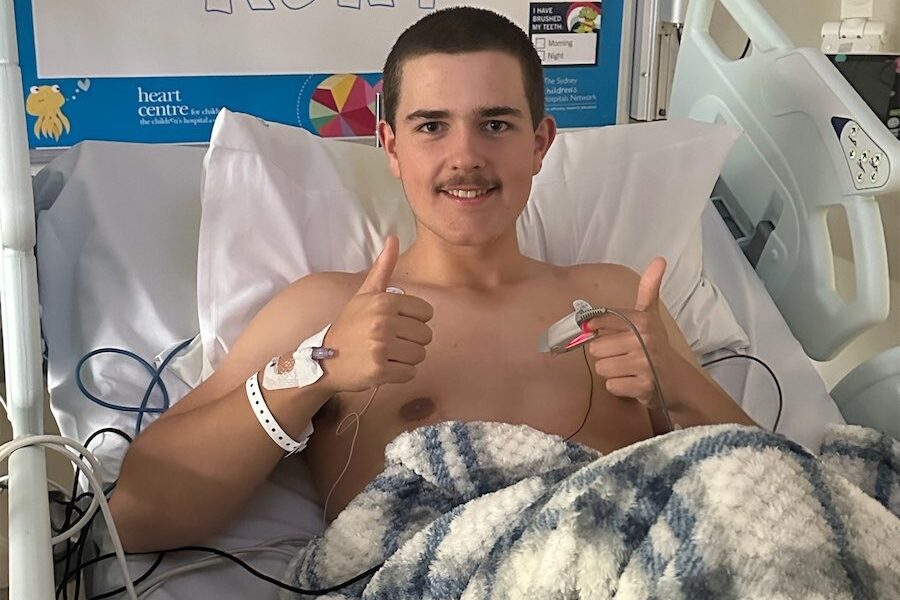
Rory spent a week at Canberra Hospital before being transferred to the Children’s Hospital at Westmead in Sydney where he underwent an operation fitting an Implantable Cardioverter-Defibrillator under his left arm.
Rory is only the sixth person in NSW to have one, and the first pediatric case.
Live data is sent to the hospital from Rory’s device and so far it’s all come back okay. It is still unknown why Rory went into cardiac arrest.
Rory has returned to school and work, but has another couple of months away from driving with his learner plates.
He wants to be a voice for the issue by advocating for the importance of learning CPR and how to use AED machines, as well as implementing more machines in public, accessible areas.
“There are a lot of businesses that go to the effort of ticking the box, but they never think of it again,” he says.
“You need to think about the actual, practical application of it.”
Abigail and Michael are thankful to have their boy with them.
“It’s crazy to think that if it had happened at home, maybe we wouldn’t have had the same outcome,” says Abigail.
“It’s encouraged me to really think about my own training and awareness.”
In Canberra, St John Ambulance runs a Defib in Your Community campaign to help locals fund publicly accessible defibrillators. More at stjohnact.org.au/DIYC.
News all day, every day at CityNewsQBN.com.au.



Leave a Reply