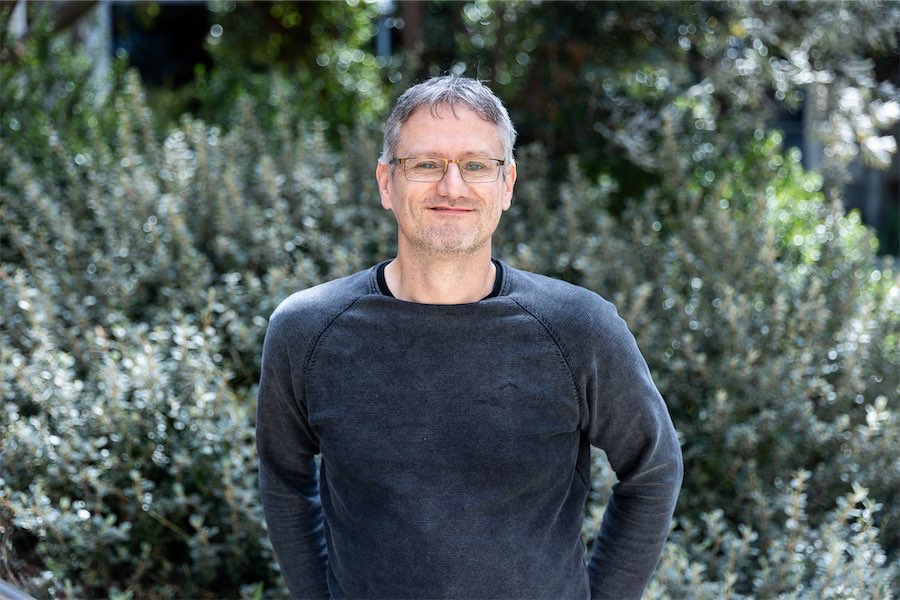
Bernd Gruber likes “elegant codes” and to prove it, the ecology and genomics professor has spent 10 years meticulously coding software that won this year’s national Eureka Prize for Excellence in Research Software.
Called DartR, Prof Gruber’s work as project lead is focused on speeding up the availability of genomic data – genetic information that has been derived from an organism’s DNA.
Identifying and targeting rare genetic diseases or identifying new flora through the study of genomes can be a lengthy process, full of never-ending statistics and datasets.
Prof Gruber, from the University of Canberra, felt the available open-source statistical software for data analysis wasn’t up to scratch and set about rewriting the code to speed things up.
“I was lucky in some sense,” he says.
“[DartR] was driven by our own demands, and that’s also a reason why it was able to grow, because it meant I could do my own research.
“When you do research, you try to be a bit more cutting edge all the time, so everything that’s new went straight into the package to analyse the data.”
Covering data analysis in population genetics, structure and historic population sizes, to name a few, Prof Gruber says dartR is a versatile program.
“I like elegant codes,” he says. “I like to make it really sufficient and have an elegant way of analysing codes to show something.
“That’s really satisfying.”
But it wasn’t all smooth sailing for the program.
“At first, I thought our package would be obsolete,” he says.
“Everyone uses the whole genome data, but then it’s so much data that you have to simplify it.
“It’s a nice compromise between still having a lot of data and not having to wait 15 hours to get a simple answer.”
Originally from Germany, Prof Gruber applied for a job as an assistant professor for spatial and ecological modelling at the Institute for Applied Ecology at UC in 2010.
A Sinclair Set ZX81 home computer was Prof Gruber’s introduction to coding, an activity that he did with his father.
“I was always a programmer in that sense,” he says.
“But I also discovered that I liked ecology and biology, and it was almost natural to combine the two because I could see I was a bit ahead of most people doing internal programming in the ecology area.
“That was my speciality, and you’ve got to find your own speciality and gap.”
Prof Gruber works with five other researchers at UC, with others contributing from universities across Australia.
They hold at least one online meeting a week to discuss ways of improving the program.
“There are some people who are excellent at field work… but then they have all the data and they’re not analysing it!” he says.
“I have to see what it tells me, and it can be disappointing, but at least I know.”
Finding ways to future-proof the technology, Prof Gruber says he and his team continue to work at increasing the speed of the data processing.
“This works because there is a limit,” he says.
“You know the length of the genome is the limit.
“There are still some things that can be integrated, but it’s not finished yet.”
Prof Gruber says Eureka Prize win could mean more attention and funding to continue improving the program.
“I’m super excited,” he says. “I don’t think it will change my life dramatically, but it’s little steps and we are working our way up.
“But it could be life changing for someone else.”
News all day, every day at CityNewsQBN.com.au.




Leave a Reply