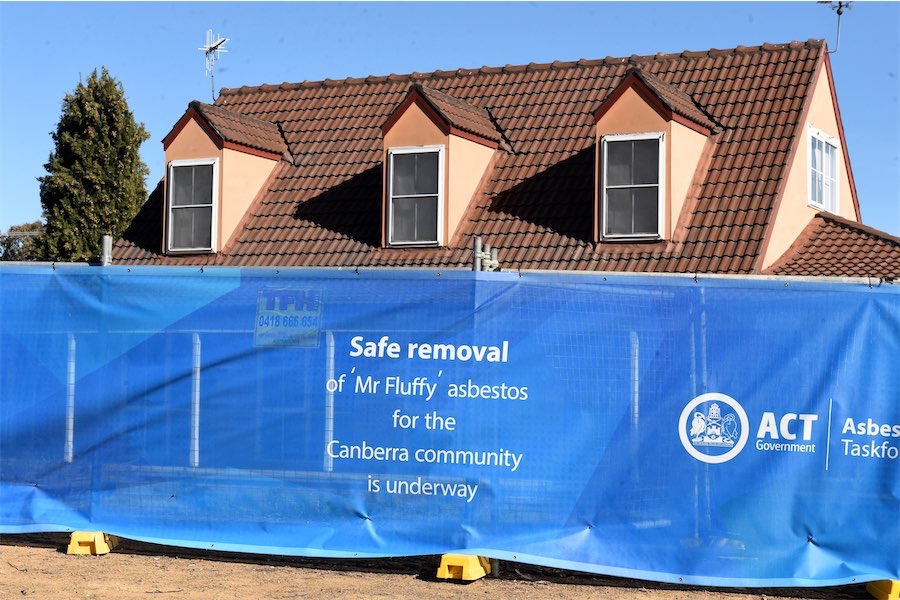
“We were underpaid, were given a pittance to help with relocation costs, our insurance didn’t cover anything, and there has been almost no acknowledgement of the latent health issues.” JON STANHOPE & KHALID AHMED reveal the cruel reality of the Mr Fluffy scheme.
The cost to each household embroiled in the Mr Fluffy scheme was, on average, around $300,000.
In effect, the affected homeowners ended up paying for the government’s Asbestos Response Taskforce and the remediation costs, and then some.
In a previous article, we revealed the serious design and implementation failures of the asbestos remediation program. In this final column, we return to the question of what went wrong?
Our assessment of the outcomes has been guided by the principles prescribed by the Legislative Assembly when authorising the appropriation in 2014, and which were subsequently adopted by the government’s asbestos taskforce as its objectives.
This discussion would have been unnecessary if the taskforce or the government had produced a set of accounts consistent with accepted norms and accounting practices, or if there had been an audit of the program.
We note a “closure audit” was conducted by a private firm engaged by the taskforce. That is, of course, not a substitute for an independent performance audit by the auditor-general who has legislated powers to demand information and explanations.
In our analysis and review, we have set aside the closure audit due to scope and space considerations, but note that other government agencies would be thrilled if they too had the right to engage private consultants for performance audits of their programs.
Principle/Objective 3: Flexibility and options for informed choices
Appropriation Act: “Provide, so far as is possible and reasonable, flexibility and options for informed choices to be made by owners of affected homes.”
The issue of options for informed choices was raised in the inquiry by the Standing Committee on Public Accounts in several submissions, including one from the ACT Law Society. This remained unaddressed throughout the program.
The Law Society, in particular, expressed concern that the legal profession could not properly advise affected homeowners if there was no information on options or alternatives to the “voluntary” surrender and acceptance of the taskforce’s valuation. In the analysis of the scheme’s design we highlighted the bizarre requirement of the government for a certificate of legal advice.
There was no advice on choices and, ipso facto, no ability to make informed choices. In fact, from comments by affected homeowners it appears that they were informally, and clearly erroneously advised, that they would get nothing from a compulsory acquisition.
The taskforce, it seems, failed to comply with the guiding principle and deliver on its objective.
Principle/Objective 4: Minimise overall net costs to the community
Appropriation Act: “Minimise overall net costs to the Canberra community and the ACT government (thereby minimising the flow-on impact to other government policy and program delivery areas).”
A reasonable interpretation of this principle would be for the taskforce to minimise administration costs; to avoid unnecessary legal costs; to engage companies with experience and scale for demolition and clean up; and to aggregate tasks and activities.
It was recognised that while the program would cost the government and the community, the taskforce should nevertheless be as efficient as possible. The principle includes the word “net”, which recognises that the mechanics of the program may/will involve acquiring land and then returning it to the owners or the market, ie, some revenue.
The Taskforce had the following consideration in mind:
“The principle that government should seek every safe opportunity to minimise its demolition and remediation costs and maximise its return on the eventual sale of clean blocks with a view to defraying the overall cost of the scheme to the Canberra community” – Asbestos Response Taskforce Closure Report.
From minimising costs to maximising revenues, the taskforce made a critical jump that changed its focus and culture.
Land blocks must be acquired, albeit, under the pretence of voluntary surrender, being the means to delivering the revenue maximisation goal. It does not appear to have occurred to the taskforce, or at least concerned it, that it was aiming to maximise revenue from affected homeowners either directly or through forcing them into the market.
It appears that for the taskforce, homeowners became little more than mere instruments in this scheme. That is the only feasible explanation for the manifestly unfair policy, cynical design of the scheme, and the behaviour of taskforce officials.
The auditor engaged by the taskforce noted with apparent approval that the taskforce sold around 60 per cent of the properties above the then market valuations (and even higher against the valuations given to homeowners), and thus achieved its revenue maximisation objective.
Table 1 details the aggregate costs of the scheme related to acquisition of land and dwellings, remediation and administration, offset by sales revenue. The table compares the actual costs with the financial estimates provided by the then treasurer, Andrew Barr, to the Standing Committee in 2014.
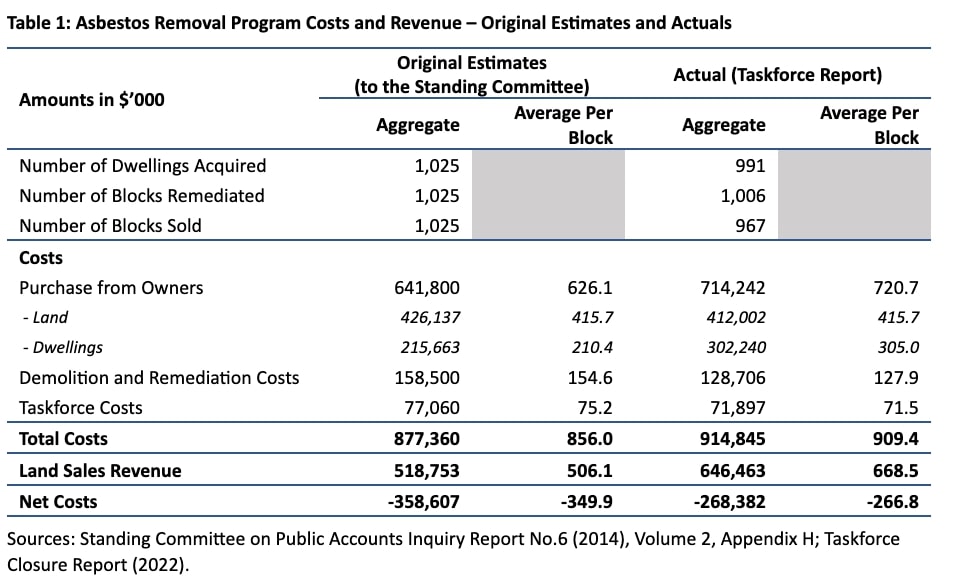
The table highlights some interesting facts.
Demolition, remediation and administration costs were about $35 million lower than the original estimates. While it is unclear from the information in the report whether this was through efficiencies, or through lower spending on support and assistance, or if the original estimates were generous, nevertheless, it is commendable.
The taskforce made $646.5 million in land sales revenue against the original estimate of $518.8 million, while selling fewer blocks. Its revenue maximisation focus produced $234 million (an average of $242,460 per block) in land revenue over and above the unimproved value paid to the homeowners.
How was this achieved? We have written extensively about the constraints on land supply, particularly on the supply of standalone blocks resulting in soaring land profits for the government.
In 2015 a mere 329 standalone blocks were released by the land development agency, less than 10 per cent of the release a few years earlier. This was the market that the taskforce entered with around a thousand blocks in its hands. For some time, it was the dominant player and extracted monopoly profits.
The increase in revenue was also in part due to the rezoning of the affected blocks through Territory Plan Variation 343, which allowed for unit titling of 700 square metre, and larger, blocks.
Notably the planning policy, in its application, increased the costs of purchase back by affected homeowners, irrespective of whether they wished to avail themselves of the opportunity of opting for dual occupancy on the block. The value of these rezoning benefits was estimated at $93 million. For homeowners, of course, it resulted in an increase in cost.
Table 1 shows what was planned and what occurred, financially, from the government’s point of view. In a previous article we highlighted that households had to bear the cost imposts of an increase in the purchase price of their own land, while seeking to access funds for reconstruction.
A fair remediation program, in principle, would be at least cost neutral for affected homeowners. They would surely also have been entitled to any capital gains from the time they handed in their blocks to the time of their return. Some may have opted to downsize, but should nevertheless, like any other homeowner, have retained the obvious financial benefits.
We estimate the cost of a fair voluntary program was in the order of $563 million. The cost of a compulsory acquisition program would almost certainly have been higher.
The original financial estimates implied a cost shift of $205 million to the affected homeowners due to the unfair elements of the scheme as previously discussed.
In reality, $268 million was borne by the government, and $295 million was carried by the homeowners, in direct land and construction costs or in foregone benefits which the government recouped.
In other words, the cost to each affected household was, on average, in the order of $300,000. The homeowners ended up, in effect, paying for the taskforce and the remediation costs, and then some more.
That the taskforce was able to dump $295 million of costs on households, against an original plan of $205 million hardly seems fair.
We conclude with a comment from an affected homeowner quoted in the Community and Expert Reference Group Report:
“I still don’t think the wider Canberra community realises just how poorly the victims of this were treated. Most people think we were paid a fortune for our houses.
“They don’t know that we were underpaid, were given a pittance to help with relocation costs, our insurance didn’t cover anything, and there has been almost no acknowledgement of the latent health issues.”
Jon Stanhope is a former chief minister of the ACT and Dr Khalid Ahmed a former senior ACT Treasury official. The entire series of articles is at citynews.com.au
News all day, every day at CityNewsQBN.com.au.




Leave a Reply