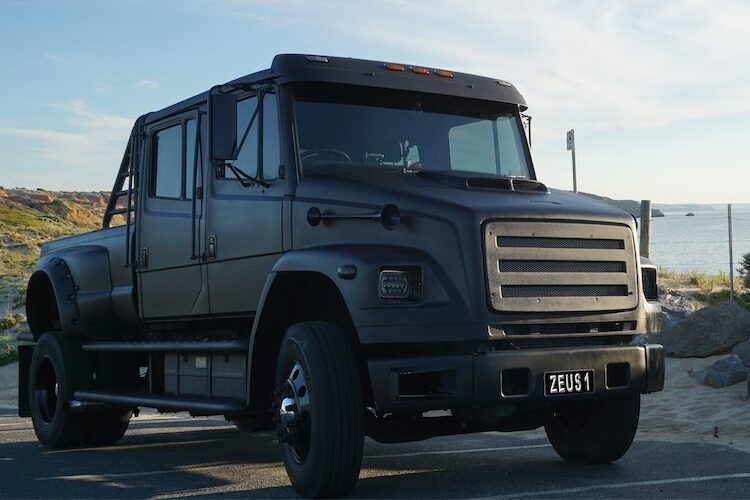
Paul Offe drove his custom, black dream machine from the Gold Coast to join a truck convoy protest at Parliament House in February 2022. He hasn’t driven it since. Police impounded it and took away his living. HUGH SELBY needs legal help to get it back for him.
There are some who speak ill of the SummerNats. That’s because their souls don’t get the deep, deep satisfaction that comes from the street style, trims, paint job, chrome, engine get up, rev noise, cabin fit-out and sound system.
It’s sad that this high-summer celebration causes them distress, not pleasure.
We can be certain that for those sad people there’s nothing of interest in a one time NT fire truck, that started life as a Freightliner FL80, twin cab (so four doors), with its chassis now shortened to take a Ford F350 ute tub, over a back axle with four tyres, with an 8.3-litre, 300 horsepower, Cummins turbo diesel up the front, all of this finished outside in the same black as Batman, and with a sound system so sophisticated that it took a team days to install.
But for the rest of us who are strangely drawn in childhood, adolescence, adulthood and old age to the throaty roar and beast-like lure of the metal behemoth, this piece of machinery has all the attraction of the best of the transformers.
As one admirer put it: “This beast makes a Dodge Ram look like a baby.” That it surely does.
Here it is, or rather, here it is as it was until a February morning in 2022. Until that morning Zeus 1 was the pride and joy, and carefully prepared income earner for its Gold Coast owner Paul Offe.
He’d spent money, a lot of money, creating this special limo for passengers wanting something different on a special night out.
It was also to be used for kids’ birthday parties, as an attraction at motor shows, in music videos, and in a film.
Paul who?
“Resilience” is a buzzword these days. For those who don’t understand its use, follow this truncated account of Paul’s life this past 16 years and you will understand it well.
In 2009 he was in the wrong place, a car, at the wrong time and got punched in the head through the window when asking directions. That caused brain injury. Ten days later a 4WD rear-ended him while Paul was stationary, giving him such severe whiplash that he has never been the same again.
Later in 2010 he went to pick up a spare wheel from a tyre repairer. The wrong size tyre had been fitted to the rim. As he was bent down the tyre exploded, causing not only the third brain injury, but also multiple broken bones in his right arm.
Most of the next decade was spent in recovery and trying to get compensation. The side effects of his injuries included “restless leg syndrome”, which made sleeping difficult, and overwhelming tiredness after any exertion.
Already dyslexic and so finding reading difficult, he now found it difficult to converse. Those problems were on display this last two weeks in the ACT Supreme Court where he asked questions of police witnesses, gave evidence and was cross-examined, and made submissions – all as a self-represented accused in a jury trial.
He was assisted by his brother and a friend. He was supported, each day over the 10 days of trial, by a group of well-wishers who came from near and far, either to be his witnesses, or to offer moral support from the public gallery. That’s a rare scene in a courtroom.
Why was Paul in court?

There was a truck convoy to Parliament House in February 2022. One of the reasons to attend was concern about the handling of covid. Paul’s grandmother, who had lived with the family, entered care during the covid epidemic.
The family was unable to visit her and she died without seeing them, an event that profoundly affected Paul, so much so that when talking about it to the jury last week he broke down, as did some of the jurors.
He drove his black dream machine to Canberra and was arrested at the protest, charged with two counts of driving at a police officer (ie two officers). That is a jury trial charge and what happened around Parliament House that morning, what police said and did, what he did, engaged the jury for a bit over two weeks.
His defence was that because of the height of the cab he couldn’t see anyone standing right in front of the truck.
Many bits of video footage were shown to the jury, much of which came from other attendees who have supported Paul’s explanation.
The jury and the trial judge went out to inspect the one-time dream machine in the police holding yard. Exposure to the elements for over three and half years has taken a heavy toll. To bring it back to its condition before a police officer smashed a side window, and another sprayed Paul with pepper spray while he was driving, will take a lot of time and money.
Why was Paul at trial without a lawyer?
In the years since his machine was seized, Paul and his family have engaged several lawyers.
As with his accidents he has been unlucky. He didn’t have the money some wanted (partly because as his machine was seized he could not earn an income, and partly because it was a lot of money), they got sick and couldn’t continue, there was pressure from some to plead guilty and get it over with, and our government lawyers were intent on keeping the machine to sell it.
At one point prosecuting staff seem to have suggested that if he pleaded guilty, and gave up any claims for compensation, then he could have it back.
All of which culminated in his appearing as a self-represented accused before a jury, having to present his case while dyslexic and with a speech impediment.
What were the results of this court case?
After a day of deliberations the jury came back with guilty verdicts on both charges. This was unexpected by many.
Whether the jury got it right or wrong is not for me to say. They listened to, and watched, every witness. I didn’t.
How juries reach their verdicts is a closed box. No one can ask: “How did you reach that result?” to acquit or to convict.
Naturally, there is always speculation about what happened; however, guesses are just guesses.
Once upon a not so long ago it was usual after a jury verdict for the jurors and the lawyers on both sides to have a drink or two.
This was an important learning experience for the advocates. When jurors told an advocate that they were arrogant, or talked too fast, or made the simple complex, or had disconcerting habits, there’s a good chance that the lawyer listened and learned.
Unfortunately, this gift horse of instant, really useful feedback was put down by parliaments that fixated on the rare vice of an errant media personality breaching the unspoken rules that the talk was only in the pub and it didn’t leave the pub.
That’s why our Juries Act, section 42C, makes it a criminal offence for a juror to talk about what happened among the jurors, or for a person to ask a juror about what happened. Jurors may talk to authorised researchers. They may also report misconduct to the court, during or after a trial. That’s how the good was thrown out with the bad.
The guilty verdicts were the first of several surprises. There were three other charges that were not before the jury, but had to be decided by judge alone. The prosecutor indicated that these charges would not proceed and they were dismissed.
The prosecutor indicated that the threshold for jail time or other penalties tied to that threshold had not been reached.
This meant that the penalty options were a fine or a bond with or without conditions. The judge asked Paul Offe a number of questions to get a better idea of his background before sentencing.
His Honour sentenced him as follows: a fine of $1000 on each of the two charges, which leaves the question of the fate of a once beloved black dream machine.
The government lawyers are determined to keep it, presumably to sell these much damaged goods for the best price available, which will be a fraction of what its value was before he drove it to Canberra.
One has to pose the question for a future answer as to the basis on which the police thought it was okay to not even throw a tarp over this work of contemporary art. It smacks of callous indifference.
That in turn means that Paul will appeal so as to establish, if he is successful, a basis for a compensation claim for his beloved machine, a dream destroyed.
His appeal grounds may be on the basis that he, along with his witnesses, gave a credible explanation for his actions that showed no intent to break the law, and that the cross-examination did not destroy his factual account, or his or their believability as witnesses.
In law speak, he put up a credible, alternative hypothesis to that of the prosecution which they failed to rebut. Hence there had to be a reasonable doubt and the jury verdicts cannot stand.
I was lucky enough to see some of his time in the witness box, sitting beside his admirers in the public gallery. Made me proud to be Australian. Made me cry, too.
But running an appeal is an altogether different beast.
That is why I am now asking for a well-respected criminal defence law firm, and a proven criminal appellate barrister to offer to run Paul Offe’s appeal for no fee, or to take a modest fixed fee only if he is ultimately successful both on appeal and in gaining compensation for his black dream machine.
Such offers should, please, be sent to me via editor@citynews.com.au
Former barrister Hugh Selby is a CityNews columnist, principally focused on legal affairs.
News all day, every day at CityNewsQBN.com.au.



Leave a Reply