“The Assembly, to inform its deliberations on the missing middle housing reforms and light rail, should initiate a comprehensive independent assessment of growth options for the Canberra region,” writes planning columnist MIKE QUIRK.
Unsurprisingly, consultation on the ACT government’s “missing middle” housing reforms has found broad community support.

They are touted as delivering improved housing choice, supply, affordability, liveability and sustainability by increasing the provision of townhouses, terrace homes and duplexes in existing residential zones.
Market realities, the government’s poor implementation of compact city policies and its decision to develop light rail suggest the benefits delivered will be moderate.
The missing middle reforms are far from a panacea as affordability and the supply of housing are determined not just by zoning but the cost of finance, labour and materials; design and construction quality; price, land values and household characteristics including age, income, wealth, mobility, ethnicity and size.
Encouraging housing in established areas has been the focus of Canberra’s planning strategy since the early 1990s.
The strategy was adopted to widen housing choice, to reduce the level of travel and the environmental impacts of development, to respond to the reduced ability of the ACT government to influence employment location and demographic changes leading to the underutilisation of infrastructure.
Decisions to increase the consolidation share to 70 per cent and to increase the multi-unit dwellings share of releases to 90 per cent in the Indicative Land Release Program 2025-26 to 29-30, the 2024 failed dual occupancy RZ1 initiative and the missing middle reforms were not grounded on a detailed assessment of the factors influencing housing choice.
Unfortunately, a survey exploring the interaction of factors determining housing choices has not been undertaken.
Consequently, it will be more difficult to develop higher-density dwellings appropriate to the needs of households especially those with children and on low-to-moderate incomes; and to better integrate redevelopments to increase their community acceptability.
Such dwellings are critically needed given the ongoing decline in housing affordability and to provide an attractive alternative to detached dwellings.
Limits on the supply of detached dwellings have contributed to the 91 per cent increase in the price of separate houses compared to 48 per cent for other dwellings between 2010 and 2024.
The savings from consolidation depends on the capacity of infrastructure networks.
Substantial infrastructure augmentation would be required in areas such as North Canberra, where in response to consolidation policies, the population increased from 38,600 in 2001 to 66,300 in 2024.
In contrast, substantial capacity could exist in areas where there have been low levels of redevelopment, such as Tuggeranong.
Environmental benefits (eg, reduced habitat loss, lower travel) could be offset if redevelopments continue to result in the creation of heat islands, vegetation loss, increased parking blight and congestion.
Furthermore, limited detached housing development in the ACT is resulting in increased car-dependent development in surrounding NSW.
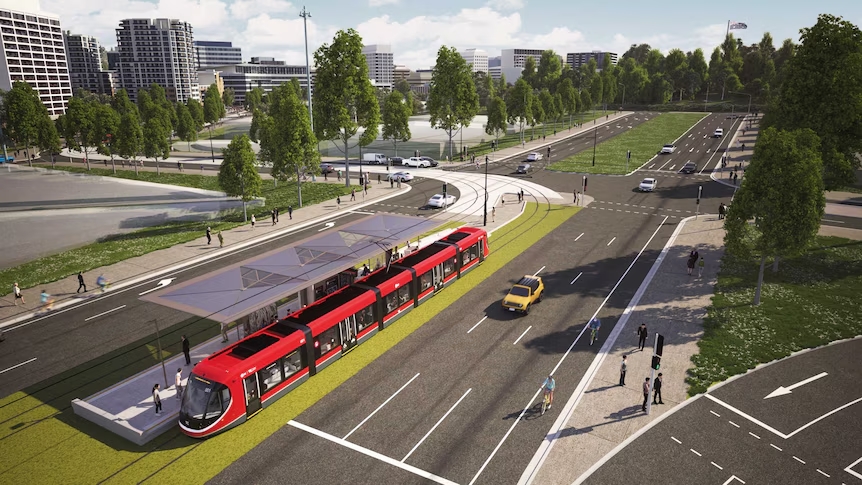
Light rail was adopted between Gungahlin and Civic despite bus rapid transport (BRT) being found to deliver a similar level of benefit at half the cost.
The government proceeded with stage 2a, a 1.7km extension from Civic to Commonwealth Park, at a cost of at least $577 million, despite the risk of it being redundant if stage 2b from Commonwealth Park to Woden is not approved.
The draft environmental impact statement for the stage 2b extension to Woden failed to compare BRT, trackless trams and light rail systems separated from the road network.
Comparative analysis undertaken in Brisbane for its “metro” found BRT was superior to light rail. In the City of Stirling (Perth) a trackless-tram was recommended.
Rapidly developing electric bus and autonomous vehicle technology and increased working from home, could undermine the justification of light rail by reducing passenger loads.
While the broad strategy of increasing development in established areas, particularly at sub-centres and along the inter-town public transport route is sound, the government’s transport and planning policies lack an analytical base and need review.
Too often community concerns and suggestions to improve the strategies and the quality of development have been ignored or routinely dismissed.
The Assembly, to inform its deliberations on the missing middle housing reforms and light rail, should initiate a comprehensive independent assessment of growth options for the Canberra region to ensure future development maximises benefits to the community.
The review would establish the appropriate locations of development after considering housing preferences (including an exploration of how higher-density dwellings can be a real alternative to households who currently prefer detached dwellings); housing affordability, including how to increase the provision of social housing and the relative environmental and infrastructure costs and transport requirements of alternative locations.
Mike Quirk is a former NCDC and ACT government planner.
News all day, every day at CityNewsQBN.com.au.





Leave a Reply