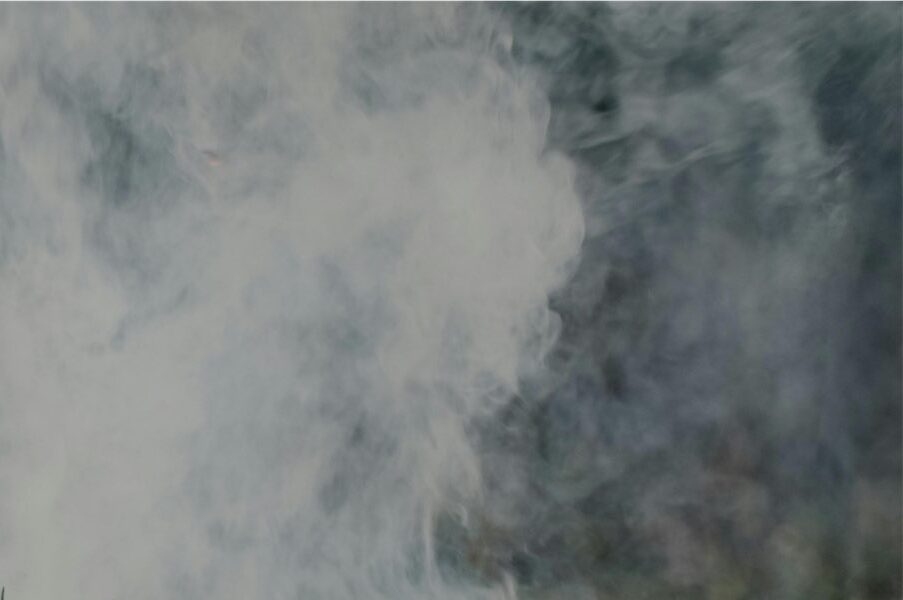
“The Winter in the City event demonstrates very poor public health practice, with adults and children potentially breathing in this toxic brew for many hours,” says letter writer MURRAY MAY.
On July 19, the Winter in the City program, under the banner of the ACT government’s City Renewal Authority, took place near the merry-go-round in Civic.

It featured a street food event, music and family entertainment. It also included bins spewing clouds of unhealthy wood smoke, which permeated City Walk and surrounding areas for many hours.
Wood smoke is a cocktail of carcinogens and very fine PM2.5 particulates linked to deaths and diseases, including from cardiovascular and respiratory illnesses, strokes, cancers, dementia and greatly aggravating asthma.
Research consistently indicates that there is no safe level of exposure to PM2.5 particulates for human health.
A previous similar event in Civic included flames emitted from drums, but without smoke at all. In that case, gas as a fuel source was presumably used.
The July 19 event demonstrates very poor public health practice, with adults and children potentially breathing in this toxic brew for many hours.
In the ACT, smoking is prohibited in outdoor dining areas of cafes via health regulations under the Smoke-Free Public Places Act 2003. Yet these types of events and pop-up venues are allowed to strongly pollute the air and damage public health by other means.
Murray May, Cook
Why do we even have a transport minister?
Driving fossil-fuelled vehicles pollutes and causes traffic congestion.
Canberra’s daily travel in 2022 included 8.2 million kilometres as car drivers, 2.9 million kilometres as car passengers, 645,000 kilometres by public transport, 266,700 kilometres on foot and 166,100 kilometres by bicycle.
Our 2004 Sustainable Transport Plan aimed to increase the commute mode shares of walking, cycling and public transport.
Walking was to increase from 4 per cent in 2001 to 7 per cent in 2026. By 2021 it had reached only 5 per cent.
Cycling was to increase from 2 per cent in 2001 to 7 per cent in 2026. By 2021 it had reached only 3 per cent.
Public transport was to increase from 7 per cent in 2001 to 9 per cent in 2011. In 2011 it was still 7 per cent.
In 2012, then-Chief Minister Katy Gallagher committed ACT Labor “to increasing the public transport share of all work trips to 10.5 per cent by 2016 and 16 per cent by 2026″. In 2021 it was still 7 per cent.
Car-as-driver commuting hit a high in 2016, and a new record high in 2021.
The government expects light rail stage 2 to increase car driving and reduce public transport travel.
Recently, I asked the transport minister what he would do to achieve the transport targets and to reduce traffic congestion.
His office replied that my question “relates to a City and Government Services matter,” and referred it to the Minister for City and Government Services.
Why do we have a transport minister?
Leon Arundell, Downer
Sad country town that wanted to be a city
I have read we need more supply of land to make more housing available, but new housing is so expensive I am not sure what is actually going on.
The ACT government talks about infill when many Mr Fluffy blocks still sit vacant and overgrown. And yet the government is destroying the environment with the development of new suburbs that don’t have trees or playing fields.
A large kangaroo hopping through the roadworks at Whitlam will be a short-lived sight when the kangaroo population along the river is driven out or killed on the roads.
Canberra is no longer the bush capital, take a drive around Jacka to see the rubbish, the overgrown blocks and the complete lack of trees – this is the future of Canberra. Not the garden city but the sad country town that wanted to be a city and got it wrong.
Mary Holmes, Melba
Pursed-lip brigade is back in force
Earlier in July, Coalition leader Sussan Ley and colleagues Jane Hume, Michaela Cash, James Paterson and Bridget McKenzie regaled us with myopic criticisms of the length and content of the prime minister’s six-day work trip to China.
These hollow soundbites only serve to remind us that the federal opposition’s pursed-lip brigade is back in force with a load of spurious but “must use” directives in tow.
Also, that we should be grateful that the shadow minister for foreign affairs, Michaela Cash, is not representing us and our interests on the world stage.
Sue Dyer, Downer
Capital letters get it right!
Re Ian De Landelles’ letter (CN July 24): I agree that AUKUS should be renamed USUKA, which would be pronounced, “you sucker”.
Warren Cox, via email
Time to favour family structure and stability
The desperate proposals in response to the recent horrific abuse in Victorian childcare centres make you wonder just how long the nation can survive by just plugging the latest leak when its ship is foundering.
Cameras to discourage offenders, no male staff, more staff but another layer of regulations before federal parliament, no private operators, and on it goes, with the Weatherill inquiry report to come.
Violent abuse is the scourge of our society threatening every form of relationship. When looking for the reasons, our human nature does not change.
Children need parents whose relationship is durable, not disposable, but sexual liberalism encourages adults to focus on their own selfish desires, rather than prioritising the needs of their children.
Too many mothers must care for their children without a committed father. The humanity of the unborn has never been clearer yet one in four suffer the violence of abortion.
Most children stumble into the violent pornography laden internet from which the males emerge unable to form a lasting relationship with a female, with outliers capable of raping a child.
There are no quick fixes. No one has a choice about being human, so we have to come to grips with what it means to be human with its inherent dependencies. Personal abuse will continue to increase unless we jettison sexual liberalism in favour of family structure and stability.
John L Smith, Farrer
Cherry pecking award goes to Ray
Maybe, just maybe, it is Ray Peck who should be awarded the cherry picking (or is it pecking?) award he is so fond of.
In his letter (CN July 16) he really has tried to scrape the barrel to try and discredit me and prove his point.
In his argument he cites obscure and little known people like Amory Lovins, who I believe has never studied the environment or energy at a tertiary institution. He is also an anti-nuclear exponent, so what would you expect? After failing to complete his initial degree, Lovins went to Oxford to study physics but never completed that degree either. But he still likes to call himself a physicist.
But wait there’s more… the other person he quotes is Fatih Birol, who has a tertiary degree in economics and engineering, none in science (of the climate and environmental kind), also said Australia’s obsession with renewables is affecting the poor and middle class, funny how Mr Peck left that out.
Then again, he thinks it is perfectly acceptable for supposed professional experts like the CSIRO and Tim Flannery who make so-called predictions based on science to get them wildly wrong. Would Mr Peck go to a doctor who kept getting his diagnosis wrong?
Ian Pilsner, Weston
Poor planning to blame for wildlife crashes
In regard to vehicle crashes with wildlife, kangaroos are not to blame. Poor planning and inadequate road infrastructure is.
Cost-effective approaches around reserves such as reduced speeds, road humps, better lighting and virtual fencing can reduce these accidents.
The ACT government is simply pushing the cost of their inaction back to Canberrans in the form of insurance claims and more importantly the death of our precious kangaroos.
Robyn Soxsmith, Animal Protectors Alliance
Conditions compromise shooter accuracy
The ACT government’s code of practice for its kangaroo cull at least prohibits shooting a kangaroo under conditions where instant death from a heart or head shot is uncertain.
Yet, every year, kangaroos are shot during rain, high winds and sub-zero temperatures, all of which compromise shooter accuracy.
Not surprisingly, every year, wide, deep puddles of blood are left on the reserves still congealing the following afternoon.
Dead kangaroos don’t bleed because it takes a beating heart to pump blood out of a wound. Every blood puddle is proof that a wounded animal has died in agony.
Frankie Seymour, Queanbeyan
Jack’s Jewel of the South stadium
“The Jewel in the South” could be our much-needed new, say, 18,000-seat, rectangular, super sight-lines, roofed, energy responsible/efficient stadium, for the popular rugby codes, soccer, and more year round.
Responding to Canberra’s famous dispersed town-centre plan, it would complement Bruce’s and Epic’s athletics and events, and Manuka’s Australian Football and cricket.
It would be fairly and squarely located in Greenway, on Athllon Drive, near the bus station, opposite the pool complex, on the planned tram line, in a picturesque lake, riparian and mountain setting.
It’d be on currently vacant land, largely already purpose zoned, with plenty of parking, and synergies with existing sports facilities, clubs and accommodation nearby.
It would mutually complement the wide variety of dining, retail, business, employment and recreational facilities in Tuggeranong Town Centre, enhancing its viability and growth.
It would also be well connected to NSW’s expanding Queanbeyan, Googong, Tralee and Jerrabomberra.
Jack Kershaw, Kambah
Cancer errors claim but no evidence
The review and statistical analysis by Luceron-Lucas-Torres (LLT) and others in Frontiers of Nutrition (2023) of the results reported in 70 papers encompassing over one million cases concluding that, in the reports considered, there is no relationship between wine consumption and development of cancer has been subject to a commentary by Fausta Natella and others (Frontiers of Nutrition, 2024).
The latter authors claim to have identified errors in the analysis.
However Natella and others:
- have not redone the analysis to come up with results different from those obtained by LLT and others. Accordingly, in the absence of contradictory statistical evidence, the conclusion that there is no relationship must stand;
- did not address and provide contradictory evidence on the comment by LLT and others that the latters’ work is the first systematic analysis of the effects of wine consumption on the development of cancers;
- do not seem to want to admit that components in wine other than alcohol may have the effect of reducing the likelihood of cancers, which would otherwise be caused by ethanol.
Ian Hone, Weston
News all day, every day at CityNewsQBN.com.au.




Leave a Reply