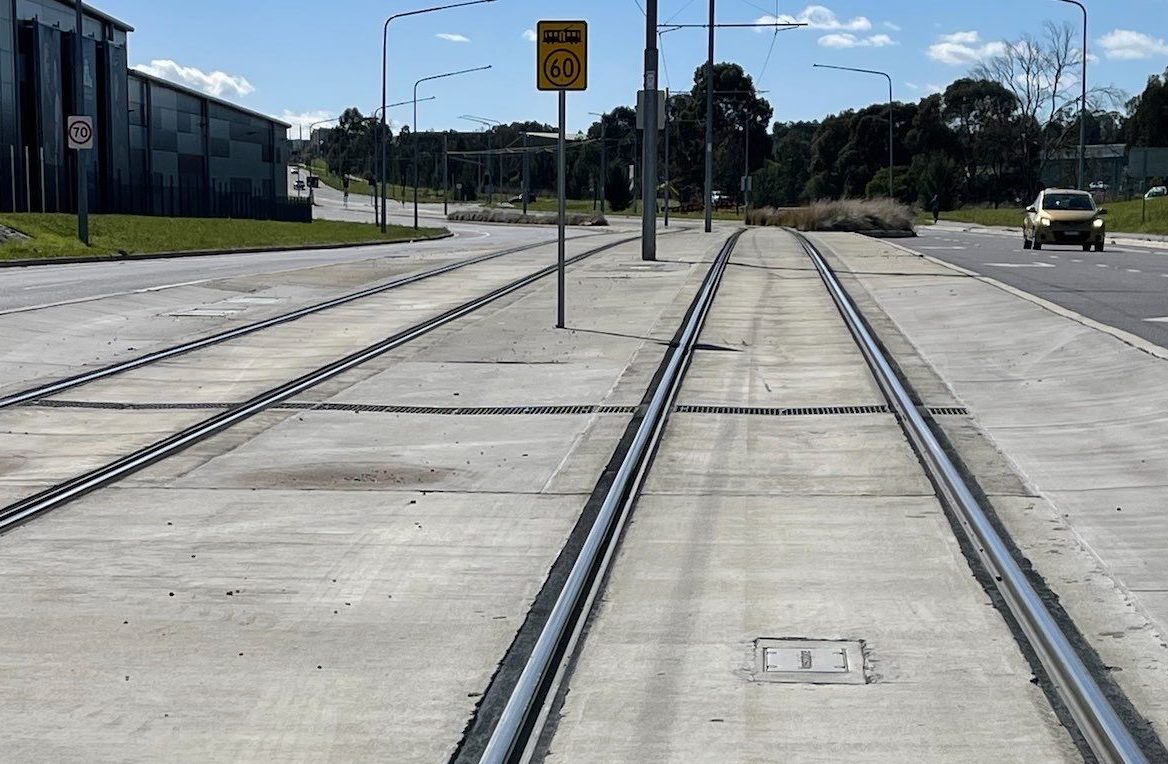
‘The budget’s fastest growing cost is interest, at an average compounding rate of 18%, while health has to deliver more on a paltry increase of 1.5%.’ JON STANHOPE & KHALID AHMED take aim at the government’s dangerous levels of debt.
It is irrefutable, that for more than a decade, the ACT government has been unable to control the expenditure side of the budget.
We should all, therefore, prepare ourselves for yet another expenditure blowout.
The latest expenditure estimates of the 2025-26 ACT Budget are clearly unrealistic, as indeed they have been for many years.
The blowout will, almost certainly, be addressed through supplementary appropriations packaged as new government initiatives designed to respond to some, as yet, unforeseen problem.
In the article “The budget: how about heartless, thoughtless, lazy and regressive?” (CN July 10) we observed that expenditure growth is “anaemic” at just 2.6 per cent. To put that in context, expenditure has grown since 2011-12 on average, at 6.5 per cent a year.
The budget: how about heartless, thoughtless, lazy and regressive?
The data is clear in revealing that, despite the imposition of extractive revenue measures, the government is posting persistent and increasing deficits. These, along with uneconomic and inefficient capital expenditure have been funded by unsustainable borrowings.
Increase in debt and interest costs
Table 1 details the budget estimates for net debt, total expenses and interest costs in the 2024-25 and 2025-26 budgets, and the changes incorporated by the government in this budget compared to last year.
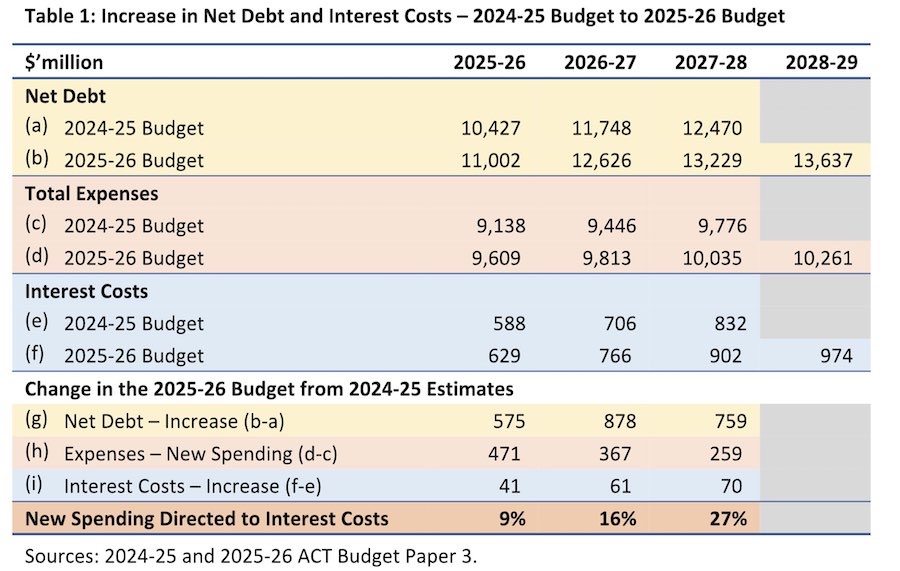
At row (g) the table highlights that the 2025-26 budget has added $575 million to existing net debt in 2025-26, and even more in the following years, climbing to $759 million in 2027-28.
Notably, from the information available in the budget papers, more than 80 per cent of the new borrowing is attributable to light rail stage 2a.
Taking into account the increase in 2028-29, this budget adds $1.17 billion of net debt to the previously budgeted increases over the forward estimates. More than 60 per cent of the increase in net debt is attributable to the light rail project.
The light rail project’s fans, urgers and devotees argue that light rail is a small cost relative to, say, the overall budget, or the sum of budgets over the life of the project, or the total economy. That, with respect, is a seriously flawed understanding of the ACT’s finances and, more worryingly, knowingly wrong.
The government’s rhetoric is, of course, meaningless and disrespectful of those community groups or essential services that missed out, or the police working in uninhabitable buildings, or the parents of children in cramped and dilapidated schools, families waiting years for public housing and those unable to afford private health insurance waiting years for, say, a knee replacement.
To them what matters is whose needs were prioritised above their needs in the allocation of funds in this budget – in this case, a few thousand travellers over a 1.7-kilometre distance to a prime residential development.
Once fiscal discipline is abandoned by a government, as has occurred in Canberra, a misallocation of resources inevitably follows. The needs of essential and high-priority services are given a lower priority and increasingly more funds are consumed by debt servicing. The misallocation is accompanied by a reduction in budget flexibility.
The last row of Table 1 highlights this point, whereby 9 per cent of additional spending in 2025-26 increasing to 27 per cent of the additional spending in 2027-28 is directed at meeting the interest costs incurred, in the main, as a result of the burgeoning debt for the tram.
Territory’s overall debt and interest costs
Deficits, if they become the norm, inevitably grow over time from small to big, as they have under Andrew Barr’s leadership – from a few hundred million to more than a billion, in the ACT’s case.
A billion here and a billion there, to fund the deficits and wasteful projects, soon adds up to tens of billions. Interest costs consume an increasing portion of the budget. Lenders start charging a higher rate, a double whammy – higher debt at a higher price.
Table 2 details total revenue and net debt for the General Government Sector, and the key measure of debt sustainability, the Net Debt to Revenue (NDR) ratio. The table also incorporates interest costs as a proportion of total expenditure, another key measure of the impact of debt on the budget.
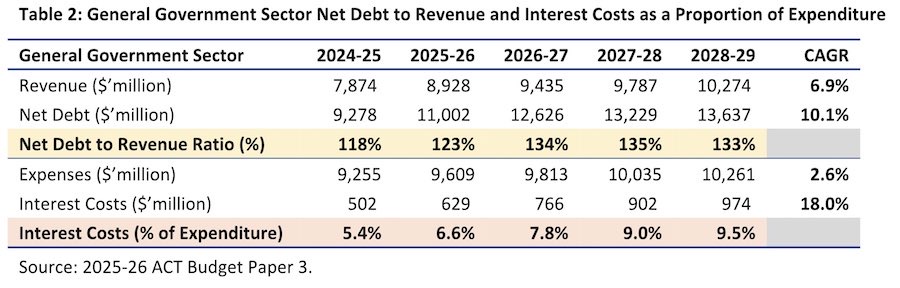
The fastest growing expenditure in this budget is interest costs at an average compounding rate of 18 per cent a year, while health is forced – or expected – to deliver more services despite an annual increase in funding of a paltry 1.5 per cent, which is not even enough to pay existing staff.
Interest costs will, in about three years, be in the order of $974 million or almost one in every 10 dollars (9.5 per cent).
Net debt grows at an annual average rate of 10.1 per cent, and the NDR ratio will increase to 135 per cent in 2027-28. We do not consider the marginal decrease (to 133 per cent) is realistic in view of the government’s track record.
The territory lost its AAA credit rating in 2023-24 before the NDR ratio reached 95 per cent. Currently, it is AA+ with a negative outlook. Another downgrade is imminent on these trends.
Reputable national commentators have observed that the Australian government’s AAA credit rating is under threat due to the rapid growth of state and territory debt, which in turn will impact on the credit rating – and costs – of not only sub-national governments, but also the banks. Victoria’s indebtedness has notably been highlighted, since its gross debt is forecast to reach 202.6 per cent of its operating revenue in 2026. Analysis by S&P Global shows Victoria proportionately carries a greater debt burden than 17 sub-national jurisdictions in Canada, Germany and Australia.
Table 3 charts the consolidated revenue and gross debt for the ACT public sector, including the general government and the public trading sectors. As we have previously noted, this provides a more comprehensive and stark picture of the indebtedness of the ACT.
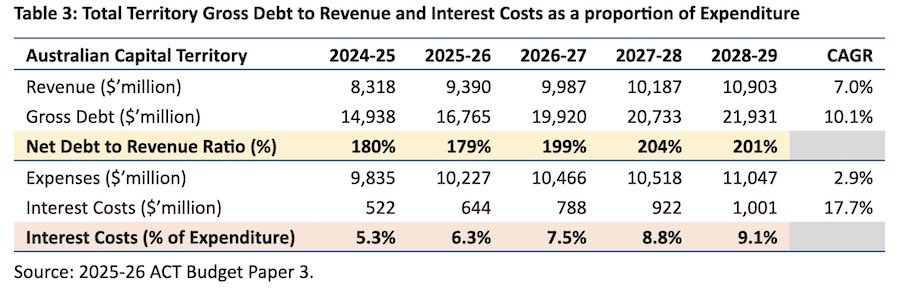
A most worrying feature of this table is the revelation that the ACT is on the cusp of dethroning Victoria as the most indebted jurisdiction in Australia with our total territory gross debt forecast to grow to $20,733 million or 204 per cent of operating revenue by 2027-28.
Apart from increasing the risk nationally, this ACT budget imposes taxation of an additional $1.17 billion on Canberrans not yet born and hence unrepresented.
The budget papers, as noted above, also confirm that the ACT is trending towards the worst levels of debt in Australia.
Despite this, the budget papers shamelessly boast of the “government’s commitment to the principles of strong fiscal management to promote intergenerational equity and ensure the wellbeing of all Canberrans”. What utter claptrap.
Jon Stanhope is a former chief minister of the ACT and Dr Khalid Ahmed a former senior ACT Treasury official.
News all day, every day at CityNewsQBN.com.au.



Leave a Reply