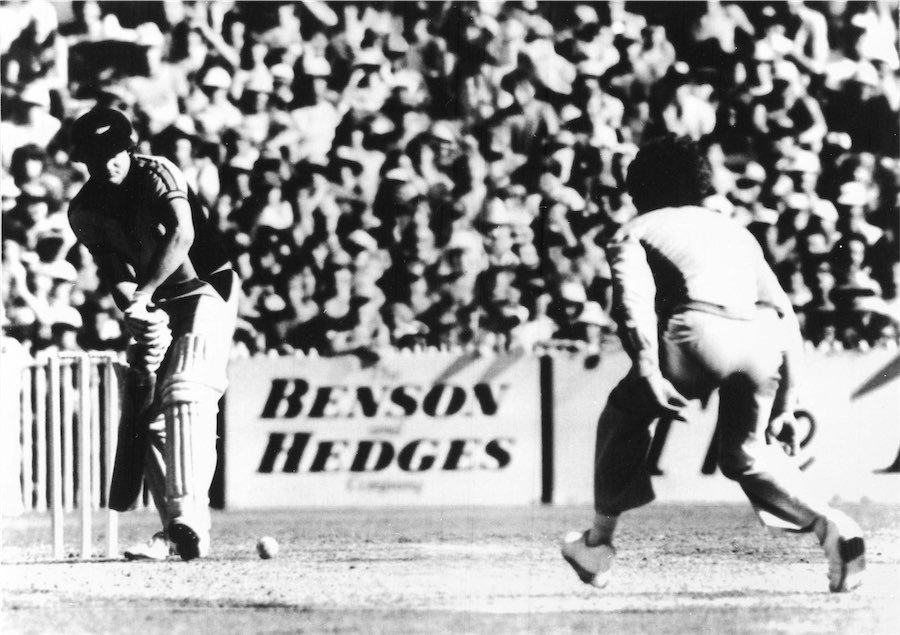
“Rules (including parliamentary privilege whether narrow or broad in their scope) can be abused, as happened that day at the MCG. The spirit of parliamentary privilege never envisaged the present claims to shut out review. Let’s not take the road to shame,” writes legal columnist HUGH SELBY.
Even if you don’t remember that infamous sporting minute in 1981 you can see it here. That was the day Australian cricket lost its decency at the MCG.
In bowling underarm, sending the ball trickling along the ground, they made sure that the New Zealand batsman could not possibly lift the ball for six runs – a result that would have tied the match.
The furore that followed this display of “win at all costs, no matter how low you go” caused the rules to be changed so that this act of indecency could not be repeated.
I was reminded of that incident when it was reported that the Speaker of our Legislative Assembly had put an argument in the Federal Court, seeking to have former Inquiry Commissioner Walter Sofronoff KC’s application to review the Integrity Commission’s finding that he behaved corruptly stopped dead in its tracks; that is, to stop the Court from reviewing the reasoning applied by Commissioner Michael Adams KC.
I wrote about that reasoning and what I regard as its errors. What I said is here.
The scope of ‘parliamentary privilege’
Why would the Speaker seek to stop an independent judicial officer review of an Integrity Commission finding? After all, the very essence of “integrity” is transparency and accountability. If ever there was a body that had to be open to external review then that body is an Integrity Commission.
The argument, put to the Court, is first that the Integrity Commission’s report, since it was tabled in the Assembly, attracted “parliamentary privilege”. No argument with that proposition. However, the second limb is extraordinary, being that the result of such tabling is that no court can review.
Article 9 of the Bill of Rights 1689 (UK) applies to the ACT Legislative Assembly (as it does in all Australian Parliaments). The privilege in Article 9 is that the “freedom of speech and debates or proceedings in Parliament ought not be impeached or questioned in any court or place out of Parliament”.
The Integrity Commission Act picks up the developed case law on parliamentary privilege in sections 177 and 178. Given what is reported below, note carefully the few words in section 177:
- This section applies if, in the exercise of the commission’s functions, a claim of parliamentary privilege is made.
- The claim of parliamentary privilege must be dealt with by the Legislative Assembly.
Providing a report to the Speaker is a Commission function. Therefore, if there is a claim of privilege arising in Walter Sofronoff KC’s court action to review Michael Adams KC’s findings against him, then the place to debate “whether there is or is not such a claim” is in the Assembly.
The law does not say that the Speaker is permitted to unilaterally take action in the courts. I come back to this point below.
(Note too that the Commission must publish the report on its website as soon as practicable after providing the report to the Speaker for tabling (sections 189 and 190). Hence it is clear that the report is intended for wide circulation, far beyond those in the Assembly.)
The privilege is a foundation of free expression in a democracy. “Tabling” a report, an opinion, a letter, an email, a message, or an image “protects” the author or the creator from defamation proceedings. It also protects those who fairly report that tabled content from defamation proceedings. This is essential for media reporting.
That protection, however, need not extend to preventing the judicial review of the contents and reasoning of any report prepared outside the Assembly, but presented and then tabled in the Assembly.
Let us call that extension a novel argument.
The helpful information provided by the Speaker
So novel that I contacted the Speaker, Mark Parton, Liberal member for Brindabella, asking some questions about how the “privilege” argument came to be raised in the Federal Court.
His replies to my questions are thorough and candid. They came within hours. All of that was welcome and refreshing. We should be grateful. Here they are (edited):
Question: Were you consulted before the decision to appear before (the Federal) court was made?
Answer: Both the Integrity Commissioner and the Solicitor-General made me aware that reports of the Integrity Commission that had been tabled by me in the Assembly were proposed to be introduced as evidence in two court proceedings. I decided that it would be prudent to try and assist the courts in looking at the specific matter of the consideration of the law of parliamentary privilege.
Were you given the opportunity to seek “independent” legal advice (that is, from a law firm and/or a senior barrister chosen by you) before the application to be heard in the Federal Court was made?
Whilst that option was available to me, I chose to use the ACT Government Solicitor and a barrister to represent the Speaker.
Was this issue (to appear or not to appear in the Federal Court) debated in the Assembly prior to the court appearance? If so, when?
On Tuesday 4 March 2025 I made a statement to the Assembly concerning my involvement to assist the ACT Supreme Court in considering the law of parliamentary privilege as it may arise in the matter of Cover v ACT Integrity Commission.
On Tuesday 8 April 2025 I made a statement to the Assembly concerning my involvement to assist in the Federal Court in considering the law of parliamentary privilege as it may arise in the matter of Sofronoff v ACT Integrity Commission.
In both statements I stated: “So, it is important to note that neither I, nor any member of this place, may waive parliamentary privilege, that can only be done through express words in statute. My interest as Speaker is to ensure, on behalf of this place, that the court receives necessary information about the constitutional importance of parliamentary privilege and to draw the courts attention to the relevant legal authorities and principles.
As both matters remain before the Courts… I cannot comment further.
Regrets, there are a few
The Speaker is to be congratulated for seeking legal advice about the ambit of parliamentary privilege.
Sadly, there are issues that may not have been considered so far. Consider the following:
- As a matter of prudence it would have been better if the Speaker had sought advice outside of the ACT Government Solicitor, to make clear the distinction between the interests of the government and the interests of the Assembly.
- If a claim of “parliamentary privilege” is being made with respect to the Integrity Commission’s report about Walter Sofronoff KC then it seems to have been made in breach of section 177 above: there has been no debate in the Assembly.
- If the Speaker (and/or others) were concerned that a claim of privilege should be made then the proper application to the court would have been for the case to be adjourned until the matter had been debated in the Assembly. If and only if the Assembly decided that privilege applied then the court action would stop.
- As I wrote above, to claim that a public inquiry report cannot be judicially reviewed is novel. Should the Assembly decide to debate the issue then its members should beware the consequences of “privilege”.
First, and foremost, such a judicial review does not contravene the doctrine of ‘separation of powers’ among the Assembly, the courts, and the government. There is no interference with Assembly responsibilities, nor with actions of the government. Rather, the Assembly and the government are assisted by an independent evaluation of the information and reasoning that has been presented to them in a report.
Second, if the Inquiry Report cannot be judicially reviewed then it is open season for any government to set up “Claytons” inquiries that bring in the “desired result”, at the expense of witness reputations and thoroughness, safe in the knowledge that they are home free. “Corruption” will add a new piece to its wardrobe.
Third, some will claim that the time for a person facing adverse comment by an Inquiry to take court action is when they receive notice from the Inquiry that adverse findings will be made about them in the final report.
That has happened during Integrity Commission inquiries. However, the now former DPP, Shane Drumgold SC, exercised his rights to reply to Commissioner Sofronoff’s draft findings. Thereafter, after the final report was released, he took action for judicial review in the ACT Supreme Court.
There was no report of any attempt by the Assembly to stop Mr Drumgold’s court action. (The effect of the Inquiries Act, section 14, 14A,14B, has the same effect as the Integrity Commission provisions with respect to a report being tabled and attracting parliamentary privilege.)
By the way, the practice of giving a person likely to be subject to adverse comment by an Inquirer the chance to comment at the draft report stage is a practice that began only a few decades ago.
If the law now becomes that any applications to a court for review must be made prior to the final report being tabled, then the final report for every inquiry will be delayed for many months, while anyone at risk of adverse comment takes court action to bring the inquiry to a halt.
Fourth, if the Assembly wants to put reports beyond judicial review then it should put such provisions in legislation and then watch how the courts cut them down to be as narrow a restriction as possible. Why? Because good government depends upon an independent, skilled judicial arm that holds people accountable for their actions.
For those who doubt this fundamental, look at the current importance of the Courts in the US as the only check upon the excesses of their President and his willing minions who see themselves as above the law.
Closer to home, remember that rules (including “parliamentary privilege” whether narrow or broad in their scope) can be abused, as happened that day at the MCG. The spirit of parliamentary privilege never envisaged the present claims to shut out review. Let’s not take the road to shame.
News all day, every day at CityNewsQBN.com.au.




Leave a Reply