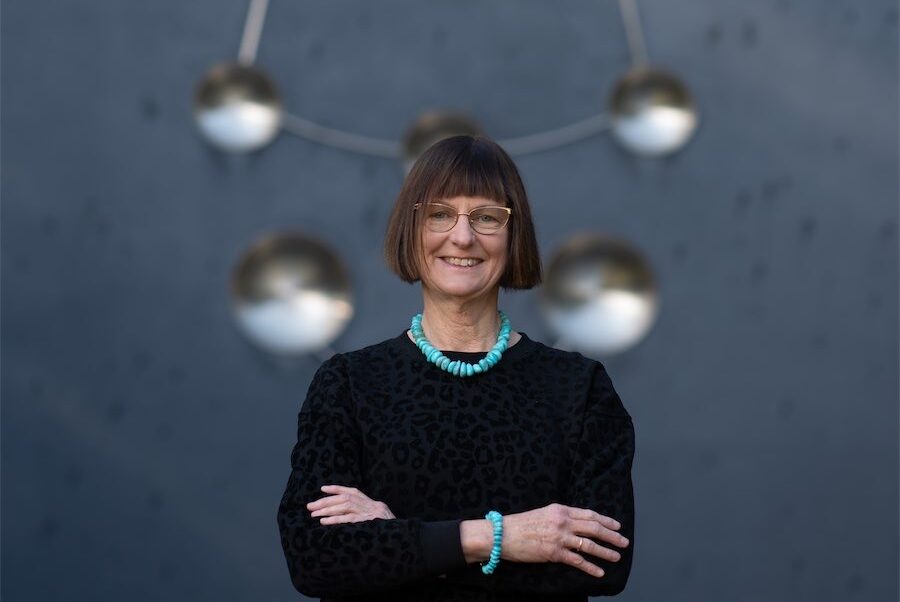
It’s the unanswered questions of the universe that inspire prize-winning ANU physicist Susan Scott. She tells reporter DHWANI PATHAK she hopes her career will inspire more young women to pursue science.
When the world’s first gravitational wave detection began to look promising in September 2015, Prof Susan Scott was at home, trying to make sense of an email about an unusual signal.
As the hours passed, the excitement grew. What initially could have been dismissed as noise in the detectors was beginning to look like something extraordinary.
By midnight, sleep was out of the question.
“It was like when I was a kid on Christmas Eve,” she says. “I had visions of these black holes twirling around each other all night.”
A world-leading mathematical physicist and pioneer in gravitational wave experiments, she was a part of the international team of 1000 scientists that detected ripples in space and time (gravitational waves), for the first time.
The discovery opened a new way of observing the universe. For Scott, a professor at the Australian National University, it was the culmination of years of work in a field she had entered in 1997.
Her contribution has now been recognised with the Harrie Massey Medal and Prize, awarded jointly by the Australian Institute of Physics and the UK Institute of Physics. She is only the second woman to receive the honour, which was first awarded in 1990.
The president of the UK Institute of Physics will present the medal in Sydney in December. The award is named after Sir Harrie Massey (1908-83), an Australian mathematical physicist who worked primarily in the fields of atomic and atmospheric physics.
Last year she was awarded the George Szekeres Medal from the Australian Mathematical Society in recognition of her outstanding contribution to research in the mathematical sciences, including her work on the structure of space-time, singularities, black holes and cosmology.
No female role models close by
As a student, the now Distinguished Professor Scott had no female role models close by. She knew of Marie Curie, but she was from “another country, and another time”.
During her four years studying at Monash University in Melbourne, Scott did not have a single female lecturer in mathematics, physics or any other subject.
“In theoretical physics, there were basically no women. And so it was very hard for a woman to have a career in that field and to progress within that career,” she says.
“You do kind of ask yourself whether you can progress in a field like that, when there are no other women.”
Things have improved, she says, and she hopes her achievement will give younger women an example of what is possible.
Scott’s own interest began when she was a primary school student who loved mathematics.
Watching the first moon landing, she wondered how astronauts could leap about on the lunar surface.
“It was inspirational,” she says. “I wanted to understand how these people could leap about on the lunar surface like that.”
The answer involved gravity, which eventually became central to her research. Today, she uses mathematical techniques to study gravitational waves and Einstein’s General Theory of Relativity.
Unanswered questions keep the work exciting
Unlike light, gravitational waves can reveal extreme cosmic events, including collisions between black holes, that are difficult to observe through traditional telescopes.
For Scott, that careful process is part of the work, but it is the unanswered questions that keep her interested.
“The unanswered questions are what keep the work exciting,” she says.
One of those questions is quantum gravity, which seeks to bring together gravity, which describes the universe on large scales, and quantum mechanics, which describes the very small.
“These two theories do come together inside a black hole,” she says. “We need to try to develop a theory which covers the coming together of those two things.”
She is also interested in neutron stars, which can pack about one-and-a-half times the mass of the sun into a space roughly the size of Canberra.
Gravitational waves offer a way to investigate their structure and properties.
She is involved in Einstein First, a program introducing modern physics and mathematics to school students through hands-on activities and experiments.
The aim is to make concepts that can seem abstract more accessible and engaging, particularly for girls who might otherwise lose interest in science.
“We find that often the girls in particular in primary school disengage with science and stuff because they don’t kind of feel involved,” she says.
For someone who began by wondering how astronauts could move on the moon, the questions have become considerably more complex. But the impulse remains the same: to understand how the universe works, and to encourage others to be curious enough to find out.
News all day, every day at CityNewsQBN.com.au.




Leave a Reply