Could BRT really be more disruptive than light rail?
“To be credible, the ACT Government has to stop its obfuscation and commission an independent assessment to evaluate if bus rapid transport could deliver the benefits of light rail at lower cost,” writes planning columnist MIKE QUIRK.
Light rail has been a divisive issue stemming from October 2014, when the ACT Government formally adopted the business plan for Stage 1, Civic to Gungahlin.
Mike Quirk.
That was despite its own analysis indicating bus rapid transport (BRT) operating on its own right of way was superior; and subsequently, its failure to genuinely assess a BRT option on Stage 2 to Woden.
The government has yet to demonstrate light rail is a better option to BRT on Canberra’s inter-town public transport route.
Has higher vehicle capacity, lower long-term operating costs, delivers better housing outcomes and has greater passenger appeal;
Is a more fiscally sustainable choice as a high-capacity BRT system costs as much as light rail.
Is easier to deliver than a high-performance BRT system given the structural and regulatory constraints imposed by the National Capital Authority (NCA).
These arguments need investigation. Some observations:
Vehicle capacity: LR vehicles carry more passengers than articulated and bi-articulated buses. The extent of the capacity advantage, including the associated labour savings from fewer drivers, is being reduced by the development of increasingly larger buses. The possibility of driverless vehicles in the medium-term could potentially further diminish the capacity advantage of light rail.
Demand: the level of demand for public transport in the corridor will be influenced by a large number of factors including the characteristics (age, income etcetera) of people living close to the corridor; the level of car ownership; energy prices; where and when people work, shop and recreate and the comfort and frequency of the transport service. Increased working from home could slow the growth in transport demand.
Light rail’s quality ride makes it more attractive than traditional buses. However, this benefit is reduced if the comparison is with a quality BRT like that operating in Brisbane.
Similarly, the stimulus to demand from the punctuality and reliability of tram services can be overstated when you consider the delays caused when a light rail vehicle breaks down.
Demand for housing: the claim light rail increases demand for housing from greater certainty about the permanence of the route is probably overstated in Canberra given the strong definition of the inter-town public transport route. The demand for higher density at the Belconnen, Woden and Tuggeranong Town Centres and at Kingston in the absence of LR indicates transport technology is secondary to accessibility in determining housing choice.
Cost: the relative cost of BRT and light rail is a contentious issue. The cost of BRT will be determined by its design features. A system that replicates light rail by incorporating a dedicated right-of-way, high-quality stations and complex intersection treatments, may not be that much cheaper when long-term operating costs are considered. Such a system could require major upgrading of infrastructure between Regatta Point and Woden.
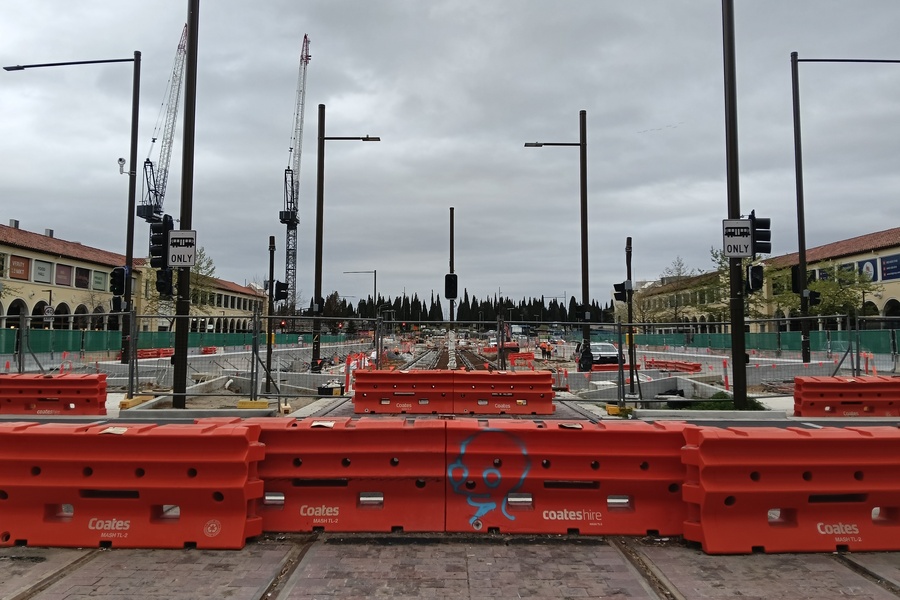
ACT Auditors-General reports for Stage 1 and 2A found light rail to be a poor use of funds with Benefit Cost Ratios of less than 0.5. Light rail incurs high costs from the laying of rail tracks, often requiring the costly relocation of services, and providing overhead wiring. Stage 2B requires a new bridge over Lake Burley Griffin. Max Flint, of Smart Growth Canberra, has estimated the build cost and operation and maintenance costs over 20 years of Stage 2B to be in the order of $3.5 billion, far higher than the government’s outdated estimates.
The ACT Government has not genuinely investigated BRT. In its Environmental Impact Statement for Light Rail 2B only considered a bus operating in general traffic.
Regulatory Constraints: The Public Transport Association argues the NCA’s strict heritage and planning laws across the Central National Area makes constructing a fully-separated, high-capacity BRT practically impossible. This claim needs to be verified – could BRT really be more disruptive than light rail?
Timing: Currently the R4 and R5 services provide high-frequency and quick services between Civic and Woden. Additional transport capacity will be needed as demand increases. Changes in housing demand, work patterns, population and financial capacity will all influence the decision of when to upgrade the transport infrastructure.
Given labour and material constraints; debt levels; demands for convention centres, stadiums, for social housing, in health and education, additional city maintenance and improving bus technology, the decision should not be made prematurely.
With so many unresolved issues, the government to be credible has to stop its obfuscation and commission an assessment, independent from government, to evaluate if BRT could deliver the benefits of light rail at lower cost.
What is the most appropriate BRT system? Should it have the operational characteristics of light rail or, for example, provide a right-of-way in congested sections and use transit lanes elsewhere with the flexibility to expand the right of way as traffic volumes increase?
Mike Quirk is a former NCDC and ACT Government planner.
"Given the Coalition’s relationship with big business has soured in recent years, AI could be a valuable opportunity to collaborate on big policy design and re-build mutual trust," writes political columnist ROBERT McMAHON.
"Pauline and her team hit the right buttons for an awful lot of people, or should that be a lot of awful people?" columnist HUGH SELBY returns to One Nation's "self help" videos and despairs at the latest one...





Leave a Reply