When words become divorced from their original meaning
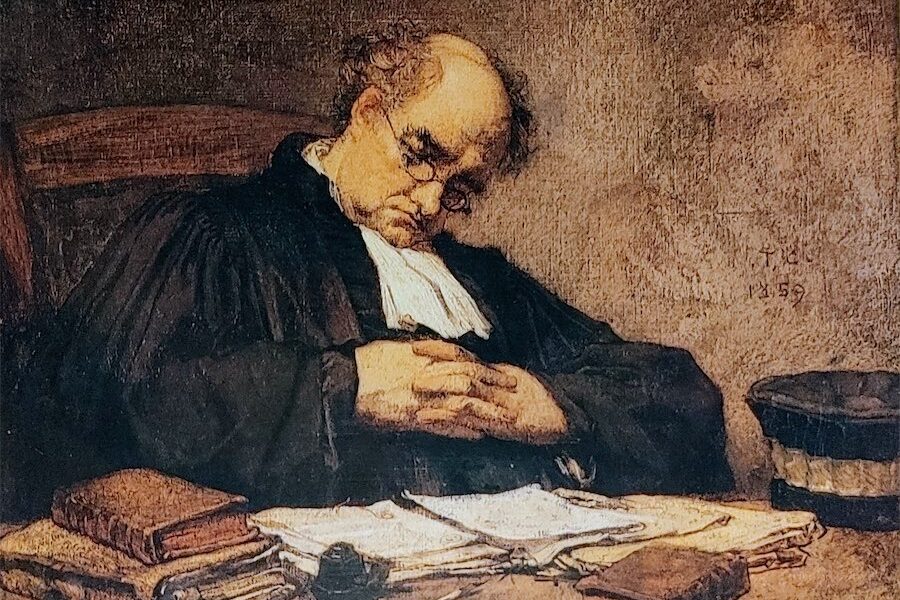
What’s in a word… A disinterested judge is ideal; an uninterested one is bored. Painting: The Sleeping Judge by Thomas Couture (1859).
“Purists will tell you the word ‘decimate’ dates back to the Roman practice of killing one in 10, but in common usage it just means ‘devastate’. Whimsy columnist CLIVE WILLIAMS shares some words where their meanings have changed.
“My wife is teaching me Cuban. It’s like Spanish but with fewer words for luxury goods.” –Emo Philips
Words often become divorced from their original meaning. Purists deride those ignorant of the true meaning of the misused word.
Clive Williams.
Eventually the misusers have the last laugh, because the misused meaning becomes mainstream and is recognised as such in dictionaries.
An example is “decimate”. Purists will tell you it dates back to the Roman practice of killing one in 10, but in common usage it just means “devastate”.
Anyway, here’s how some words have drifted away from their original meaning:
Aesthetic
Original meaning: Pertaining to beauty or artistic taste.
Common usage: Descriptor for vibe or style, especially in social media.
Ambivalent
Original meaning: Having mixed or conflicting feelings.
Common usage: Indifferent or uninterested.
Anxious
Original meaning: Nervous or worried.
Common usage: Eager.
Chronic
Original meaning: Persisting for a long time (especially illness).
Common usage: Severe.
Dilemma
Original meaning: A situation requiring a choice between two (often equally undesirable) options.
Common usage: Any problem.
Disinterested
Original meaning: Unbiased, impartial.
Common usage: Uninterested. (A disinterested judge is ideal; an uninterested one is bored.)
Enormity
Original meaning: Great wickedness or moral outrage.
Common usage: Sheer size.
Epic
Original meaning: Grand in scale or heroic, like Homer’s Iliad.
Common usage: Denotes excellence (eg, “That burger was epic.”)
Fortuitous
Original meaning: Happening by chance.
Common usage: Fortunate or lucky.
Infamous
Original meaning: Famous for something bad.
Common usage: Very famous.
Ironic
Original meaning: A situation where the opposite of what’s expected happens.
Common usage: Coincidences or just weird situations.
Nonplussed
Original meaning: Bewildered or confused to the point of inaction.
Common usage: Calm or unimpressed (especially in the US).
Notoriety
Original meaning: Fame for a bad reason.
Common usage: Sometimes used to mean fame.
Peruse
Original meaning: To read thoroughly or carefully.
Common usage: To skim or glance at.
Phenomenal
Original meaning: Something extraordinary or unusual.
Common usage: Anything remotely impressive.
Redundant
Original meaning: Unnecessarily repetitive.
Common usage: “Replaceable,” as in employment.
Reticent
Original meaning: Reluctant to speak.
Common usage: Synonym for hesitant or unwilling.
Travesty
Original meaning: A distorted or grotesque imitation.
Common usage: “A shame” or “a bad thing”. (A travesty of justice isn’t just unfortunate – it’s a mockery of the whole process.)
Ultimate
Original meaning: Final, last, or most fundamental.
Common usage: The best.
Unique
Original meaning: One of a kind, unparalleled.
Common usage: Beloved by real estate agents (with a qualifier added eg, “very unique”)
On a lighter note: A man is riding through blistering desert heat on a camel when he comes across a dying dog beside a sand dune.
The dog sees them and calls out: “Oh help me, please! I’ve been lost in this desert for days and I’m dying of thirst! Please, please help me!”
The man immediately leaps off his horse, pulls out his water canteen and rushes to the dog. He pours water into a cup and offers it to the dog, who quickly laps it up and says: “God bless you, sir! You’ve saved my life!”
As the dog drinks some more, the man puzzles over this unexpected encounter, saying, “I didn’t know dogs could talk.” At that point the camel says, “Me neither…”
"Some folks never learn to read the room… they hear someone’s pain that reflects their experience and say to the woman weeping at her miscarriage, 'that’s nothing, I had six of them'," writes Kindness columnist ANTONIO DI DIO.
Letter writer and new Mawson resident DAVID ROBERTSON has written three times to his local MP David Smith after being "badly burned by the housing market’s budget reaction". But to no replies from the Member for Bean.





Leave a Reply