“Most women are attracted to the simple things in life. Like men.” –Henny Youngman
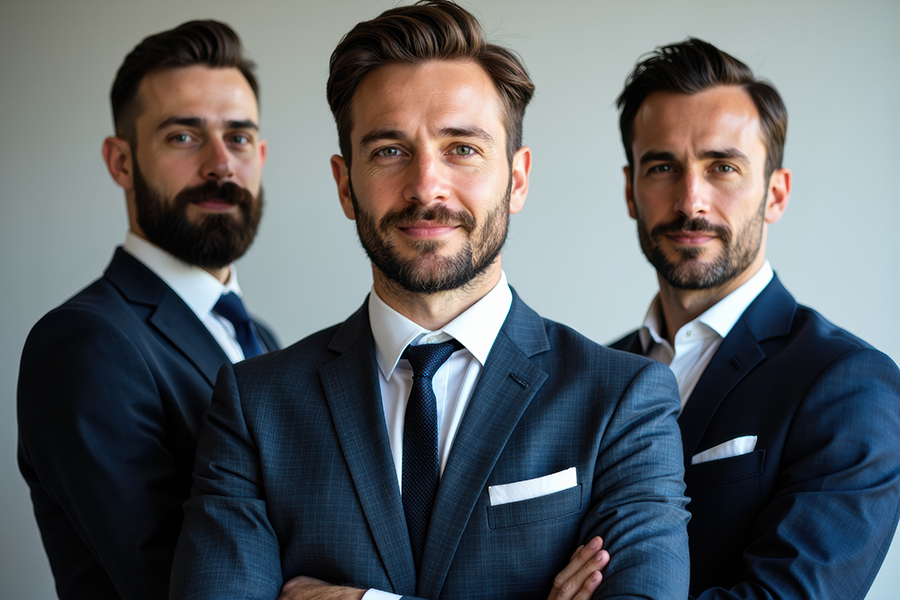
To follow on from his last Whimsy about women’s make-up and heels, columnist CLIVE WILLIAMS looks at men’s grooming and attire, which he says have evolved from deep social and biological roots into complex forms of signalling, self-presentation and identity.
To take the same approach as my last Whimsy, this column looks at the subject of men’s grooming and attire from the point of view of evolutionary and social psychology; cultural and fashion norms; psychological identity and self-expression; and social expectations and peer enforcement.

Firstly, evolutionary and social psychology. At a biological level, both women and men use appearance to signal fitness, status and control.
- For men, muscular physiques or broad shoulders traditionally signal strength, capability, and protection – traits that historically conveyed value in survival and reproduction.
- Facial grooming (beards, clean shaves, styled hair) subtly communicate age, dominance, or refinement.
- Cologne amplifies scent cues – not in a literal pheromone sense, but as a marker of hygiene and self-care, both subconsciously attractive traits.
So, just like make-up and heels, men’s grooming can operate as unconscious signalling.
Secondly, cultural and fashion norms. Over time, these primal cues were absorbed into cultural systems of status and respectability.
- The suit and tie, for instance, evolved as a symbol of authority, wealth and rational masculinity – the male equivalent of a woman’s polished appearance.
- In many workplaces, the well-dressed man signals competence and reliability, even though the clothing may be restrictive (tight collars, stiff shoes, heat-trapping fabrics).
In both cases, fashion functions as a kind of uniform of social power. I noted that in the City of London the bowler hat has been replaced by tight blue suits and brown shoes – the modern equivalent to indicate involvement in professional finance-related industries.
Third, psychological identity and self-expression. Many men also use dress and grooming as self-expression, not just conformity.
- A well-tailored suit or a signature fragrance can feel like putting on armour – the same psychological effect makeup can have for women.
- For others, maintaining a strong body or a sharp style reinforces self-discipline and control – inner qualities made visible.
So, again, the line between attractiveness and confidence is blurred. Often, the goal isn’t to attract others, but to feel powerful or worthy oneself.
Fourth, social expectations and peer enforcement.
Just like women, men experience social pressure – though it’s expressed differently.
- A man who doesn’t “look put together” may be judged as careless or unsuccessful.
- Cultural ideals of male bodies – fit, tall, confident – can be as unforgiving as beauty standards for women.
So, while men might not wear high heels, they’re also performing a version of socially sanctioned discomfort – in suits, gyms or grooming rituals.
In summary, both women and men use appearance – clothing, grooming, scent, posture – as a language of social navigation.
- Women’s signals have often emphasised refinement, beauty, and control,
- Men have emphasised strength, authority, and composure, but both serve the same human goals: to attract respect, attention, or connection — and to project control over one’s environment.
Next Whimsy I will look at how these signals shift depending on the context (eg, workplace vs dating vs social power dynamics). That’s where the meaning of make-up or a suit really changes!
On a lighter note: A tourist driving in New Jersey gets pulled over by a motorcycle cop on Route 35 for going too slowly and holding up traffic.
“Ma’am,” the officer says, “the speed limit here is 55 miles an hour. Why are you only doing 35?”
“Oh,” she replies, looking bewildered, “I thought the Route 35 sign was the speed limit.”
The cop sighs, then notices her passengers looking pale and terrified. “Are you folks all right?” he asks.
“We are now,” one of them says. “But we just came off Route 130.”
Clive Williams is a Canberra columnist.
News all day, every day at CityNewsQBN.com.au.




Leave a Reply